
Nation
THE STATES

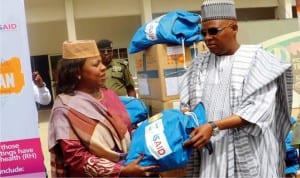
un Resident Coordinator, Ms Fatma Samoura handing over unfpa Health Kits to Governor Kashim Shettima of Borno during her visit to Maiduguri last Thursday.
Adamawa
The National Emergency Management Agency (NEMA)
has advised Internally Displaced Persons (IDPs) in Adamawa not to sell relief materials donated to them by the agency and other donors.
The state Coordinator of NEMA, Mr Sa’ad Bello, gave the advice in an interview with newsmen in Yola.
Bello said the advice became necessary as some beneficiaries of relief materials sold the items.
He said that on many occasions when such relief materials were seen in the market, people accused NEMA officials of selling them.
“Not for sale is boldly written on the materials. I want to appeal to the public to report any person seen selling the materials to the nearest police station,’’ Bello advised.
Benue
Concern Universal, an NGO, said it has received a grant
of N642 million from the Department for International Development (DFID) to scale up sanitation and hygiene in Cross River.
The Programme Manager of the organization Mr Nanpet Chuktu, made this known in an interview with newsmen in Makurdi.
He explained that the grant would be used for implementing the Community-Led Health Improvement through Sanitation and Hygiene Promotion (CHISPIN) in Nigeria.
He said the programme was expected to run for three years in similar design of the Rural Sanitation and Hygiene Promotion Programme with emphasis on activities at the local areas.
Chuktu said using the Community Led Total Sanitation approach, no fewer than 702, 000 persons in Biase, Ikom and Yala local government areas would benefit from the programme.
Ekiti
An Ado-Ekiti High Court has sentenced two students of
Ekiti State University (EKSU)- Akintunde Olumide and Oladapo Olaoluwa, to three years imprisonment each for belonging to secret cults.
Justice Mosun Abodunde, in her judgment held that the prosecution established a case of secret cultism against the two convicts beyond reasonable doubt.
The judge said that the police found in their custody, a small cutlass, black head warmer band, black T. shirt, and black trousers during investigation.
The judge held that the short cutlass was not the type used for agriculture or weeding grass.
“It is not a tool for education, it is a weapon of danger and incriminating, and should not be seen within the school premises,’’ she added.
Gombe
Governor Ibrahim Dankwambo of Gombe State has urged
traditional rulers in the state to sensitise their subjects on the need to guard against fire outbreaks.
Dankwambo made the call when he visited the Emir of Pindiga in Akko local government area.
He said traditional rulers had an important role to play in sensitising their subjects against fire disasters in view of the recent reports of fire outbreaks in parts of the North.
He advised the public to always switch off electrical appliances before closing from businesses, offices and their houses when going to bed, to avoid fire outbreaks.
The governor also advised people to desist from storing petroleum products in their houses, warning that such act may lead to fire outbreak.
Jigawa
The Jigawa Government says it wants some Chinese com
panies that have indicated interest to invest in agriculture to establish their factories in the state.
The Commissioner for Agriculture and Natural Resources, Alhaji Kabiru Ali, made this known when he briefed newsmen in Maigatari on the visit of the Chinese investors to the state.
“Basically, what we want these Chinese to do is to establish the factory here in Jigawa so that the state will be buying in bulk the equipment we need.
“Also, other states will come to Jigawa and buy the equipment they need,’’ Ali said.
Ali said that Chinese were in the state to see the possibility of establishing a factory for the manufacturing of small farm equipment.
Katsina
Sen. Mustapha Bukar (APC-Katsina North) says he is
training 710 youths in Computer and Information Technology (ICT) in Katsina State.
Bukar stated this in Daura at the opening ceremony of the training programme.
He said that the training would be conducted by the Global Plus ICT in collaboration with the National Information Technology Development Agency (NITDA) sponsored by him.
According to him, the beneficiaries will be trained in three months, after which a certificate would be given to each trainee.
He pointed out that the programme would complement the state government efforts at making people of the state computer literate.
“Computer education is regarded as backbone of societal development worldwide, but our youths are left behind in that area,’’ he said.
Besides, Bukar said that the trainees would be empowered with working materials and capital to enable them establish their businesses and become self-reliant after the programme.
Kaduna
The Kaduna State Government has awarded N11 billion
contracts for the renovation of schools and provision of furniture, the Commissioner for Education, Science and Technology, Dr Shehu Adamu, has said.
Adamu said while briefing newsmen in Kaduna that N7 billion would be spent on the renovation of 420 secondary schools, while N4 billion was for the provisions of furniture.
According to him, the state has a total of 4, 225 primary schools and 524 secondary schools, most of which are dilapidated.
“The contract entails the complete renovation of the schools, construction of toilets facilities, provision of solar-powered motorized boreholes with overhead tanks, and construction of new classes where necessary.
“For the furniture, the contracts were awarded for the provision of more than 770,000 units of furniture to be distributed across the state”.
Nasarawa
A Mararaba Grade 1 Area Court, Aso Pada, has admitted
a 28-year-old wheelbarrow pusher, Friday Bebaca, to bail in the sum of N100,000 for alleged extortion.
Bebaca of Aso Junction Mararaba was arraigned on a two-count charge of criminal conspiracy and extortion.
The presiding officer, Mr Albert Maga, in his ruling, ordered the defendant to produce one surety in like sum.
Maga ordered that the surety should have a fixed address, reasonable means of livelihood, and also reside within the jurisdiction of the court.
He adjourned the case till April 15 for further hearing.
Prosecutor Friday Adaji had told the court that Musa Abubakar of Aso Pada, Mararaba, reported the matter at ‘A’ Divisional Police Headquarters, Mararaba, on March 30.
Adaji said the defendant conspired with two others now at large to attack the complainant along Mararaba Junction while he was coming back from work.
Oyo
The Sickle Cell Hope Alive Foundation (SCHAF) said it
has partnered with the National Youth Service Corp (NYSC) to fight sickle cell in the country.
The President of the foundation, Prof. Adeyinka Falusi, made this known in an interview with newsmen in Ibadan.
Falusi said that the foundation was forging collaboration with NYSC as part of efforts to promote awareness and education on preventive approach to the disease.
“The objective of NYSC is to inculcate in Nigerian youths the spirit of selfless service to the community.
“The corp members are distributed nationwide and SCHAF is initiating a partnership with the NYSC to serve as a vehicle of Sickle Cell Disease (SCD) prevention.
Plateau
The Federal Road Safety Commission (FRSC) in Pla
teau has said that its Mobile Court has been a vital tool to check unqualified drivers and vehicles from plying the highways.
The state Public Education Officer of the commission, Mr Andrew Bala, made this known in an interview with newsmen in Jos.
According to him, the mobile court activity has been a vital tool that the corps is using to reduce the number of unqualified drivers and vehicles from plying highways.
“Mobile court proceeding has given our men on patrol the opportunity to charge traffic offenders and they are given a fair hearing when arrested.’’
Niger
Twenty thousand rice farmers in Niger would be as
sisted with a N1.8 billion loan, under CBN Anchor Borrowers Programme within the next four years, Niger Coordinator of Agriculture Graduates Association of Nigeria (AGAN), has said.
The Coordinator, Malam Hussaini Iliyasu, stated this in Minna at a stakeholders’ meeting.
Our correspondent reports that the Rice Value Chain Investment Project Multi Stakeholders’ meeting was held between the State Ministry of Agriculture, IFAD, CBN and the association.
Zamfara
The Emir of Gusau in Zamfara, Alhaji Ibrahim Bello, has
refuted rumours of his purported death being peddled across the state.
In a statewide broadcast on the state –owned radio station the emir assured the people of the state that he was still alive.
“I want the people to know that I am alive, but I will soon go to Saudi Arabia for medical treatment,” he said.
The monarch said the announcement was necessary in order to clear the air over rumours being peddled by some people that he had died.
The emir, however, thanked his well wishers for their concern over his well-being and urged them to continue to pray for him.

Nation
Zabbey Emerges Social Impact Man Of The Year 2025 …Reaffirms Commitment To Ogoni Transformation


The Project Coordinator of the Hydrocarbon Pollution Remediation Project (HYPREP), Prof. Nenibarini Zabbey, has been named Social Impact Man of the Year 2025 by Daily Independent Newspapers.
The award was presented at the Independent Awards 2025 Silver Jubilee Edition held at Eko Hotels and Suites, Lagos, as part of activities marking the organisation’s 25th anniversary of editorial excellence.
Managing Director and Editor-in-Chief of Independent Newspapers, Steve Omanufeme, said the award recognises individuals who have demonstrated exceptional leadership and transformative impact in their respective fields. He explained that recipients emerged through a rigorous process involving public voting, editorial board scrutiny, and assessment by a panel of judges.
Omanufeme noted that Zabbey’s selection reflects his outstanding contributions to environmental restoration and community development in Ogoniland through the Ogoni cleanup project.
With over two decades of experience spanning research, advocacy, capacity development, and administration, Zabbey has, within three years of leading HYPREP, implemented people-focused initiatives aimed at improving livelihoods and restoring degraded ecosystems.
Under his leadership, the project has reportedly created more than 7,000 direct jobs and facilitated the training of thousands of youths and women in high-demand skills, including mechatronics, cybersecurity, commercial diving, underwater welding, and data analytics.
HYPREP has also trained over 5,000 beneficiaries across 21 vocational skill areas, providing start-up kits to support entrepreneurship and economic empowerment.
In the area of environmental sustainability, the agency has established 31 environmental clubs in secondary schools and trained 2,500 youths with International Maritime Organization (IMO) certification to support shoreline cleanup and mangrove restoration efforts.
The project has recorded significant ecological milestones, including the cleanup of over 1,000 hectares of shoreline and restoration of 560 hectares of mangroves. This progress contributed to the designation of Ogoni mangrove wetlands as a Ramsar Site of international importance.
Beyond environmental remediation, HYPREP has expanded its social intervention programmes to include educational grants and scholarships for over 1,000 students, support for small and medium-scale enterprises, and skills training for persons living with special needs.
Infrastructure and healthcare development have also featured prominently, with ongoing projects such as the Ogoni Specialist Hospital, a Cottage Hospital, the Ogoni Power Project, and the Centre of Excellence for Environmental Restoration. The agency has further strengthened emergency healthcare delivery by donating five ambulances to medical facilities in the region.
Additionally, potable water has been provided to more than 40 communities, alongside the construction of wind-powered water systems in underserved areas.
Speaking on the award, Zabbey described it as a validation of HYPREP’s integrated approach to environmental restoration, healthcare improvement, and economic empowerment.
“We remain committed to delivering a cleanup that not only restores the environment but also improves livelihoods in line with the Renewed Hope Agenda of President Bola Ahmed Tinubu,” he said.
HYPREP, in a statement, expressed appreciation to the management of Independent Newspapers for the recognition, the Federal Ministry of Environment for its oversight role, and the Ogoni communities for their continued support and collaboration.
The agency was established by the Federal Government of Nigeria to implement the recommendations of the United Nations Environment Programme (UNEP) report on Ogoniland and restore areas impacted by oil pollution.
Nation
Rivers State Judiciary Counters NBA National Position over Contempt Ruling, Says Judge Acted Within the Law

The Rivers State Judiciary has faulted the Nigerian Bar Association National over its March 26, 2026 press release condemning the jailing of a lawyer for contempt, insisting the trial judge acted lawfully to protect the court’s integrity.
In a rejoinder issued by Chief Registrar High Court,David D. Ihua-Maduenyi, Esq., the judiciary said it was necessary to “set the records straight” following reactions to the NBA’s statement on the contempt conviction of Mrs. Lovinah Ugbana Benjamin.
Titled: “JUDGES MUST NOT BULLY LAWYERS OR
ABUSE POWER TO PUNISH FOR CONTEMPT AS A TOOL
FOR INTIMIDATION OF LAWYERS”
RE: IN THE MATTER OF CONTEMPT OF COURT BY MRS.
LOVINAH UGBANA BENJAMIN
IN SUIT NO.
PHC/301/2016 CORAM C. NWOGU J., OF THE HIGH
COURT OF RIVERS STATE.
The state judiciary explained that case in question is Suit No. PHC/301/2016 before Justice Chinwendu Nwogu of the Rivers State High Court, where Mrs. Benjamin served as defence counsel.
The statement read thus
“We are compelled to make this rejoinder regarding the
incident of the conviction for contempt and subsequent
unconditional discharge of Mrs. Lovinah Ugbana Benjamin,
Learned Counsel for the Defendants in the above suit by Hon.
Justice Chinwendu Nwogu of the High Court of Rivers State in
order to set the records straight, and not allow the
misinformation, misconception and reactions arising from the
NBA National Press Release in the matter to fester as reality or
truth.”
In the suit under reference wherein the said Learned
Counsel appeared for the Defendants, the Learned Counsel
attempted to mislead the Court by her signed and filed final
written address, by knowingly and falsely presenting non-
existent facts and evidence of a witness. When confronted by the
Court, she admitted that what she stated in her final written
the address was not true and she was unapologetic.”
“The to uphold the dignity and integrity of the Court, which the
said Learned Counsel treated with clear and brazen contempt, the
Court after following due process, convicted her for contempt and
sentenced her to prison for 3 days only, instead of the 3 months
statutory term due to passionate plea from the Bar.”
“According to the statement the suggestion of the NBA National in paragraph 10 of the
Press Release under reference that “where a court considers
counsel’s conduct improper, the proper course is to invoke
recognised disciplinary mechanisms, including referring
counsel to the Legal Practitioners Disciplinary Committee
(LPDC), rather than resorting to summary punitive measures”,
is not an invariable rule because the act of the Defence Counsel
constitutes contempt in facie curiae which the Court can punish
instantly, hence the action of the Judge is not an abuse of power
or an act of intimidation.”
“Nevertheless, due to the numerous calls from respected
members of the Bar to the offices of the Chief Registrar and the
Honourable Chief Judge for the release of the said Learned
Counsel, and the intervention of the NBA Port Harcourt Branch
delegation led by its Chairman, Mrs. Cordelia U. Eke to the Judge.
in his Chambers in the morning of 26/03/2026 where the
delegation upon learning the true facts of the incident, apologised
and pleaded for the release of the said Learned Counsel.
“The Judge
having accepted the apology signed a production warrant and
upon her production in court and oral application by Mrs. Cordelia
U. Eke, discharged her unconditionally that same morning.”
The statement further stated that It is therefore shocking to read later that day the NBA
National Press Release signed by its President and Secretary, Mazi
Afam Joseph Osigwe (SAN) and Dr. Mobolaji Ojibara respectively,
fiercely threatening and hastily advocated the following ultimata and
the immediate release of the affected
Counsel.
:That the Hon. Chief Judge of Rivers State
immediately investigate the circumstances
surrounding this incident and take
appropriate administrative action.
That appropriate disciplinary steps be taken
by the National Judicial Council, where
necessary.
That the remand of Mrs. Lovinah Ugbana
Benjamin under the circumstances be
condemned and set aside”
“That all NBA branches in Port Harcourt and
its environs and all legal practitioners
boycott the proceedings before the Court of
Hon. Justice Nwogu for a period of 7 days if
Mrs. Lovinah Ugbana Benjamin is not
released within 24 hours.
“It seems to us that it is either the NBA Port Harcourt Branch
leadership did not relate the true position to the NBA National or
if they did, the NBA National decided to speak daggers, not peace
to impugn the Judge as a villain.
“We find the position of the NBA National on this subject very
offensive and embarrassingly raising a feeling of acrimony against
the Judge in particular, and the High Court bench of Rivers State
in general. We categorically state that the Hon. Justice Chinwendu
Nwogu is one of our respected and respectful Judges with
unblemished integrity.
We view this Press Release as an isolated departure from the
enterprising and amiable leadership of the NBA National,
especially its President, whom we hold in high esteem and
admiration.”
“Whilst we appreciate the concern of the NBA National in
bringing attention to the event of 25th March 2026, we assure that
the Bench and the Bar in Rivers State remain veritable partners
in the administration of justice.
“We firmly restate that the Bench in Rivers State holds the Bar
in high esteem and this event would not disrupt the cordial
relationship between the Bench and the Bar.”
-
Nation5 days ago
Rivers State Judiciary Counters NBA National Position over Contempt Ruling, Says Judge Acted Within the Law
-
Politics22 hours ago
Ekiti 2026: IPC Trains Journalists On Election Coverage
-
Sports22 hours ago
WAN Mourns Ex-NFF President Galadima
-
Sports22 hours ago
Brentford Miss Chance To Move Up
-
Sports22 hours ago
NBA PlayOff: Lakers Make Winning Start
-
Politics22 hours ago
GROUP BLASTS ATIKU CRITICAL COMMENTS AGAINST JONATHAN … SAYS EX-VP CAREER ASPIRANT
-
Politics22 hours ago
INEC To Display Voters Register April 29 As CVR Phase II Closes Nationwide
-
Sports22 hours ago
NSF champion Osaretin wins at Tour du Faso