
Business
CBN Should Drive Floating Exchange Rate System – Expert

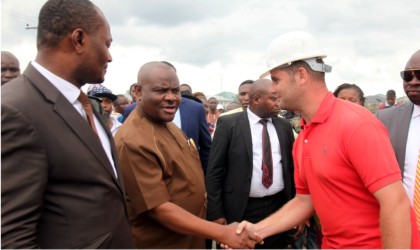
: Governor Nyesom Wike of Rivers State (2nd left), exchanging pleasantries with the Project Manager of Abonnema-Obonoma Bridge, Engr. Fadeen (right) while the CTC Chairman, Akuku-Toru LGA, Hon. Odimabo (left), watches, during the inspection of Abonnema-Obonoma bridge, by the governor, yesterday.
The Managing Director, Citibank Nigeria Limited, Mr Akinsowon Dawodu, has urged the Central Bank of Nigeria (CBN) to allow the country’s exchange rate to be determined by trading in the forex market in contrast to a fixed rate.
Dawodu, who was represented by Citibank’s Head of Strategy, Mr Sharaf Muhammed, gave the advice on Wednesday in Calabar at CBN’s 20th Seminar for Finance Correspondents and Business Editors.
Dawodu presented a paper on the implications of closure of Retail Dutch Auction System (RDAS) and Wholesale Dutch Auction System (WDAS) segment of the Foreign Exchange Market in Nigeria.
He explained that at the moment, Nigeria was practising an Intermediate Exchange Rate regime which was characterised by inconsistency problem and exchange rate volatility.
He said that once the transition had been done, it would eliminate the requirement to hold large reserves, hence free funds for necessary infrastructure development.
Dawodu said that the closure of RDAS and WDAs by the CBN was also the right step to stabilise the nation’s currency.
“The closure of RDAS and WDAS will unify the market. And when it is unified, the naira will be at good price. So the closure is a good step in the right direction.
“What we need to do now is to gradually move towards the free float system. It is better if the market takes over and determines the price of the currency, and the CBN comes in once in a while to intervene.
“And when our fiscal policy is in harmony with our monetary policy, the economic transformation has been completed and then the FX (Forex) margin can be completely liberalised, “ he said.
Dawodu said that economic transformation and fiscal discipline were prerequisite for Nigeria to be ready for a free floated economy.
He said the progress in economic areas such as Agriculture, Manufacturing, Oil and Gas was a step in the right direction.
Dawodu also recommended that the CBN should reduce intervention in the FX market and be frugal with the use of the nation’s reserve, to further stabilise the economy.
Meanwhile, the Director, Corporate Communications Department, CBN, Mr Ibrahim Muazu, said the seminar aimed at educating the media on the impact of oil crude prices on external reserves and exchange rate management in Nigeria.
“At the end of the seminar, participants would have been exposed to fundamental issues and challenges of oil price volatility on external reserves and exchange rate management in Nigeria.
“The management of CBN believes that as media practitioners, you have great roles to play in disseminating accurate information on financial and economic policy issues.
“I have no doubt that the enlightenment which this seminar will bring will contribute to your understanding of the topical issues that are crucial to the nation’s financial system and economic development.


-

 Featured5 days ago
WASSCE: RSG Distributes Science Materials To Secondary Schools
-
Sports5 days ago
Football Pundit Lauds Chelle’s Effort In Monitoring Nigeria League Players
-
News5 days ago
RSG Reaffirms Commitment To Quality Education
-

 Niger Delta5 days ago
Fubara Charges Graduands On Discipline, Professionalism … As IAUE Holds 44th Convoc
-

 News2 hours ago
FG To Unveil Radio Station For Adult Education
-

 News2 hours ago
Afenifere Raises Alarm Over Attacks On Oyo Schools …Says Yorubaland Now Under Siege
-

 News2 hours ago
Fubara, Wife Hail Tinubu’s Renewed Hope Initiative …As Over 6,800 Families Benefit From Largesse In Rivers
-

 News2 hours ago
Isaac Boro Memorial: N’Delta Still Bleeds For Justice -MOSIEND