
Nation
THE STATES

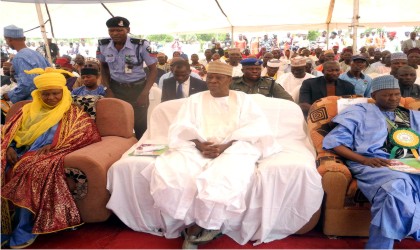
L-R: Chief of Dadiya, Alhaji Adamu Abubakar Galadima; Deputy Governor of Gombe State, Mr Charles Iliya and Chairman, Balanga Local Government Council, Alhaji Garba Tallase, at the First Annual Cultural Festival of Dadiya Community in Balanga, Gombe State, recently. Photo: NAN
Adamawa
The Adamawa State Government has alerted that about one million
people in the state are likely to be affected by flood this year.
The Permanent Secretary and Chairman, Adamawa State Emergency Management Agency, Mr Haruna Furo, raised the alarm in an interview with newsmen in Yola.
Furo confirmed that the state office of the agency received a warning message from the National Hydrological Centre that some local government areas of the state would be seriously affected with flood in 2015.
Furo said that among the predicted areas to be affected included Fufore, Yola South, Yola North, Girei and Demsa.
Others, he said, were Numan, Lamurde, Guyuk and Shelleng local government areas.
He recalled that in 2012 over 500,000 people were affected while many lost their lives and property worth billions of Naira destroyed by the flood.
The chairman warned that more than one million people would likely be displaced if precautionary measures were not taken in time.
Borno
The Shehu of Borno, Alhaji Abubakar Ibn Garbai, has urged Muslims
to intensify prayers towards seeking divine intervention against Boko Haram insurgency in the country.
Garbai made the call while receiving members of the Indimi Mosque Management Committee, Maiduguri, who paid him a courtesy visit at his palace in Maiduguri.
He lamented that the state had witnessed tremendous setbacks due to the prevailing insurgency, and expressed optimism in the power of prayers to end the problem.
Garbai commended the committee for its numerous efforts in spreading Islamic knowledge in the country.
He also commended the mosque for organising yearly Qur’anic tafsir (preaching) during Ramadan fast to educate Muslims on the religion.
Earlier speaking, Dr Muhammad Abubakar, the Chief Imam of the Mosque who led the delegation, said they were in the palace to pay a yearly visit to the monarch as part of the activities of the committee during Ramadan fast.
Ekiti
Cocoa farmers have been advised to replace their old cocoa trees,
which have reduced yields, with new ones to boost production.
Mr Michael Afolabi, an Agriculture Extension Officer, gave the advice in an interview with newsmen at Usi in Ido/Osi Local Government Area of Ekiti.
Afolabi said that replacement of the old trees would sustain the future of the cocoa industry and allow farmers to begin reaping high quantity and quality cocoa beans in few years of planting.
He called on the Ministry of Agriculture in both state and Federal Ministries in the cocoa producing states to establish nurseries in every local government.
This he said was to enable farmers have enough seedlings of the new variety to replant their old cocoa farms.
Afolabi further appealed to government to introduce more incentives to support young Nigerians who want to venture into the cultivation of cocoa, saying such would motivate them to embrace farming.
He said that urgent steps needed to be taken to attract more young people into cocoa farming, to replace aging farmers.
FCT
The Chief of Army Staff, Lt.- Gen. Kenneth Minimah, has called for
more prayers for soldiers in the battle field as the Nigerian Army intensifies efforts to defeat terrorism in the country.
Minimah made the call in Abuja at a special Juma’at Prayer as part of activities to commemorate the 2015 Nigerian Army Day Celebration.
Jumat prayer which was attended by President Muhammadu Buhari at the Mogadishu Cantonment Mosque, witnessed special prayers for the nation.
Minimah, who was represented by Maj.- Gen. Adamu Abubakar, Chief of Army Administration, said that the Juma’at Service was one of the highlights of the 2015 Nigerian Army Day Celebration.
The chief of army staff, who described terrorism as a global phenomenon, which Nigeria was also battling to defeat, expressed optimism that the menace of terrorism would soon be defeated in Nigeria.
Kaduna
The Nigerian Breweries said in Kaduna that it had spent over N100
million on education in the northern region within the last five years.
The company, maker of Maltina and other assorted drinks, said the gesture was part its Corporate Social Responsibilities (CSR) to the host communities.
The Brewery Manger in Kaduna, Mr Adebolu Obawole stated this while donating books and other instructional materials to Government Secondary School Makera in Kaduna South Local Government Area.
Obawole explained that the amount was spent on various interventions including construction of class rooms, supply of library
materials, upgrade of laboratories and provision of education materials among others.
Kebbi
The Kebbi State Urban Development Authority (KUDA) said it has
begun evacuation of waste from drains in major towns across the state as preventive measures against flooding.
The General Manager of the authority, Alhaji Muhammad Altine, made this known on Tuesday in an interview with newsmen in Birnin Kebbi.
Altine said the exercise would ensure that drainages in flood prone areas within the metropolis and major towns were cleared.
He warned against the habit of constructing structures along water ways and in areas prone to flood.
According to him, the conversion of farmlands into residential buildings without government’s permit is illegal and unacceptable.
“People should consult the authority-concerned before embarking on building construction as it would complement our efforts in making sure that we avoid the 2014 disastrous flood experience,” Altine said.
Niger
The Anglican Bishop of Minna Diocese, Retired Rev. Daniel Yisa, has
condemned the United States of America’s decision to legalise same-sex marriage, describing such marriages as “satanic”..
Yisa made the remark while speaking with journalists after the 100 years (centenary) thanksgiving service at the St. Peter’s Anglican Cathedral Church, on Sunday in Minna.
“Gay is not a Biblical or African practice; if God hates it, we all must hate it.
“We must know the basic truth of the Bible. As far as we are concerned as Nigerians, same sex-marriage is not our portion,’’ he said.
He said whoever wanted to engage in the practice in his country, could do so out of his or her free volition, but should not say that the Bible supported it.
The Bishop urged Nigerian leaders to be firm on moral issues, adding that same sex marriage would destroy whoever practiced it.
“We should be faithful to God, our families and our nation if we want God to heal our land,’’ he said.
Osun
The Nigeria Labour Congress (NLC) in Osun State, says it will resist
any attempt by the State Government to reduce workers’ salaries by 50 per cent.
NLC Chairman in Osun State, Mr Jacob Adekomi, told newsmen after an emergency meeting of the union in Osogbo on Friday that the government had concluded plans to reduce workers’ salaries.
Although he did not disclose his source of information, it may not be unconnected with the government’s recent 50 per cent reduction in the salaries of political office holders as part of its austerity measures.
He said the financial mess the government found itself was a product of its systemic failure.
According to him, workers will not accept salary cut adding, any attempt to cut the salaries of workers by even one per cent will be vehemently resisted.
“If the plan is imposed on the workers, it will lead to unimaginable chaos. We learnt that the cut will take effect from January 2015”, he said.
Plateau
Governor Simon Lalong of Plateau State says he inherited a cash
balance of N93million and a debt profile of N104 billion from the immediate past administration of former Governor Jonah Jang.
Lalong disclosed this at the 2015 graduation ceremony of Saint Louis College Jos on Saturday.
The governor stated that having started the payment of outstanding workers salaries, his next priority would be on security and education.
He said that he would still give his best to the state, notwithstanding the inherited liabilities.
Sokoto
The Sokoto State Government has promised to assist
the victims of flood disaster in Butuku-Babba village of Bodinga Local Government of the state.
No fewer than 100 houses, 25 livestock, farm produce and stored food items, were washed away by the June 29 flood in the area.
The Director-General, State Emergency Management Agency (SEMA), Alhaji Hassan Maccido, told newsmen in Sokoto last Saturday that a team of experts had since been dispatched to the village.
Maccido said that the team would ascertain the extent of damage caused by the disaster.
He said that the team would also recommend the types of reliefs to be provided for the victims and proffer solutions to forestall the recurrence of the disaster.
Taraba
The Taraba StaCoordinator, National Youth Service
Corps (NYSC), Mr Tumba Freeman has said that three 2014 Batch ‘B’ corps members (names withheld) would repeat their service year for misconduct.
Freeman made this known at a news conference in Jalingo, saying that the culprits were punished for absenteeism at their places of primary assignments for three consecutive months.
According to him, three other corp members died in the course of the service as a result of medical complications which they had in an accident during the service year.
The coordinator said that the agency had given awards to 10 corp members for their meritorious service during the service year.
“We rewarded them for their excellent service which they totally deserved. “It may interest you to know that Taraba came second in terms of the number of corp members that received honors in the country.
“What we are simply doing is to recognise their contributions in community development, and to encourage other corps members to follow suit’’, Freeman said.
Yobe
Yobe State Coordinator, National Youth Service Corps
(NYCS), has said that the management of the scheme would consider re-opening the orientation camp in the state next year.
According to Lass, the reopening depends on if the state government rehabilitates the camp.
He made this known while addressing newsmen during the passing-out ceremony of the 2014 Batch ‘B’ corps members in Damaturu.
He said that NYSC had not been holding orientation camp in the state since 2010 due to persistent security problems.
The coordinator said that holding orientation camp outside the state posed serious challenges to the management of the scheme in the area.
Lass, however, advised corps members deployed to the state not to panic, saying that the security situation in the state had improved tremendously.
He said that a total of 265 corps members served in the 2014 Batch B out of which five got presidential merit award.

Nation
Rumuaholu Community Denies Land Grabbing Allegations, Accuses Obio/Akpor Chairman of Interference in Land Dispute


The Rivers State Commissioner for Education, Dr. Peters Nwagor, has commended the orderly conduct of the ongoing 2026 West African Senior School Certificate Examination in the state and urged schools to sustain the standard.
Dr. Nwagor gave the commendation on Tuesday during a monitoring tour of selected secondary schools in Port Harcourt and environs where the WAEC exam is ongoing.
The commissioner, who was accompanied by directors and monitors from the Ministry of Education, said he was impressed with the peaceful atmosphere at the centres visited.
“The students conducted themselves properly and wrote their papers under conducive conditions. Invigilators and supervisors also performed their duties professionally,” he stated.

Nwagor noted that the Rivers State Government had invested heavily to ensure the smooth and credible conduct of the examination across the state
He urged candidates to reciprocate government’s effort by shunning all forms of examination malpractice and focusing on their studies.
“Government has done so much to ensure successful examinations in our schools. Students should take advantage of it by remaining focused,” the commissioner said.
While no case of malpractice was recorded in the centres inspected, Dr. Nwagor warned that any principal, teacher, invigilator, or official caught aiding malpractice would face strict sanctions in line with regulations.
He also commended school administrators, teachers, WAEC officials, and security personnel for upholding the integrity of the process.
Centres visited included County Grammar School, Ikwerre/Etche; Government Comprehensive Secondary School, Borokiri; Government Secondary School, Borokiri; and Pabod Model Secondary School.
-

 Niger Delta4 days ago
Warri Airport Manager Disputes Air Peace Bird Strike Claim
-

 News4 days ago
Nigeria Won’t Surrender Any Territory To Criminals -Tinubu
-

 News4 days ago
FG Begins Trial Of Over 600 Terrorism Suspects
-

 Politics4 days ago
Parties’ Deregistration: How Justice Lifu Overruled Appeal Court Justices
-

 Rivers4 days ago
79th IAUE Inaugural Lecture: Prof Anero Advoctes Tuition-Free Education For Children
-

 Politics4 days ago
ADC: Okonkwo Rejects Amaechi As Presidential Running Mate, Withdraws Support
-

 Politics4 days ago
2027: Tinubu’s Projects Give APC Edge In South East – Yilwatda
-
News4 days ago
Forum Expresses Confidence In APC Candidates’ Performance In Rivers