
Politics
Rivers Guber:Sara-Igbe, Others Make Case For Kalabari

An activist cum
politician in Rivers State, Chief Anabs Sara-Igbe has urged all political parties and stakeholders in the State to respect the governorship zoning arrangement reached by all the ethnic nationalities in the State in 2007, saying, it is the turn of the Kalabaris to produce the next governor.
Chief Sara-Igbe who made the call recently at the Kengema Unity Forum (KUF) thanksgiving programme at Kala-Ido in Asari-Toru Local Government Area of Rivers State, said there was an oral agreement among statesmen representing over nine ethnic groups in 2007 on zoning and sharing of political offices including governorship in the state.
According to him, political stakeholders in the state, including past and present governors, ministers, party stalwarts, commissioners among others, were aware of the zoning agreement, which brought an Ikwerre person to power in 2007.
He mentioned Prince Uche Secondus, G.U. Ake, Dr Peter Odili, Governor Chibuike Rotimi Amaechi, among others as those in the meeting when the agreement was reached.
According to him, the zoning was to allow an Ikwerre man to become governor after Dr Peter Odili who is from Orashi region.
Chief Sara-Igbe stated that, by the arrangement, Kalabari is the next to Ikwerre, followed by Ogoni. Andoni, Ibani, Ndoki and Etche/Omuma extractions in the state.
He, therefore, called on Kalabari people to unite and insist on the implementation of the zoning agreement in pursuit of their governorship ambition in 2015.
Also speaking, the Chairman, Presidential Task Force on Power (PTFP), Engr Reynokds Bekinbo Dagogo-Jack, called on Kalabari people to speak with one voice in negotiating for the number one position in the state.
According to him, Kalabari is a major ethnic group in the state that should be treated with fairness.
He, however, called on the group and the people of Kalabari to spread the campaign and solicit the support of other ethnic groups and not to see the state governorship as a right.
Earlier, the leader of KUF, Sobomabo Jackrich had opposed the zoning of political offices based on senatorial districts, saying, the senatorial districts as presently constituted can not be used for sharing political offices such as governor without considering upland-riverine dichotomy.
According to him, since the creation of the state in 1967, the upland and riverine dichotomy had been the central consideration, and definitive basis for distribution and sharing of the highest political office in the state.
Comrade Jackrich noted that former governors, Peter Odili, Celestine Omehia and the present Governor Amaechi were all products of upland, and that it would be unfair and unjust for another upland man to become the next governor in 2015.
Enoch Epelle
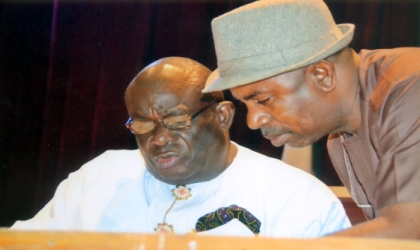
Clerk of the Rivers State House of Assembly, Sir Emmanuel Ogele (left) listens to his deputy, Mr. Dumnu Lekie (right) at the sitting of the House, last Monday.

Politics
Alleged Coup: Protests Rock N’Assembly As Detained Officers’ Children, Wives Demand Justice

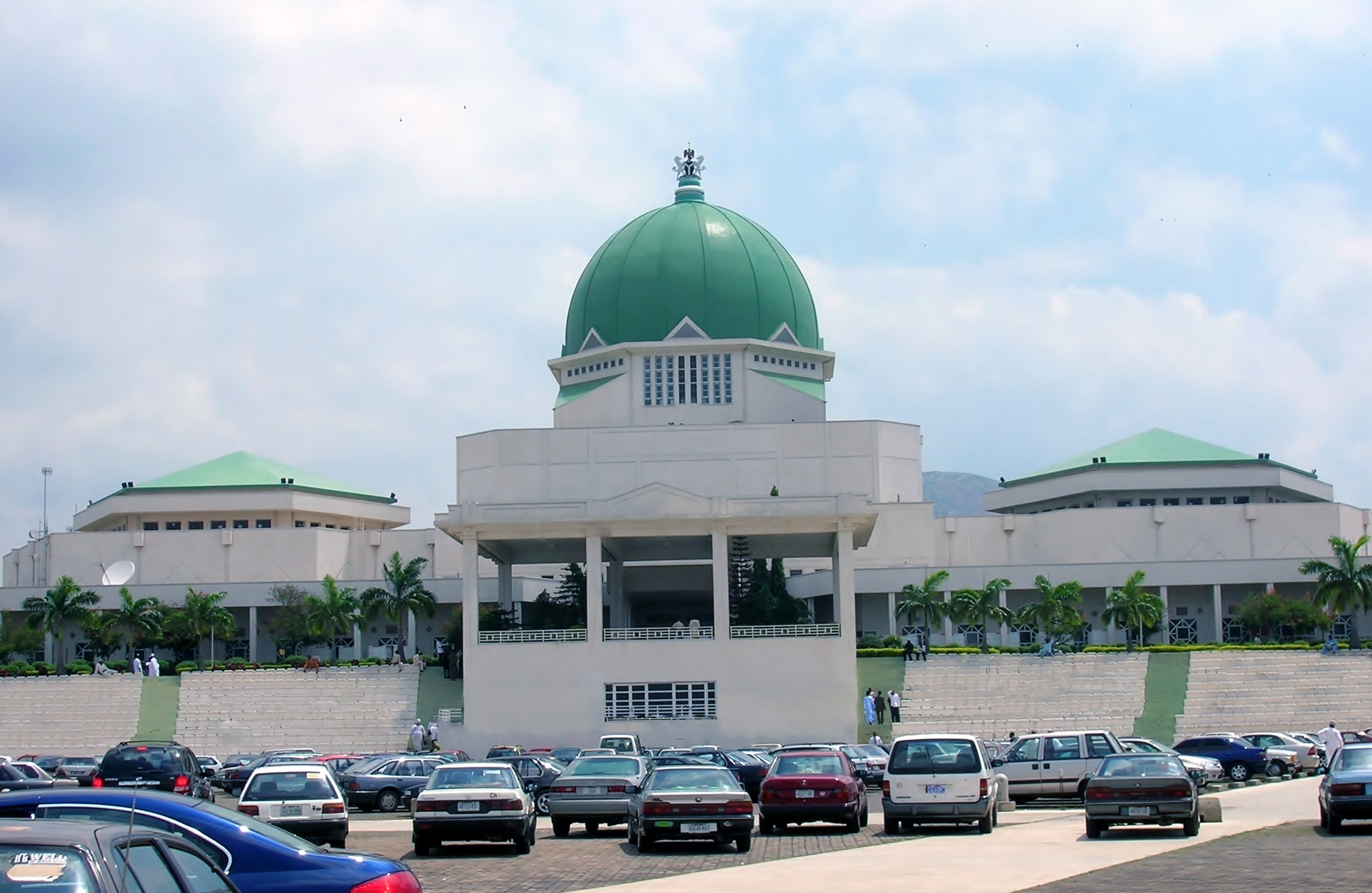
Scores of children and wives of military officers detained over an alleged coup plot yesterday staged a peaceful protest at the National Assembly, demanding a speedy trial and the release of the accused officials.
The protesters who gathered at the entrance of the National Assembly complex, moved in a slow procession while clutching placards with inscriptions such as “Don’t Kill Our Daddies,” “Detention Without Trial is Injustice,” and “Six Months of Torture: Enough Is Enough.”
Amid tears and trembling voices, the children appealed for justice and access to their detained fathers, many of whom they said they had not seen for months.
The appeal was made during a press briefing in Abuja attended by no fewer than 20 wives and several children of the detained officers, including a two-month-old baby.
The families were accompanied by human rights lawyer, Deji Adeyanju and activist Omoyele Sowore.
At the briefing, the families lamented that the officers had been held for over 160 days without trial or contact with their relatives, describing the situation as a violation of their fundamental rights.
Speaking on behalf of the families, Memuna Bashiru said the prolonged detention had thrown their households into uncertainty and emotional distress, noting that while allegations had been widely publicised, families remained in the dark about the fate of their loved ones.
The arrest of the indicted officers was first announced on October 4, 2025, by the then Director of Defense Information, Brigadier General Tukur Gusau, who disclosed that 16 officers were taken into custody for alleged breaches of military regulations and acts of indiscipline.
However, an interim investigation later suggested the existence of a clandestine network of officers, allegedly coordinated by a senior Army officer, which had begun preliminary planning for a coup.
According to the report, the alleged plot involved surveillance of key national assets, including the Presidential Villa, Armed Forces Complex, Niger Barracks in Abuja, and major international airports, with October 25, 2025, cited as the planned date for the operation.
Those reportedly in custody include Brig Gen M. A. Sadiq, Col M. A. Maaji, Lt Col S. Bappah, Lt Col A. A. Hayatu, Lt Col P. Dangnap, Lt Col M. Almakura, Maj A. J. Ibrahim, Maj M. M. Jiddah, Maj M. A. Usman, Maj D. Yusuf, Capt I. Bello, Capt A. A. Yusuf, Lt S. S. Felix, Lt Cdr D. B. Abdullahi, Sqn Ldr S. B. Adamu and Maj I. Dauda.
The alleged plot, according to findings, targeted senior government officials, including President Tinubu and Vice President Kashim Shettima.

In a statement issued yesterday, the party’s National Publicity Secretary, Mr Felix Morka, said the exercise would take place in all wards and designated centres nationwide.
He called on existing members to update their records, while encouraging new entrants to join the party through the digital platform.
“As the electronic membership registration exercise resumes in all wards and designated locations nationwide, we urge existing members to validate their membership while new members are encouraged to register and join the progressive family,” Mr Morka said.
According to him, eligibility for registration is limited to individuals aged 18 and above who possess a valid National Identification Number (NIN).
The party said the initiative is part of efforts to modernise its operations by transitioning to a digital database that would enhance record accuracy and accessibility.
Mr Morka noted that the e-registration would “digitise the party’s membership register, ensure the integrity of records, and enhance efficient access to membership data for planning and management decisions.”
He added that the move is also aimed at promoting internal democracy within the party and strengthening its commitment to democratic innovation.
The APC had previously introduced electronic registration as part of broader reforms to streamline its membership system and improve organisational efficiency.
-
 Editorial5 days ago
Domesticate FG’s Exit Benefit Scheme
-

 News5 days ago
RSU Unveils Five-Year Strategic Dev Plan …Calls For Collective Commitment To Institutional Excellence
-
 News5 days ago
DHQ Confirms Deaths Of Terrorists, Soldiers In Borno Attack
-

 News5 days ago
Tinubu Commissions Bayelsa Gas Turbine, Other Projects Today
-
Business5 days ago
Niger Delta Investment Summit Targets $5bn Inflows, 500,000 Jobs
-
Sports5 days ago
Full Draw For 2026 U-17 AFCON
-
Nation5 days ago
Rumuji Youth Leader Condemns Protest, Disowns Alleged Government Empowerment Claim
-

 Nation5 days ago
Haniel Jack Foundation Awards Five Rivers Indigenes Scholarship