
Nation
THE STATES

Adamawa
The Independent National Electoral Commission (INEC) has
said that the commission is yet to decide on when to conduct the governorship election in Adamawa state following the recent impeachment of the governor and the resignation of his deputy.
Also, the commission said that it is yet to be formally informed of the impeachment of Muritala Nyako as governor and the resignation of James Ngilari as the deputy governor.
The constitution mandates that a governorship election should be conducted within 90 days of the impeachment of the governor.
The INEC Chairman, Prof. Attahiru Jega, disclosed this during a dialogue with Media Professionals in Abuja, where he justified the drafting of military to maintain peace in Ekiti state and advocated that military also be drafted to maintain peace in the August 9 governorship election in Osun state.
Borno
Eleven women have been delivered of babies at the two camps
established by the National Emergency Management Agency (NEMA) for people displaced from Damboa as a result of the capture of the town last weekend by the Boko Haram insurgents.
NEMA also revealed on Thursday that it has registered about 10000 internally displaced persons (IDPs) at the two camps established in Biu town, about 100 kilometres away from Damboa town.
In a statement by the Northeast zonal information officer of the agency, Mallam AbdulKadir Ibrahim, who revealed that the agency had deployed two truckloads of relief materials to Biu to take care of the IDPs, revealed that the ten of the women had normal deliveries at the camps while a lone woman had to be taken to the General Hospital, Biu where she was delivered after a Caesarean Session (CS).
Ibrahim said the newly delivered mothers were apart from the normal relief materials, also given some toys, feeding bottles and baby food for the needs of the newly delivered babies.
Ekiti
Peoples Democratic Party in Ekiti State has criticised the House
of Assembly for passing the bill for creation of 19 additional local governments in the state.
The Assembly on Wednesday approved the creation of 19 additional councils following the adoption of the report of the ad-hoc committee set up to work on the bill seeking the creation of the new councils.
In a statement in Ado-Ekiti by the State Publicity Secretary, Kola Oluwawole, said the action was illegal because there is a suit seeking to stop the LCDAs and also wondered why the Assembly increased the number of the proposed LGs from 18 to 19 when referendum was conducted for 18 LGs.
Oluwawole said, “We are still in court challenging the legality of the Ekiti State Independent Electoral Commission and the body went ahead to organise an illegal referendum. The Assembly added more illegality to an illegal act by increasing the number of the councils. We are restating the fact that both State Independent Electoral Commission and Assembly are into illegal acts.
Jigawa
The Jigawa Government on Thursday said it earmarked N1.8
billion for the construction of senate building and Vice Chancellor’s lodge at the state university, Kafin-Hausa.
The Commissioner for Information, Youth and Sports, Alhaji Babandi Ibrahim, told the News Agency of Nigeria (NAN) in Dutse that the money was approved during the state executive council meeting on Wednesday.
He said N1.6 billion was set aside for the construction of the senate building, while N128 million would be used for the construction of of the vice chancellor’s residence.
Kaduna
A former National Chairman of Peoples Democratic Party and
Nigeria’s Ambassador-at-Large, Alhaji Bamanga Tukur, has described the recent bomb blasts in Kaduna State, which killed about 82 innocent Nigerians, as “most barbaric and unholy.”
Tukur, in a statement in Abuja on Thursday, said it was more painful that the perpetrators of such heinous crime against humanity could carry out such action during the month of Ramadan.
He said no right-thinking person would like to take the lives of innocent people away against the teaching and doctrines of Christianity and Islamic injunctions and called on those “behind these dangerous acts against humanity” to have a re-think and return to the path of religious and social rectitude.
Tukur said, “The perpetrators of these acts are not thinking of the consequences of their actions against God and humanity. The damage they have done to human race are irreparable and condemnable. The Boko-Haram sect do not belong to any religious organization since every religion in the world clearly condemn murder of fellow human being in any form, shape or ramification.”
Kano
A non governmental organization (NGO), under
the aegis of Health Initiative Forum (HIF), yesterday in Kano, commended Resident Doctors in Kano and Kaduna states who voluntarily went back to work following the bomb blasts that rocked the two ancient cities.
Chairman of the group, Alhaji Bala Danladi, during a chat with reporters, observed the human feeling in the hearts of the doctors that participated in the rescue operations and their leadership in the affected states.
“Despite their perennial disagreement with the Federal Government, these doctors believe that the strike action should not stop them from showing love to Nigerians under such emergency situations. We also believe that Nigerian doctors are not enemies of Nigerians as some elements were trying hard to make us believe,” he stated.
While commending the widely circulated statement of the President of the National Association of Resident Doctors of Nigeria (NARD), Dr Jibril Abdullahi, immediately after the happening of Kaduna blasts, the group urged federal government to make a second thought on her stand on the doctors’ demands.
Nasarawa
The Chief Judge of Nasarawa State Justice
Suleiman Dikko, last Friday inaugurated a seven-member panel to investigate the allegation of gross misconduct levelled against Governor Umaru Al-Makura by the state assembly.
The state lawmakers had on July 23, passed a resolution directing the Chief Judge to set up the probe panel within seven days in line with the provisions of the constitution.
Inaugurating the panel on Friday in Lafia, Dikko said that setting up of the committee was in line with the state assembly’s request to appoint a seven man panel to investigate the governor.
Those in the panel are MalamYusuf Usman (Chairman); Malam Mohammed Sabo Keana; Rev. Joel Galadima; Alhaji Abdul Usman; Mr Samuel Chaku; Malam Mohammed Sani Usman and Pastor Daniel Chaga as members.
The chief judge urged the members to discharge their duties in line with Section 188, Sub-section 1-11 of the 1999 Constitution as amended.
Ondo
The remains of the late Lagos lawyer and human rights activist, Bamidele
Aturu, were buried in his hometown, Ogbagi Akoko, Ondo State, last Friday.
Scores of sympathisers, including human rights activists, legal practitioners, members of the organised labour , were in attendance to witness the burial service.
His corpse was moved into the venue of the burial programme around 10.25 by the casket bearers and followed by a song rendered by members of the Redeemed Christain of God (RCCG) who came to honour one of their own. Aturu was an Assistant Pastor in the church.
The officiating minister, in his sermon, said death is an inevitable end for every human, hence, the need for people to move closer to God
He described Aturu as a dogged fighter and a fearless lawyer who stood for justice and equity,urging the younger ones to emulate his virtues.
Osun
The All Progressives Congress (APC) says it has gone to
the courts to challenge the powers of President Goodluck Jonathan to deploy troops to Osun State for the August 9 governorship election.
The party said it was also seeking to oust the power of the Inspector-General of Police Mr. Muhammed Abubakar, to impose a curfew on any part of the state during the election.
In a statement issued yesterday by its National Publicity Secretary, Alhaji Lai Mohammed, the party said the actions were aimed at avoiding a repeat of the massive harassment, intimidation and arrest of opposition politicians witnessed during the Ekiti State governorship election, and to prevent any illegal lock down of Osun State, which turned out to be a ploy to pigeon-hole opposition politicians, while allowing PDP members to move around freely during the polls.
The party urged the Independent National Electoral Commission (INEC) to take concrete actions to ensure that all the candidates in the August 9 governorship election in Osun State are provided with a level playing.
Plateau
The crisis rocking the Plateau State chapter of the
All Progressives Congress deepened last Thursday as some aggrieved members locked out some executives and other stalwarts of the party who were holding a meeting at the secretariat.
The party had been enmeshed in crisis over the outcome of its state congress, especially the chairmanship position, which a former aide of the former Governor, Joshua Dariye, Mr. Latep Dabang won.
The outcome of the exercise was hotly contested by the former interim state chairman, Senator John Shagaya and another member, Amos Gombi, who had earlier petitioned the national secretariat.
However, the new twist occurred following an attempt by the Dabang-led executive to hold a meeting at the party secretariat for the nomination, but was prevented from doing so by some aggrieved members of the party.
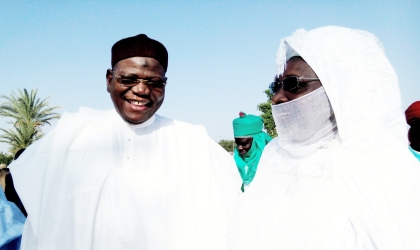
Governor Sule Lamido (left) of Jigawa State with the Emir of Dutse, Alhaji Nuhu Sunusi, during Sallah in Dutse, yesterday.



The Ibanibo Haniel Jack Foundation has awarded scholarships to five Rivers State indigenes in different tertiary institutions.
The scholarship programme was announced on Easter Sunday by Rev. Dr. Samuel Wachukwu, who is also the presiding pastor of Redeemer Baptist Church, at No. 44/46 Lumumba Street, Mile Two Diobu, in Port Harcourt.
Speaking, the chairman of the occasion, Barrister Karibi George, advised the recipients to justify the scholarship by ensuring that they put in their best and finish at the expected time.
George reminded them that opportunity comes but once and they should take advantage of the opportunity that comes their way judiciously.
“Those of you who are beneficiaries of this scholarship should also remember to help others and the resurrection of our Lord Jesus Christ.
“I advise you to justify the opportunity given to you and make the man who gave you the scholarship, yourself, and your family proud,” Barrister George said.

He explained that the scholarship spans undergraduate and postgraduate levels in various high institutions in Nigeria. He thanks Sir Jack for the gesture.
The scholarship is to promote education in our society, most especially for Rivers indigenes, and equally assist those who cannot immediately afford tuition fees.
It will interest you to know that
The scholarship was borne out of God’s blessings, and this is a way to give back to the society. Besides, two of the beneficiaries are direct employees of the chairman of the foundation, sir.
Ibanibo Haniel Jack, who is also the chief executive officer (CEO) of White House Hotel, in Port Harcourt.
Chief Prezi Diffa, while presenting the awards, commended Sir Ibanibo Haniel Jack, who has deemed it necessary to give back to society.
Chief Diffa equally advised the beneficiaries to take their academics seriously and count themselves lucky.
“The man who has given you this scholarship wants to better your lives, so please put in every effort to ensure you finish the school with flying colors,” Chief Diffa said.
The beneficiaries are Isoboye Haniel Douglas, Naomi Douglas, Charles Batubo, Ajé Sokari, and
Dakoru Owen Amachree.
Tonye Orabere