
Nation
THE STATES

Borno
The Borno State Government plans to create a special task force to ensure timely completion of various projects in this year’s budget, an official said in Maiduguri last Wednesday.
In a statement he issued, a Special Adviser to the state governor, Malam Isa Gusau, said Governor Kashim Shettima announced the plans while presenting the state’s 2014 budget proposal.
Shettima had presented to the State House of Assembly in Maiduguri, last Tuesday, a budget proposal of N178.5 billion.
“Shettima announced that a special task force, with extant powers, is likely to be created. “The task force is to have the mandate of accelerating the speed of projects to ensure timely completion in 2014,’’ Gusau said in the statement.
Gombe
Gombe State Police Command has confirmed that a gang killed two persons and injured one in Ceceniya quarters of Gombe.
Spokesman of the command, DSP Fwaje Atajiri, said in Gombe that the attack took place last Tuesday at about 11.45 p.m.
Atajiri said that a group of criminals attacked and killed their victims in Gombe Wednesday, metropolis with various dangerous weapons.
He described the incident as unfortunate, calling on the public to always report suspicious movements and promised a handsome reward for any one that could feed the police with information about the criminals.
Jigawa
As Nigerians celebrate the new year, farmers in Hadejia, Jigawa, have expressed hope for bumper harvest in the next cropping season.
A cross section of farmers in Hadejia last Wednesday, also hoped that the country would experience total peace and prosperity in 2014.
A farmer, Malam Ali Makintari, expressed optimism that farmers would record high yields in 2014 “in view of the application of new farming techniques and farmers’ support programmes initiated by the federal and state governments.’’
Makintari said he recorded a bumper harvest in 2013 due to prompt availability of fertiliser and other inputs, adding “we hope that the Growth Enhancement Support (GES) programme initiated by Federal Government will be expanded to include other farmers.”
Katsina
About 4,000 patients with various eye diseases from 11 local government areas of Katsina South Senatorial District have received free eye treatment in Funtua.
Special Assistant to Katsina State Deputy Governor on Special Duties, Alhaji Qassim Muhammad, said last Thursday in Funtua that the exercise, tagged “Free Eye Camp’’, took place from December 26 to December 31, 2013.
Muhammad said the treatment was conducted by a team of 14 doctors from Abasar Foundation in Saudi Arabia, in collaboration with Ihsan Yardam Vakfi Foundation from Turkey.
He said the Deputy Governor, Alhaji Abdullahi Garba, facilitated the exercise and sponsored all the required logistics used for the exercise and disclosed that the six day exercise was a milestone that enhanced the health of the people, especially the elderly from the rural communities in the state.
Kebbi
The Gwandu Local Government Area in Kebbi State last Thursday, said it had earmarked N35.7 million to boost water supply in the area.
Chairman of the area, Alhaji Juli Dangi, said in Gwandu that the council would drill 30 additional boreholes in Gwandu, Dalijan and Kambaza districts.
Dangi said the council had drilled 20 open wells in remote areas to augment the existing water projects initiated by the state government.
He said the council would continue to provide social services to improve the living condition of the people “in line with our mandate as representatives of the people” and
commended the state government for constructing one of the best health facilities in the area.
Kwara
Some religious leaders in Omu-Aran, Kwara State, last Wednesday, urged Nigerians to reflect on the significance of the New Year celebration and collectively proffer solutions to the nation’s challenges.
The Bishop of The Cathedral Church of St. Paul, Omu-Aran, Rt. Rev. Phillip Adeyemo, urged Nigerians to embrace love, peace and unity in the New Year and he appealed to citizens to check their shortcomings in the previous year and re-dedicate themselves to God in the New Year.
Adeyemo urged politicians and civil servants to shun corrupt practices, ungodliness and other acts capable of retarding the growth of the nation.
The President of the Women Wing of the Christian Association of Nigeria (WOWICAN), Kwara Chapter, Prophetess Bosede Adimabua,urged wealthy Nigerians to extend their assistance to the poor and those with disabilities.
Lagos
A Muslim cleric in Epe Local Government Area of Lagos State, Alhaji Haroon Daya-Biu, has urged Muslims and Christians to embrace the peace and live in unity in 2014.
Daya-Biu, who is the Head of “Ratibi Imam” in Epe, gave the advice last Tuesday night at a special prayer, tagged “Tahajjud Night’’, to mark the end of 2013.
In his message, Daya-Biu appealed to both Christians and Muslims to live in unity and embrace the peace to enhance progress in the country and urged adherents of both religions to show love to one another.
“Muslims love peace, Islam does not preach violence and we are peaceful people. “That is why we are going to use this prayer to pray for the peaceful coexistence of Muslims and our Christian brothers and sisters,” he said.
Nasarawa
No fewer than seven persons have died from cholera at Badawa-Galadima ward in Nasarawa Local Government Area of Kano State, an official of the council has said.
The Head of Health Department of the local government, Alhaji Ma’azu Doka, said in Kano on Wednesday that 68 patients were now receiving treatment.
Doka said 29 of them were at the Infectious Diseases Hospital (IDH) Kano, while the remaining 39 were outpatients.
“The outbreak, which started five days ago, has so far claimed seven lives. “We have also treated more than 71 persons, particularly those with cases that are not severe,’’ he said.
Ogun
For the umpteenth time, Iwoye-Ketu community leaders in Yewa North area of Ogun State have called on Federal and Ogun governments to intervene in the provision of road and other infrastructure in the border town between Nigeria and Benin Republic.
The traditional ruler, Oba Ademola Aremu, made the appeal last Tuesday, while conducting newsmen and leaders round the road and parts of the 20,000-strong community.
He decried what he called abject neglect of the community by previous administrations in the state, saying, “the neglect is dehumanising and unfortunate.’’
Oyo
Governor Abiola Ajimobi of Oyo State has granted amnesty to five condemned prisoners, total release and state pardon for four convicts who are on life imprisonment as well as amnesty to 12 convicts who are on various terms of imprisonment for misdemeanors.
In a statement issued by the State Attorney-General and Commissioner for Justice, Mr. Ojo Adebayo , the amnesty was in commemoration of the New Year.
According to the Attorney-General, the amnesty was an exercise of the governor’s power to grant prerogative of mercy to convicts as conferred by the Constitution of the Federal Republic of Nigeria, 1999 under section 212(1) of the Constitution.
The State Attorney-General said the governor is empowered to pardon, free, grant respite or substitute a severe punishment with lesser one as a form of amnesty for convicts, and by sub-section (2) of that section, can exercise that power on the advice of the Advisory Council on Prerogative of Mercy.
Plateau
Two officers in the Plateau State Police Command, Usman Adamu and Saad Ibrahim, both Chief Superintendents of Police (CSP) last Wednesday in Jos, received the State Commissioner of Police awards for dedication to duties and excellence in crime prevention.
The state Commissioner of Police, Mr Chris Olakpe who decorated the officers, said they were honoured for their consistency in high performance in their line of duties.
Olakpe, who described Adamu as the engine room of the command’s administration department, extolled him for discharging his duties without complaining.
The commissioner also said Ibrahim, who is the Divisional Police Officer (DPO) of Laranto Police Station, had consistently and tenaciously been fighting crime in his area.
Responding on behalf of the recipients, Adamu said they were ready to work tirelessly for the progress of the command.
Taraba
Acting Governor of Taraba State, Alhaji Garba Umar, last Wednesday, said his loyalty to his ailing boss, Governor Danbaba Suntai, was consistent and unshakable.
Umar, who made the disclosure in his New Year broadcast in Jalingo, said he was only holding brief for his principal, pending the time the governor would fully recover and capable of resuming full duties as governor.
The acting governor listed some of his achievements to include the completion of work on Jalingo-Sunkani-Garba Chede Road and the completion and inauguration of Takum General Hospital.
Others, he added, include the connection of Suntai Village, the governor’s country home, to the national grid, as well as the state’s House of Assembly Service Commission Complex.
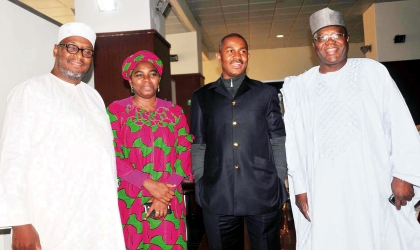
L-R: Former Governor of Bauchi State, Senator Adamu Muazu; Minister of Water Resources, Mrs Sarah Ochekpe; Executive Secretary, Nigerian Christian Pilgrims Commission, Mr Johnkennedy Opara and Commissioner, National Salaries, Incomes and Wages Commission, Ambassador Abdullahi Bage, during arrival of the last batch of Christian pilgrims in Abuja, last Friday. Photo: NAN

Nation
Zabbey Emerges Social Impact Man Of The Year 2025 …Reaffirms Commitment To Ogoni Transformation


The Project Coordinator of the Hydrocarbon Pollution Remediation Project (HYPREP), Prof. Nenibarini Zabbey, has been named Social Impact Man of the Year 2025 by Daily Independent Newspapers.
The award was presented at the Independent Awards 2025 Silver Jubilee Edition held at Eko Hotels and Suites, Lagos, as part of activities marking the organisation’s 25th anniversary of editorial excellence.
Managing Director and Editor-in-Chief of Independent Newspapers, Steve Omanufeme, said the award recognises individuals who have demonstrated exceptional leadership and transformative impact in their respective fields. He explained that recipients emerged through a rigorous process involving public voting, editorial board scrutiny, and assessment by a panel of judges.
Omanufeme noted that Zabbey’s selection reflects his outstanding contributions to environmental restoration and community development in Ogoniland through the Ogoni cleanup project.
With over two decades of experience spanning research, advocacy, capacity development, and administration, Zabbey has, within three years of leading HYPREP, implemented people-focused initiatives aimed at improving livelihoods and restoring degraded ecosystems.
Under his leadership, the project has reportedly created more than 7,000 direct jobs and facilitated the training of thousands of youths and women in high-demand skills, including mechatronics, cybersecurity, commercial diving, underwater welding, and data analytics.
HYPREP has also trained over 5,000 beneficiaries across 21 vocational skill areas, providing start-up kits to support entrepreneurship and economic empowerment.
In the area of environmental sustainability, the agency has established 31 environmental clubs in secondary schools and trained 2,500 youths with International Maritime Organization (IMO) certification to support shoreline cleanup and mangrove restoration efforts.
The project has recorded significant ecological milestones, including the cleanup of over 1,000 hectares of shoreline and restoration of 560 hectares of mangroves. This progress contributed to the designation of Ogoni mangrove wetlands as a Ramsar Site of international importance.
Beyond environmental remediation, HYPREP has expanded its social intervention programmes to include educational grants and scholarships for over 1,000 students, support for small and medium-scale enterprises, and skills training for persons living with special needs.
Infrastructure and healthcare development have also featured prominently, with ongoing projects such as the Ogoni Specialist Hospital, a Cottage Hospital, the Ogoni Power Project, and the Centre of Excellence for Environmental Restoration. The agency has further strengthened emergency healthcare delivery by donating five ambulances to medical facilities in the region.
Additionally, potable water has been provided to more than 40 communities, alongside the construction of wind-powered water systems in underserved areas.
Speaking on the award, Zabbey described it as a validation of HYPREP’s integrated approach to environmental restoration, healthcare improvement, and economic empowerment.
“We remain committed to delivering a cleanup that not only restores the environment but also improves livelihoods in line with the Renewed Hope Agenda of President Bola Ahmed Tinubu,” he said.
HYPREP, in a statement, expressed appreciation to the management of Independent Newspapers for the recognition, the Federal Ministry of Environment for its oversight role, and the Ogoni communities for their continued support and collaboration.
The agency was established by the Federal Government of Nigeria to implement the recommendations of the United Nations Environment Programme (UNEP) report on Ogoniland and restore areas impacted by oil pollution.
Nation
Rivers State Judiciary Counters NBA National Position over Contempt Ruling, Says Judge Acted Within the Law

The Rivers State Judiciary has faulted the Nigerian Bar Association National over its March 26, 2026 press release condemning the jailing of a lawyer for contempt, insisting the trial judge acted lawfully to protect the court’s integrity.
In a rejoinder issued by Chief Registrar High Court,David D. Ihua-Maduenyi, Esq., the judiciary said it was necessary to “set the records straight” following reactions to the NBA’s statement on the contempt conviction of Mrs. Lovinah Ugbana Benjamin.
Titled: “JUDGES MUST NOT BULLY LAWYERS OR
ABUSE POWER TO PUNISH FOR CONTEMPT AS A TOOL
FOR INTIMIDATION OF LAWYERS”
RE: IN THE MATTER OF CONTEMPT OF COURT BY MRS.
LOVINAH UGBANA BENJAMIN
IN SUIT NO.
PHC/301/2016 CORAM C. NWOGU J., OF THE HIGH
COURT OF RIVERS STATE.
The state judiciary explained that case in question is Suit No. PHC/301/2016 before Justice Chinwendu Nwogu of the Rivers State High Court, where Mrs. Benjamin served as defence counsel.
The statement read thus
“We are compelled to make this rejoinder regarding the
incident of the conviction for contempt and subsequent
unconditional discharge of Mrs. Lovinah Ugbana Benjamin,
Learned Counsel for the Defendants in the above suit by Hon.
Justice Chinwendu Nwogu of the High Court of Rivers State in
order to set the records straight, and not allow the
misinformation, misconception and reactions arising from the
NBA National Press Release in the matter to fester as reality or
truth.”
In the suit under reference wherein the said Learned
Counsel appeared for the Defendants, the Learned Counsel
attempted to mislead the Court by her signed and filed final
written address, by knowingly and falsely presenting non-
existent facts and evidence of a witness. When confronted by the
Court, she admitted that what she stated in her final written
the address was not true and she was unapologetic.”
“The to uphold the dignity and integrity of the Court, which the
said Learned Counsel treated with clear and brazen contempt, the
Court after following due process, convicted her for contempt and
sentenced her to prison for 3 days only, instead of the 3 months
statutory term due to passionate plea from the Bar.”
“According to the statement the suggestion of the NBA National in paragraph 10 of the
Press Release under reference that “where a court considers
counsel’s conduct improper, the proper course is to invoke
recognised disciplinary mechanisms, including referring
counsel to the Legal Practitioners Disciplinary Committee
(LPDC), rather than resorting to summary punitive measures”,
is not an invariable rule because the act of the Defence Counsel
constitutes contempt in facie curiae which the Court can punish
instantly, hence the action of the Judge is not an abuse of power
or an act of intimidation.”
“Nevertheless, due to the numerous calls from respected
members of the Bar to the offices of the Chief Registrar and the
Honourable Chief Judge for the release of the said Learned
Counsel, and the intervention of the NBA Port Harcourt Branch
delegation led by its Chairman, Mrs. Cordelia U. Eke to the Judge.
in his Chambers in the morning of 26/03/2026 where the
delegation upon learning the true facts of the incident, apologised
and pleaded for the release of the said Learned Counsel.
“The Judge
having accepted the apology signed a production warrant and
upon her production in court and oral application by Mrs. Cordelia
U. Eke, discharged her unconditionally that same morning.”
The statement further stated that It is therefore shocking to read later that day the NBA
National Press Release signed by its President and Secretary, Mazi
Afam Joseph Osigwe (SAN) and Dr. Mobolaji Ojibara respectively,
fiercely threatening and hastily advocated the following ultimata and
the immediate release of the affected
Counsel.
:That the Hon. Chief Judge of Rivers State
immediately investigate the circumstances
surrounding this incident and take
appropriate administrative action.
That appropriate disciplinary steps be taken
by the National Judicial Council, where
necessary.
That the remand of Mrs. Lovinah Ugbana
Benjamin under the circumstances be
condemned and set aside”
“That all NBA branches in Port Harcourt and
its environs and all legal practitioners
boycott the proceedings before the Court of
Hon. Justice Nwogu for a period of 7 days if
Mrs. Lovinah Ugbana Benjamin is not
released within 24 hours.
“It seems to us that it is either the NBA Port Harcourt Branch
leadership did not relate the true position to the NBA National or
if they did, the NBA National decided to speak daggers, not peace
to impugn the Judge as a villain.
“We find the position of the NBA National on this subject very
offensive and embarrassingly raising a feeling of acrimony against
the Judge in particular, and the High Court bench of Rivers State
in general. We categorically state that the Hon. Justice Chinwendu
Nwogu is one of our respected and respectful Judges with
unblemished integrity.
We view this Press Release as an isolated departure from the
enterprising and amiable leadership of the NBA National,
especially its President, whom we hold in high esteem and
admiration.”
“Whilst we appreciate the concern of the NBA National in
bringing attention to the event of 25th March 2026, we assure that
the Bench and the Bar in Rivers State remain veritable partners
in the administration of justice.
“We firmly restate that the Bench in Rivers State holds the Bar
in high esteem and this event would not disrupt the cordial
relationship between the Bench and the Bar.”
-
Politics1 day ago
ADC ELECTS NEW EXECUTIVES IN RIVERS LGA
-
Politics1 day ago
Ekiti 2026: IPC Trains Journalists On Election Coverage
-
Sports1 day ago
WAN Mourns Ex-NFF President Galadima
-
Sports1 day ago
Brentford Miss Chance To Move Up
-
Politics1 day ago
INEC To Display Voters Register April 29 As CVR Phase II Closes Nationwide
-
Sports1 day ago
NBA PlayOff: Lakers Make Winning Start
-
Sports1 day ago
NSF champion Osaretin wins at Tour du Faso
-
Politics1 day ago
GROUP BLASTS ATIKU CRITICAL COMMENTS AGAINST JONATHAN … SAYS EX-VP CAREER ASPIRANT