
Business
CBN Targets Higher Lending Rates

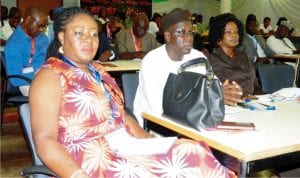
Participants at the Airport Business Summit and Expo in Abuja, recently.
The Central Bank of Nige
ria (CBN) has projected that lending rates would go up in the coming months as domestic and international headwinds continue to undermine efforts aimed at keeping the nation’s inflation rate at single digit level.
The CBN Governor, Mr Godwin Emefrele, made this known during an interview with journalists at the ongoing world Bank/International Monetary Fund (MF), spring meetings in Washington.
Emefiele, stated that the situation where the inflation rate was higher than the Monetary Policy Rate, (MPR) or benchmark lending rate, was not an acceptable model.
The Nigerian apex bank boss, pointed out that despite the current domestic and global fiscal headwinds affecting the economy negatively, the CBN world continue to do everything reasonable to stimulate broad-based growth of the economy through innovative monetary policy measures.
He said, CBN would focus its monetary support measures on critical sectors such as agriculture and mining that have the potential of boosting domestic production and by implication, help in the efforts to sustain macroeconomic stability and inclusive growth.
He added that the present shocks being experienced by oil exporting countries could be averted through the diversification of the economies and described the drive by the government to diversify the economic base as a step in the right direction.
“Practically, all are facing the challenges and everybody is looking at the possibility of diversifying their economies from being over-reliant on oil. So, obviously we are on the right course, but the challenges are still there not just for Nigeria but for different countries in the world”, he said.
Furthermore, he said”, what is important is that I reemphasise that we are on the right course by saying we need to continue to diversify our economy and I think for Nigeria, I see light at the end of the tunnel because we have a couple of Nigerian investors that have embraced the diversification of the Nigerian economy”.
On the increase in inflation rate, he said, “truly, Nigerians expect that if they want to access fund they should do so at a low interest rate but, of course, you will agree with me that with the increase in inflation rate from about 11.3 per cent that it was in February to almost about 12.4 per cent in March, naturally what you find is that interest rate will still have to go up sort of because when you have the MPR below inflation rate it is not a model that is acceptable. Interest rate has to be higher than inflation rate. So, that is what we expect”.


Nkpemenyie Mcdominic
Reports say that the training is designed to equip youths with practical technical skills for employment in the oil and gas and construction sectors, with emphasis on employability, safety, competence and self reliance.
In attendance at the flag-off ceremony this week, at the Petroleum Training Institute (PTI) Conference Hall, Effurun, were stakeholders, dignitaries, and political representatives, among others.
Dafinone, represented by his Chief of Staff, Adelabu Bodjor, said the initiative reflects a deliberate political investment in human capital development across Delta Central.
He explained that the training focuses on rigging and scaffolding, noting that “both are essential technical competencies required in industrial operations, construction projects, and oil and gas installations”.
Bodjor added, “The programme is intended to reduce dependency among youths by providing job-ready skills capable of supporting long-term economic opportunities and self-sufficiency. The initiative aligns with Senator Dafinone’s broader development agenda, which prioritises practical skill acquisition as a pathway to sustainable empowerment.”
Also addressing the participants, the NCDMB, Felix Omatsola Ogbe, represented by Mr. Teddy Bai, commended Dafinone for sponsoring the programme, describing it as “a timely response to critical manpower gaps in the industry”.
Bai explained that rigging and scaffolding remain safety-sensitive skills required across fabrication yards, offshore platforms, and construction sites, stressing that the programme bridges the gap between certification and practical competence.
He also charged the training consultant, OROH Contractors Limited, to maintain strict standards of professionalism, safety, and discipline, while urging participants to remain committed, focused, and disciplined throughout the exercise.
The Senate Liaison Officer for Sapele Local Government Area, Chief Patrick Akamuvba, , described the programme as a major step in strengthening human capital development in Delta Central.
Akamuvba said scaffolding and rigging skills are in high demand across residential, commercial, and industrial construction projects, noting that the training offers real employment opportunities for beneficiaries
He urged participants to prioritise knowledge and certification over short-term material expectations, stressing that discipline and seriousness would determine their long-term success.
He also cautioned youths against social vices and distractions, advising them to remain focused to maximise the opportunities provided by the programme.
-
News1 day ago
Obuah’s Victory Excites Former Lawmaker as APC Primaries Conclude in Rivers West
-

 Politics3 days ago
APC PRIMARIES: FUBARA’S WITHDRAWAL, HISTORIC SACRIFICE FOR NATIONAL STABILITY ……. GROUP
-

 News3 days ago
Court Sentences Seven To Death Over Murder Of Cleric In Rivers
-
News1 day ago
105 Nigerians Killed In S/Africa In Seven Years
-

 Sports3 days ago
PH Arsenal Community Set For Streets Procession, Saturday
-

 Politics3 days ago
IPAC Flays INEC Over Election Guidelines Judgement
-

 Politics3 days ago
NDC To Adopt Electronic Voting For Future Primaries
-

 Niger Delta1 day ago
Royal Father Endorses PH Arsenal Community, Pledges To Support