
Nation
THE STATES

Adamawa
The Federal Ministry of Agriculture and Rural
Development says it has registered 13,335 farmers for the 2013/2014 dry season farming in Adamawa State.
The Federal Director of Agriculture in the state, Dr Walia Hamman, disclosed this in an interview with newsmen in Yola.
Hamman said that the development followed the successful implementation of the Growth Enhancement Scheme (GES) in the state.
He added that the dry season farming scheme was the first of its kind, introduced by the Federal Government.
Borno
The Borno State Government has
presented certificates to 40 Vesico Vaginal Fistula (VVF) patients, who were trained on various skills.
The State Commissioner for Women Affairs and Social Development, Hajiya Inna Galadima, said at a ceremony to present the certificates in Maiduguri that the women had undergone successful corrective surgery.
Galadima said that the women were trained in tailoring and catering services to enable them sustain themselves.
“I am pleased to inform you that the trainees have learnt different income generating skills that will assist them to improve their health conditions and provide support to their families.
Ekiti
The National Directorate of Employment (NDE) has
advised unemployed graduates in Ekiti State to make themselves available for the various skill acquisition programmes of the directorate.
The State NDE Coordinator, Mrs Adeola Shafaru, gave the advice, while speaking with newsmen in Ado-Ekiti.
She stressed that jobless graduates would become gainfully employed if they embraced the programmes.
She said that the NDE had put in place a “Graduate Attachment Programme’’, where graduates were recruited and posted to government and private establishments for a six-month training to expose them to practical experiences in various vocations.
FCT
The Minister of Special Duties, Alhaji Kabiru Turaki,
has called on stakeholders in education to take urgent action and show commitment in tackling the problems of the education sector.
Turaki made the call in Abuja at the Pre-AGM Dinner of Unity Schools Old Students Association (USOSA).
“There is no substitute for good and qualitative education and we must all agree that education is the business of all.
“To ensure any transformation, there must be functional and social infrastructure, which education is a larger part,” he said.
Jigawa
The Nigeria Security and Civil Defence Corps
(NSCDC) in Jigawa last Saturday said that it had arrested two suspects (names withheld) for allegedly stealing diesel.
The NSCDC Commandant in the state, Mr Muhammad Gidado, told newsmen in Dutse that the suspects were arrested on the Dutse-Huguma road by NSCDC officers who were on patrol of the area.
He explained that the suspects were arrested in a Golf car that was fully loaded with 30 jerry cans, containing 25 litres of diesel each.
Gidado said that the diesel was suspected to be stolen from the yards of Dantata and Sawoe, as well as Setraco construction companies.
Kaduna
A Catholic priest, Rev. James Bako, has urged
Nigerians to ensure equity and justice for all persons, irrespective of their religious affiliations or status in society.
Bako made the call in his homily at the Our Lady of Fatima Chaplaincy, Sabo in Kaduna State.
The cleric called on the populace to be humble, advocate truth and pray for peace, unity and development of the nation.
He also urged the citizenry to be unbiased in their judgments and to imbibe positive attitudes.
Kano
Female members of All Farmers Association of
Nigeria (AFAN), in Kano State, have called on the state government to include them as beneficiaries when distributing fertilisers.
Leader of the women farmers, Hajiya Fatima Kiru, told newsmen in Kano that government should also give them implements for irrigation farming.
“We are calling on the state government to give special consideration to our members in the distribution of fertilisers for this year’s dry season farming’’, Kiru said.
She said the call was necessary because members of the association produced about 500,000 bags of rice during dry season farming in the state.
Kwara
Governor Abdulfatah Ahmed of Kwara State has
advised the new local government chairmen in the state, to practise politics of inclusion in their respective council areas.
He gave the advise while speaking with newsmen on the outcome of Saturday’s local government elections in 15 local government areas of the state.
Ahmed urged the winners to see their victory as part of nation building and therefore, be magnanimous in victory so as to collectively move the state forward.
“We are running a true democracy in the state and in an ideal democratic setting, people are free to do things the way they want it.
Lagos
A member of the Lagos State House of Assembly,
Suuru Avoseh has warned Lagos residents to desist from patronising roadside food vendors to prevent the spread of cholera disease in the state.
Avoseh, who is the Chairman of House Committee on Health Services, gave the advice while speaking with newsmen in Lagos State.
“The most important step to prevent the spread of cholera disease is to be conscious of whatever we eat.
“People should stay away from roadside foods; they should also be careful of the water they drink.
Niger
The Niger State Government has approved the sales
of uncompleted 250 housing units opposite Zuma Rock in Suleja in line with the tripartite arrangement for the project in 2003.
The Commissioner for Land and Housing, Dr. Peter Sarki, told newsmen in Minna that the State Executive Council approved the sales in agreement with the two other parties involved.
Sarki said the other two parties involved were Federal Mortgage Bank and Sintax Nigeria Limited.
He recalled that the Federal Mortgage Bank had earlier agreed to provide N639.7 million in three tranches of 40 per cent initial release and 30 per cent each in two subsequent releases.
Plateau
The wife of late Senator Gyang Dantong, Mrs Hanatu
Dantong, has inaugurated four health centres initiated by her husband and completed by his successor, Sen. Gyang Pwajok in Jos.
The widow inaugurated the Plateau North constituency projects at the behest of Pwajok in memory of his late predecessor, who died in a stampede on July 8, 2012, when gunmen attacked mourners in Bachit, Plateau State.
The four health centres, undertaken by the office of the Millennium Development Goals (MDGs) included a Management Care ward and Primary Health Care (PHC) centre facility at the Christian Hospital, Vom, as well as a PHC centre at Fan-Loh and Bisichi in Barkin-Ladi, Plateau.
Also inaugurated was a block of three classrooms, VIP toilets and boreholes at the Jos Township Primary School.
Taraba
The DSK Foundation, a non-governmental
organisation, has urged the people of Taraba State to eschew violence and embrace peace so as to enhance the socio-economic development of the state.
The foundation’s President, Chief David Kente, gave the advice in Wakari at the end of a two-day workshop on “Peace as a Panacea for Development’’, organised by the foundation.
Kente stressed that the recurrent acts of violence in parts of the state had slowed down economic activities, adding that the development had further aggravated the rate of poverty and hunger in the society.
“We must eschew violence and imbibe the spirit of ‘give and take’, so as to promote peace and development in the state.
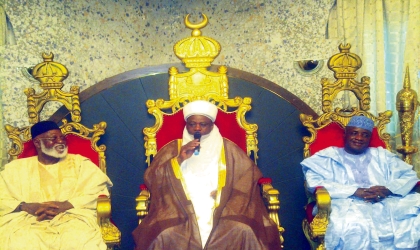
L-R: Former Head of State, General Abdulsalami Abubakar, Sultan of Sokoto, Alhaji Sa’ad Abubakar III and Governor Aliyu Wamakko of Sokoto State when General Abubakar paid a courtesy call in Sokoto, yesterday.



The Rivers State Commissioner for Education, Dr. Peters Nwagor, has commended the orderly conduct of the ongoing 2026 West African Senior School Certificate Examination in the state and urged schools to sustain the standard.
Dr. Nwagor gave the commendation on Tuesday during a monitoring tour of selected secondary schools in Port Harcourt and environs where the WAEC exam is ongoing.
The commissioner, who was accompanied by directors and monitors from the Ministry of Education, said he was impressed with the peaceful atmosphere at the centres visited.
“The students conducted themselves properly and wrote their papers under conducive conditions. Invigilators and supervisors also performed their duties professionally,” he stated.

Nwagor noted that the Rivers State Government had invested heavily to ensure the smooth and credible conduct of the examination across the state
He urged candidates to reciprocate government’s effort by shunning all forms of examination malpractice and focusing on their studies.
“Government has done so much to ensure successful examinations in our schools. Students should take advantage of it by remaining focused,” the commissioner said.
While no case of malpractice was recorded in the centres inspected, Dr. Nwagor warned that any principal, teacher, invigilator, or official caught aiding malpractice would face strict sanctions in line with regulations.
He also commended school administrators, teachers, WAEC officials, and security personnel for upholding the integrity of the process.
Centres visited included County Grammar School, Ikwerre/Etche; Government Comprehensive Secondary School, Borokiri; Government Secondary School, Borokiri; and Pabod Model Secondary School.

Rivers State University and the Otonti Nduka Foundation for Values Education jointly hosted a two-day National Conference on 8 and 9 May 2026 to examine the state of values in Nigeria.
The two days conference held at Rivers State University convocation arena brought together academics, policymakers, legal experts and education leaders under the theme _“Trends and Challenges in Upholding Values in Nigeria.”_
The gathering focused on policy gaps, curriculum reform, and the role of ethics in public service and education.
The event opened on Friday with remarks from Vice Chancellor Prof. Chief Isaac Zeb-Obipi, who stressed the need to address declining moral and civic values across Nigeria’s education and public sectors. A book of abstracts for the plenary sessions was also presented to participants.
Key speakers included former Attorney General Chief Dr Kanu Agabi, SAN; NERDC Executive Secretary Prof. Shehu Salisu; Prof. Hauwa Imam, FNAE, of the University of Abuja; former Rivers SUBEB Chairman Ven Dr Fyneface Akah, ; former NIMASA DG Dr Hon. Dakuku Adol-Peterside; and RSU Director of ICT Prof. Sunny Orike.
Discussions centered on integrating values education into schools, tertiary institutions and public institutions, alongside the impact of technology on moral development among young Nigerians. Panel and plenary sessions produced practical recommendations for curriculum and policy reform.
On Saturday, the foundation marked its centenary with the unveiling of the book _Otonti Nduka in History_, launched by Chief Engr. Grant Offor, FNSE. The Nigerian Academy of Education held a ceremonial procession led by its President Prof. Olu Jegede and the Ikwerre Professors Forum.
In a communiqué, participants called for stronger collaboration between government, civil society and academia to mainstream values education nationwide. They recommended reviewing teacher training curricula and expanding digital platforms to promote ethical civic engagement, with the foundation pledging to share the outcomes with education authorities for implementation.
Dignitaries present included Ogbakor Ikwerre Worldwide as Chief Host, Prof. Emeritus Chief T. Uzodimma Nwala, the Ikenga 1 of Mbaise and first philosophy student of Prof. Otonti Nduka, alongside scholars and community leaders.
Amadi Akujobi
-

 Rivers2 days ago
Police arrest 3 suspects over killing of driver in Rivers
-
Politics2 days ago
I DIDN’T PROMISE YOU TICKETS, AKPABIO TELLS APC SENATORS WHO FAILED PRIMARIES
-

 News2 days ago
FUBARA ASSURES NUT OF SECURITY OF SCHOOLS IN RIVERS
-

 News2 days ago
NDLEA Arrests Four Notorious Female Drug Dealers In Four States
-

 Sports2 days ago
Okpekpe Road Race Gets Mobility Solutions, Fan Engagement
-
Politics2 days ago
Court Dismisses Rivers PDP Members’ Suit Over LG Election Candidates
-
Politics2 days ago
POST PRIMARIES: IKWERRE MONARCHS ADVOCATE ISSUES-BASED POLITICS IN RIVERS
-

 News2 days ago
WORLD FOOD SAFETY DAY: VETERINARIANS TASK GOVT ON MODERN ABATTOIR IN RIVERS