
Nation
THE STATES

Adamawa
The Coordinator of Subsidy Reinvestment and Em
powerment Programme (SURE-P) in Adamawa State, Alhaji Salihu Yunusa, said that the Federal Government had allocated 3,000 slots to the state in the Graduates Internship Scheme of SURE-P.
Yunusa said this in Yola while speaking at a one-day sensitisation session organised by the Federal Ministry of Finance.
He said that the session was organised for the invited and registered companies and organisations that were based in Adamawa to educate them on how to participate in the scheme.
“The Federal Government has allocated 3,000 slots to unemployed graduates in the state under the SURE-P scheme,’’ he said.
Borno
The Joint National Association for the Physically Chal
lenged Persons (NAPCP) has appealed to Borno State Government to appoint one of its members as a special adviser in the state.
The Chairman of the association, Malam Umar Mohammed, made the appeal at a news conference in Maiduguri recently.
Mohammed said the gesture would create a better environment for members of the association in the state.
“We wish to thank the state government for its assistance to the less privileged, especially during festivities like the month of Ramadan and Sallah.
Bauchi
The Bauchi State Agency for the Control of HIV and
AIDS, Tuberculosis, Leprosy and Malaria (BACATMA) says it will train 30 laboratory scientists on malaria control measures.
The Executive Chairman of the agency, Dr Abdulazeez Manga, told the newsmen in Bauchi that the training would further ensure that the various tests were designed to identify different mosquitoes that caused malaria.
Manga said that plans were on to set up an insectory at the Abubakar Tafawa Balewa University (ATBU) Bauchi.
He said that the agency would also distribute 3.5 million Long Lasting Insecticidal Nets in 2014 to further protect residents against the disease.
Benue
The Benue State House of Assembly has ordered Mr
Simon Iwar, a former Chairman, of Gwer Local Government, and two other officials to refund N1 million to the coffers of the council.
The order followed a report of the House Committee on Public Accounts which considered the interim report of the Auditor General for Local Government on the council’s accounts from 2008 to 2012.
The other affected officers of the council are Mrs Regina Odangla, the Director General, Service and Administration, and the Protocol Officer, Mr Joseph Orya.
The House of Assembly, at a plenary in Makurdi, directed the affected officers to refund the money within three weeks and tender evidence of payment to the committee.
Ekiti
Two men, Ojo Omoniyi and Segun Fadipe, aged 25
years each, appeared before an Ado-Ekiti Magistrates’ Court charged with stealing satellite television decoder and laptop.
Police prosecutor Sgt. Ebenezer Ewuola told the court that the accused committed the offence on October 25 at Adebayo Street, Ado-Ekiti.
Ewuola said the accused broke into the house of one Adeleye Akingbaso and stole the items which also included one cell phone, one tin of Glucose D, one tin of Nescafe and N130,000.
He added that the offence contravened sections 390 and 411 of the Criminal Code, cap C 16, Vol. 1, Laws of Ekiti State, 2012.
FCT
The Civil Society Legislative Advocacy Centre
(CISLAC), an NGO, has urged Ministries, Agencies and Parastatals (MDAs) to implement budgets as approved by the National Assembly to avoid breach of Procurement Act.
The Executive Director of CISLAC, Malam Auwal Rafsanjani, made the call in an interview with newsmen in Abuja.
“ We call on various MDAs to implement their budgets as approved by the National Assembly and released by the Federal Ministry of Finance to avoid breach of the procurement act.
“ We have to learn to go by the Medium Term Strategy which clearly spells out how the MDAs are supposed to implement their budgets, ‘’ Rafsanjani said.
Kwara
The Kwara State House of Assembly has passed the
Kwara Signage and Advertisement Agency Amendment Bill.
The bill, which was sent to the House by Gov. AbdulFattah Ahmed , was passed after the House adopted the report of its Committee on Development, Youths, Sports and Information.
The committee, in its report, recommended that a new agency be put in place and should be supervised by the state Ministry of Information and Communications for effective performance.
The report also recommended that members of the agency should meet once in two months on how to carry out its assignment.
Katsina
Governor Ibrahim Shema of Katsina State says 5,000
unemployed youths have received skills training at the Katsina Youth Crafts Village, since its establishment in 2009.
Shema said this in a message delivered by his Deputy, Abdullahi Garba to the 2013 graduation ceremony of trainees of the centre.
The governor said the centre was established by the state government to train unemployed youths on various skills to be self employed and address the problem of youth restiveness.
He said that youths from the 34 local government areas of the state as well as Borno and the neighbouring Niger Republic benefitted from the training.
Nasarawa
A Director in the Nasarawa State Ministry of Agricul
ture and Natural Resources, Dr Emmanuel Sunday, has urged veterinary experts to embark on regular monitoring of abattoirs.
Sunday made the call in Lafia during the inauguration of new officials of the Nigeria Association of Animal Health and House-Boundary Technology from all the local government areas of the state.
He said that constant monitoring of abattoirs would ensure the sale of wholesome meat in the state.
“If every member of the association would sit up and discharge his duties properly, it would go a long way in restoring the lost confidence of meat consumers in the state.’’
Niger
The Niger State Development Company (NSDC) says
it will partner with the Federal University of Technology, Minna, in the areas of Agriculture and Information and Communication Technology (ICT).
The company’s Head of Investment Services, Malam Ahmed Kuta, disclosed this during a courtesy visit to the Vice- Chancellor, Prof. Musbau Akanji in Minna.
Kuta said the company was making efforts towards strengthening the state economy through key investment initiatives and strategic partnership.
He said the company was collaborating with the university based on its track record in research and academic excellence.
Osun
The police in Osun State have arraigned a 32-year-old
woman, Ganiyat Ogunride, before an Osogbo Magistrates’ Court for alleged theft of N15,000.
The prosecutor, Insp Abiodun Fagboyinbo, told the court that the accused committed the offence on Thursday at about 10.00 a.m. at Agunbelewo area of Osogbo.
Fagboyinbo said the accused entered the house of one Adeleke Sakirat without her consent and stole N15, 000 from her room.
He said the offence committed contravened sections 412 and 390 of the criminal code, Cap 34 Vol. II, Laws of Osun, 2003.
Oyo
A 35-year-old man, Moses Ogah, was arraigned be
fore an Ibadan Chief Magistrates’ Court sitting at Iyaganku over a N1.25 million fraud.
Ogah was arraigned on a two-count charge of conspiracy and fraud.
The prosecutor, Insp Aliu Samad, told the court that Ogah and others now at large conspired among themselves to commit the crime.
Samad alleged that Ogah fraudulently obtained the sum from one Michael Idowu.
He said the accused obtained the money under the pretence of selling a 2012 model Sienna bus to Idowu, adding that the accused converted the money to his own use.
Plateau
The Commissioner for Information and Communication in Plateau State, Mr Abraham Yiljap, said the state government had mapped out strategies to prevent further spread of cholera in the state.
Yiljap, while briefing newsmen in Jos, said the measures would assist in the prevention of further spread and outbreak of other communicable diseases.
“Since the unfortunate incident in Namu village, more steps had been taken to mitigate the spread of the disease and ensure that those who were hospitalised received appropriate medical attention.
“We have decided to provide clean and safe drinking water in Namu and other parts of the state to check the spread of the disease.
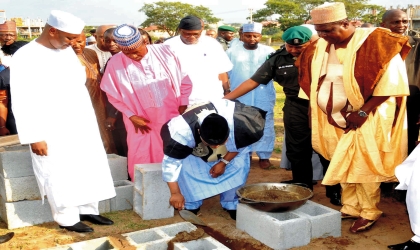
Vice President Namadi Sambo (middle), laying the foundation stone for International Institute of Journalism in Abuja, yesterday. With him are National President, Nigerian Union of Journalist, Malam Mohammed Garba, Minister of Information, Mr Labaran Maku, NUJ Deputy President, Mr Rotimi Obamuwagun and Chairman, Building Committee and Board of Trustees, Otunba Olusegun Runsewe




The Hydrocarbon Pollution Remediation Project (HYPREP) has commemorated the 15th anniversary of the release of the United Nations Environment Programme (UNEP) Environmental Assessment Report on Ogoniland, reaffirming its commitment to restoring the environment and improving the livelihoods of affected communities.
In a statement signed by the Project Coordinator, Prof Nenibarini Zabbey, to commemorate the anniversary, HYPREP described the anniversary as a significant milestone in Nigeria’s environmental restoration efforts, noting that the project has made remarkable progress in implementing the recommendations of the landmark UNEP report released on August 4, 2011.
The UNEP report had revealed extensive oil pollution across Ogoniland, severe environmental degradation, and serious public health risks resulting from decades of petroleum operations. It also recommended an initial $1 billion fund to commence the cleanup of the affected communities.
According to HYPREP, the Federal Government formally launched the Ogoni clean-up in 2016, while the Project Coordination Office was established in 2017 to drive the implementation of UNEP’s recommendations.
Zabbey said the current administration has continued to prioritise the project under the Renewed Hope Agenda.
Providing an update on the cleanup, the Project Coordinator disclosed that 30 of the 65 contaminated sites identified by UNEP have been fully remediated, while work is ongoing at several medium- and high-risk locations. It also stated that more than 1.5 million mangrove seedlings have been planted as part of what it described as the world’s largest restoration of oil-degraded mangroves, with over 1,000 hectares of shoreline already rehabilitated.
Zabbey further revealed that 49 Ogoni communities have been connected to potable water schemes through multiple water projects and booster stations aimed at providing safe drinking water across the region.
In the health sector, he said the 100-bed Ogoni Specialist Hospital in Kpite and the 43-bed Cottage Hospital in Buan are nearing completion, adding that several existing health facilities have been upgraded with modern medical equipment, while five ambulances have been donated to improve emergency healthcare services. The Project Coordinator also disclosed that a three-year human health biomonitoring study is being conducted in collaboration with the World Health Organization’s International Agency for Research on Cancer (IARC).
On economic empowerment, Zabbey stated that the Project has created more than 8,000 direct jobs and trained thousands of Ogoni youths and women in various vocational and technical skills, including software development, cybersecurity, aviation, commercial diving, seafaring, mechatronics, and creative arts. The project also reported awarding scholarships to more than 1,000 students, providing grants to small businesses, and supporting persons living with special needs through skills acquisition programmes.
The statement further highlighted ongoing legacy projects, including the Ogoni Power Project and the Centre of Excellence for Environmental Restoration, which it said is about 96 per cent complete. HYPREP also welcomed the recent designation of the Ogoni Wetland as a Ramsar Site of International Importance and pledged to continue promoting biodiversity conservation and sustainable management of the ecosystem.
Marking the anniversary, Zabbey said the progress achieved over the past 15 years demonstrates the collective commitment of government, development partners, stakeholders, and local communities to restoring Ogoniland. He called for renewed collaboration to sustain the cleanup effort, promote environmental sustainability, and support the long-term development of the region. 3
-

 News2 days ago
RSG Targets Nine Million Residents in Mosquito Net Distribution Campaign
-

 Oil & Energy1 day ago
Aiyedatiwa Signs New Electricity Bill
-

 Maritime1 day ago
Marine Minister Commends President Tinubu On NPERA Bill Assent
-

 Oil & Energy1 day ago
NLNG Commissions Research And Innovation Centre In RSU
-

 News2 days ago
KenPoly Holds Eight Convocations, August 29
-

 News2 days ago
RSG Begins Another Phase of Projects Commissioning Today
-

 News2 days ago
RMAFC Completes Revenue Sharing Review, Proposes New Pay
-

 Maritime1 day ago
NAGAFF Petitions IGP Over Alleged Maritime Police Harassment