
Featured
FG, States, Local Govts Share N1.42trn In January

The Federation Account Allocation Committee (FAAC) has disbursed a total sum of N 1.424 trillion to federal, state and local governments. The total amount is derived from the federation account revenue generated in December 2024.
The disbursement, which was made at the January 2025 Federation Account Allocation Committee (FAAC) meeting held in Abuja, last Friday comprising distributable statutory revenue of N386.124 billion, distributable Value Added Tax (VAT) revenue of N604.872 billion, Electronic Money Transfer Levy (EMTL) revenue of N31.211 billion and Exchange Difference revenue of N402.714 billion.
According to a communiqué issued by the committee, the total gross revenue of N2.310 trillion was available in the month of December 2024, while the total deduction for cost of collection was N84.780 billion, total transfers, interventions and refunds was N801.175 billion.
According to the communiqué, gross statutory revenue of N1.226 trillion was received for the month of December 2024. This was lower than the sum of N1.827 trillion received in the month of November 2024 by N600.988 billion.
Also, the gross revenue of N649.561 billion was available from the Value Added Tax (VAT) in December 2024. This was higher than the N628.973 billion available in the month of November 2024 by N20.588 billion.
The communiqué stated that from the N1.424 trillion total distributable revenue, the federal government received total sum of N451.193 billion while state governments received total sum of N498.498 billion.
The local government councils received total sum of N361.754 billion and a total sum of N113.477 billion (13 percent of mineral revenue) was shared to the benefiting states as derivation revenue.
On the N386.124 billion distributable statutory revenue, the Federal Government received N167.690 billion and the state governments received N85.055 billion while local government councils received N65.574 billion. The sum of N67.806 billion (13 percent of mineral revenue) was shared to the benefiting States as derivation revenue.
“From the N604.872 billion distributable Value Added Tax (VAT) revenue, the Federal Government received N90.731 billion, the State Governments received N302.436 billion and the Local Government Councils received N211.705 billion.
“A total sum of N4.682 billion was received by the Federal Government from the N31.211 billion Electronic Money Transfer Levy (EMTL). The State Governments received N15.605 billion and the Local Government Councils received N10.924 billion.
“From the N402.714 billion Exchange Difference revenue, the communiqué stated that the Federal Government received N188.090 billion and the State Governments received N95.402 billion. The Local Government Councils received N73.551 billion, while the sum of N45.671 billion (13% of mineral revenue) was shared to the benefiting States as derivation revenue,” the communique stated.




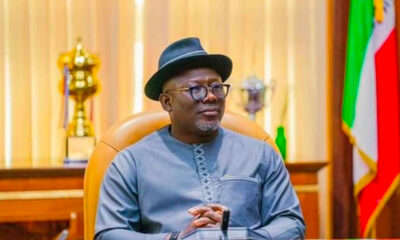


The Rivers State House of Assembly has approved the 2026–2028 Medium Term Expenditure Framework (MTEF) submitted by Governor Siminalayi Fubara.
This reaffirms the lawmakers’ commitment to enacting laws and taking legislative actions geared towards the overall development of the State.
The Assembly gave the approval during its Second Legislative Sitting of the Fourth Session held last Friday.
Speaking on the MTEF document during plenary, the House Speaker, Rt. Hon. Martin Amaewhule, noted that by the provision of Section 10(1)(b) of the Rivers State Fiscal Responsibility Law No. 8 of 2010, the MTEF ought to have been laid before the House in September 2025.
Amaewhule explained that traditionally, the document is expected to be presented four months before the commencement of the next financial year and immediately after the expiration of every three-year fiscal cycle.
He, however, stated that in the interest of the State and its people, the House considered it necessary to deliberate on the document, describing it as a precursor to the 2026 Budget Estimates.
The Speaker expressed concern that the year had already progressed significantly before the presentation of the framework.
During deliberations on the document, members examined the assumptions and projections contained in the MTEF and observed that strict adherence to the outlined fiscal parameters would ultimately serve the interest of Rivers people.
The lawmakers maintained that effective implementation of the framework would promote prudent financial management and enhance developmental planning across the State.
Following the debate and positive consideration by members, the Speaker put the question to the House and members voted overwhelmingly in support of the approval of the MTEF.
Meanwhile, during the same sitting last Friday, the House also received a petition from the Chairman of Obio/Akpor Local Government Council, Dr. Gift Worlu.
The petition was presented by the member representing Obio/Akpor Constituency II, Hon. Emilia Amadi.
According to the petition, concerns were raised over an imminent security breach, threats to lives, destruction of property and alleged forceful takeover of property by some lawless persons within parts of the Local Government Area.
Presenting the petition before the House, Hon. Amadi appealed to the lawmakers to revisit the matter and take necessary steps aimed at safeguarding lives and property in the affected communities.
The House is expected to further deliberate on the petition and consider measures to address the concerns raised in order to sustain peace and security in the area.
King Onunwor
Featured
JUNE 12: Democracy Remains Nigeria’s Strongest Path To Unity, Progress, Says Fubara ….Extols Abiola, Wife


Governor of Rivers State, Sir Siminalayi Fubara, has reaffirmed that democracy remains the most effective system of government for Nigeria, given the country’s rich diversity of ethnic, religious, and cultural identities.
In a goodwill message to Nigerians on the occasion of the 2026 Democracy Day celebration, Governor Fubara said June 12 represents far more than a historic date; as it embodies the enduring struggle, sacrifice, and collective aspiration of Nigerians for freedom, justice, and representative governance.
The Governor extended warm felicitations to Nigerians at home and in the Diaspora, paying tribute to the heroes and heroines of the democratic struggle, particularly Chief MKO Abiola, his wife, Kudirat Abiola, and countless others whose courage and sacrifices helped secure the democratic freedoms Nigerians enjoy today.
According to him, “June 12 is a reminder of the price paid for the democracy we enjoy today. The sacrifices made by Chief MKO Abiola, Kudirat Abiola, and many other patriots who laid the foundation for the democratic journey we continue to enjoy today. Their commitment to the principle that power must ultimately reside with the people remains a source of inspiration for every generation of Nigerians.”
Governor Fubara noted that thirty-three years after the historic June 12, 1993 election, Nigeria’s democratic experiment has continued to evolve despite challenges and setbacks.
“Our democratic journey has not been without difficulties, but the resilience of our institutions and the determination of our people have kept the nation moving forward. The ability to express differing opinions, engage in constructive debate, and peacefully choose leaders through the ballot remains one of the greatest achievements of our nation,” he said.
Governor Fubara stressed that democracy provides the best framework for managing Nigeria’s diversity and transforming it into a source of national strength.
“Nigeria’s diversity should never be seen as a weakness. Properly harnessed, it is our greatest asset. Democracy offers us the opportunity to build consensus, promote inclusion, strengthen national unity, and create the conditions for sustainable development and shared prosperity,” he said.
Governor Fubara commended President Bola Ahmed Tinubu, for his commitment to the Renewed Hope Agenda and ongoing efforts aimed at economic revitalization, strengthening security, and deepening democratic institutions across the country.
He reiterated the readiness of Rivers State to continue partnering with the Federal Government in advancing policies and programmes that improve the lives of citizens through infrastructure development, job creation, enhanced security, quality education, healthcare delivery, and good governance.
The Governor further called on Nigerians, regardless of political affiliation, ethnic background, or religious belief, to use the occasion of Democracy Day to renew their commitment to the Nigerian project and the ideals that underpin democratic governance.
“Democracy must not be viewed merely as a periodic electoral exercise. It must be reflected in our daily commitment to accountability, transparency, tolerance, justice, respect for the rule of law, and responsible leadership. As citizens and leaders, we all share a collective responsibility to strengthen our democracy and build a nation that future generations will be proud to inherit,” he said.
Governor Fubara expressed optimism about Nigeria’s future, urging citizens to remain united, hopeful, and committed to the values of peace, dialogue, and national development.
“Together, we can build a stronger, more inclusive, and more prosperous Nigeria where every citizen has the opportunity to thrive and contribute meaningfully to national progress,” he said.

Governor of Rivers State, Sir Siminalayi Fubara, has reaffirmed the unwavering commitment of his administration to peace, unity, security, and inclusive development as Rivers State marked its 59th anniversary, last Wednesday.
In a goodwill message issued on Wednesday to commemorate the anniversary, Governor Fubara stated that despite the challenges faced over the years, the people of Rivers State have continued to demonstrate resilience, strength, and an enduring spirit of unity that has sustained the state since its creation.
The Governor noted that the strong bond of brotherhood among the various ethnic nationalities of the state, including the Ijaw, Ikwerre, Ogoni, Etche, Ekpeye, Andoni, Kalabari, and others, remains one of Rivers State’s greatest strengths and a critical foundation for peace, stability, and progress.
He further observed that Rivers State has remained a major driver of Nigeria’s economy for decades, not only because of its abundant oil and gas resources, but also because of the exceptional contributions of its people across diverse sectors including academia, jurisprudence, business, entertainment, public service, and sports.
Governor Fubara assured the people that his administration will continue to prioritize policies and programmes that promote peace, protect lives and property, and expand development across all parts of the state. He emphasized that governance must be people centered and impactful, with equal attention given to every Local Government Area of the state.
The Governor also paid tribute to the elders and founding leaders of the state for preserving the spirit of unity and coexistence over the years, while urging the youths to remain hopeful, responsible, and actively committed to building a greater Rivers State through innovation, hard work, and patriotism.
He equally acknowledged the invaluable role of women in strengthening families, communities, and society, describing them as indispensable partners in the continued growth and stability of the state.
Governor Fubara called on all Rivers people to use the occasion of the anniversary as a moment of reflection and renewed commitment to peaceful coexistence, mutual respect, dialogue, and collective progress, stressing that the unity and future of Rivers State must always rise above personal interests and political differences.
Rivers State was created on May 27, 1967, by General Yakubu Gowon.
-
Rivers1 day ago
Rivers Police Uncovers Firearm Concealed In Loaf Of Bread
-

 Niger Delta22 hours ago
Pro-Chancellor Hands Over Okey Onuchuku Peace, Conflict Institute Building
-

 News22 hours ago
Fubara Reaffirms Commitment To Blue Economy, Private Sector Growth …Calls For Protection Of Marine Resources
-
Sports1 day ago
Six Nigerians To Play For NBA Teams
-
Business1 day ago
Gas Economy: Decade of Gas, Pi-CNG/ EV Deepen Media Engagement
-
Business1 day ago
Navy Nabs 13 Black Sand Miners In Bayelsa –Impound Two Boats
-
 Business23 hours ago
IPMAN Raises Concern Over Delay In Chinese Refinery Deal …Predicts Lower Fuel Prices Through Competition
-
Business1 day ago
Accountable Leadership, Urgent Reforms Will Stimulate Economic Growth — Osi