
Politics
Election Observation Reports: INEC Threatens To Blacklist CSOs

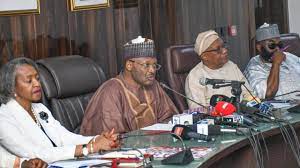
The Independent National Electoral Commission (INEC) has said it will no longer accredit civil society organisations (CSOs) and other bodies as observer groups if they fail to submit their observation reports of previous elections.
INEC Chairman, Prof. Mahmood Yakubu, disclosed this on Wednesday in Abuja at the first quarterly consultative meeting with Civil Society Organizations (CSOs).
Prof. Yakubu said INEC will continue to partner with Civil Society Organizations, saying the commission appreciates the observations and recommendations contained in their election observation reports.
He said, “Some of the reforms and innovations introduced by the Commission over the years draw from your observation reports. However, while many of you have submitted your reports, some accredited observers are yet to do so for the general election, supplementary elections, off-cycle elections, bye-elections, and re-run elections.
“May I therefore seize this opportunity to remind those who are yet to submit their observation reports that it is mandatory to do so, being one of the conditions for eligibility to observe future elections? Going forward, the Commission will operate strictly on the policy of ‘No Observation Report, No Accreditation.”
He said that for Edo State, 18 political parties conducted their primaries monitored by the Commission, adding that, going by the provision of the timetable and schedule of activities for the election, “political parties have 20 days from March 4, 2024, to upload the list and personal particulars of their candidates to our dedicated web portal.”
Prof. Yakubu explained that eight parties had filed their nominations.
“We expect the other parties to do so before the deadline of 6 p.m. on March 24, 2024, when the portal automatically shuts down. Thereafter, the Commission will publish the personal particulars of the candidates (Form EC9) on March 31, 2024, for public scrutiny as required by law.
“Turning to Ondo State, political parties will commence their primaries for the governorship election in the next two weeks. Sixteen political parties have indicated interest in participating in the election.
“I urge Civil Society Organisations (CSOs) to engage with political parties and observe their primaries just as you engage with INEC and deploy observers to the main election conducted by the Commission. By doing so, you will strengthen your advocacy for inclusivity for groups such as women, youths, and Persons with Disability (PwD) that are underrepresented in elective offices at the national and state levels,” he added.



He said he would not hesitate to activate the recall process against any lawmaker found wanting, if he returns for a second term in office.
He stated this while addressing members of the All Progressives Congress (APC), including those who lost out at the recently held national and state assemblies primaries and have become aggrieved and disrespectful to the party.
While emphasizing the supremacy of the party, he said decisions were taken in the overall interest of the party and the state and must, therefore, be respected by all members.
He warned lawmakers against being insolent and arrogant to their people to the extent of shutting them out after each election cycle, saying such would no longer be condoned.
“So I am appealing to all of you. If you were born with arrogance, please just drop that ticket here”, he said.
The governor hinted that after the next cycle of elections, the process of recalling lawmakers who made themselves “tin gods” would be activated.
“Well, they say they don’t recall people from parliament, but this will be the first time.
“Anybody whom the people say they are tired of will be brought back home. Anybody who goes and forgets his people completely and doesn’t care, thinking that during elections he will come and pretend to be a good man, will be brought back.
“And we are making this very, very clear. We will not fail in what we have said. I am working tirelessly; I don’t sleep. If you are going into office during this period, there will be no sleep for you”, he said.
He advised politicians not to ignore their people who hold the power, insisting: “You cannot overlook them and become so arrogant and pompous that you don’t know your people.”
Gov. Otu also advised members of the ruling APC, who lost at the just-concluded party primaries in the state, not to defect to opposition parties like the Nigerian Democratic Congress (NDC) or the African Democratic Congress (ADC), warning that they would suffer untold hardship and would not make any political headway, if they did.
“There are some kwashiorkor parties that are registering people. Such parties are wasting their time and not even my time. They cannot do anything.
“I don’t want anybody to suffer the fate I suffered. That’s why I’m warning those aggrieved aspirants who lost not to go the way of those parties to avoid unnecessary suffering.
“I don’t want anybody to go that route. It’s an absolute waste of time, energy and people’s future, because at the end of the day, you will drag people into that bottomless pit.
“And when you drag them there and can’t take care of them, you begin to rot, you begin to die. May God give me the energy and power to sustain.”
He appealed to the aggrieved APC members, saying: “There’s nothing that we cannot settle. God’s time is the best. Whatever we’ve done is for the common good of all of us.”
2027: INEC APPEALS JUDGMENT ON ELECTION GUIDELINES
The Independent National Electoral Commission (INEC) has appealed the judgment of the Federal High Court in Abuja which nullified aspects of the Commission’s 2027 General Election Guidelines.
The appeal, filed before the Court of Appeal, seeks to overturn the judgment delivered on May 20, 2026, by Justice Muhammed Umar of the Federal High Court, Abuja.
The trial court had nullified the provision in the guidelines directing political parties to submit their membership registers and databases by May 10, 2026, as part of the conditions for participation in the 2027 General Election.
The suit challenging the directive was instituted by the Youth Party, which argued that the Commission’s timeline was inconsistent with provisions of the Electoral Act 2026.
In his ruling, Justice Umar held that INEC could not lawfully shorten the timeline stipulated under Section 29(1) of the Electoral Act 2026 regarding the submission of party membership records and candidates’ particulars.
However, INEC, through its counsel, Chief Alex Izinyon, SAN, filed a notice of appeal dated May 25, 2026, asking the appellate court to set aside the judgment.
The Commission also filed a motion seeking an order staying the execution of the judgment pending the hearing and determination of the appeal.
INEC raised nine grounds of appeal, arguing among others that the trial court failed to determine the jurisdictional issue concerning whether the suit was hypothetical and academic in nature.
The Commission further contended that the respondent lacked the locus standi to institute the suit and urged the Court of Appeal to strike out the case accordingly.
INEC maintained that its actions were in line with its constitutional mandate to ensure the orderly conduct of elections and effective electoral administration ahead of the 2027 General Election.
WHY I ENDORSE TINUBU’S SECOND TERM BID — ADELEKE
Governor Ademola Adeleke of Osun State has explained that his decision to support President Bola Tinubu’s bid for a second term in 2027 was influenced by moral responsibility and the need to sustain developmental progress.
The governor said his endorsement was not based on political calculations alone but on what he considers appropriate in view of the relationship between Osun State and the President, as well as ongoing projects benefiting the region.
The position of the governor was disclosed in a statement issued on Monday by his spokesperson, Mr Olawale Rasheed.
According to the statement, Gov. Adeleke spoke on Sunday after conducting an inspection of the ongoing construction work on the Ibadan–Ile Ife–Ilesa Expressway.
During the visit, the governor reportedly commended President Tinubu for embarking on major infrastructure projects across Osun State and other parts of the South-West.
Gov. Adeleke noted that infrastructure development remains essential to economic growth and improved connectivity among communities.
He acknowledged the significance of road projects currently underway, stressing that such investments are expected to contribute to easier transportation, commercial activities, and broader development outcomes within the region.
The governor also highlighted the importance of leadership support in facilitating projects that have direct effects on residents.
He indicated that recognition should be given where efforts are being made to improve public infrastructure, particularly projects capable of enhancing movement between states and strengthening economic interactions in affected areas.
According to the statement, Gov. Adeleke’s remarks came while assessing the progress of the expressway project, which has continued to attract attention due to its strategic role in linking major cities within the South-West.
The governor reportedly used the opportunity to express appreciation for federal involvement in projects impacting Osun State.
His comments further reflected his view on political and regional ties, especially considering Osun State’s historical connection to President Tinubu.
Gov. Adeleke suggested that such considerations, alongside visible developmental initiatives, shaped his decision to openly support the President’s anticipated re-election effort in 2027.
He said, “I am the governor of the ancestral birthplace of Mr President. How can I have my own in the saddle and think twice before embracing him?”

IPAC specifically said that INEC guidelines cannot supersede constitutional provisions or extant electoral laws.
The Council, which stated these while appraising the judgement of the Federal High Court, stressed that the court judgement specifically addressed exclusionary conditions capable of disenfranchising aspirants and party members during primaries.
This is contained in a statement by the National Publicity Secretary of IPAC, Mr Martins Egbeola, stating that the judgment was a reaffirmation of constitutional supremacy, democratic principles and the rule of law within Nigeria’s electoral process.
IPAC said that even though INEC possesses powers to issue election guidelines, such powers must however, operate strictly within constitutional provisions and electoral laws.
It noted that the court judgment represented a major victory for democracy, political parties and citizens participating in Nigeria’s electoral process.
IPAC also said that the court judgement had restored the constitutional rights of political parties to manage their internal affairs democratically without unlawful interference through administrative directives.
“The judgment would ensure equal opportunities for eligible members to participate in party primaries without discriminatory or exclusionary conditions.
“The INEC Chairman should deepen engagement and consultation with political parties on issues concerning electoral administration and reforms.
“Greater dialogue and collaboration between INEC and political parties would help prevent avoidable disputes and litigation arising from controversial guidelines,” IPAC stated.

Prof. Yilwatda stated this while speaking on a live television interview programme.
According to him, the ruling APC was not focused on fighting opposition parties, claiming that the political battle was currently between the African Democratic Congress (ADC) and the Nigeria Democratic Congress (NDC).
He said, “In the last three weeks, the APC has not been fighting ADC or NDC. It is NDC versus ADC or ADC versus NDC.
“Actually, I watched with fun all the insults that the ADC is raining on the NDC and the NDC is returning those fireworks on the ADC.
“I watched the videos, and I laughed. The self-implosion is in the opposition rather than in the APC.”
When asked whether he was orchestrating the crisis in the opposition, Prof. Yilwatda denied the allegation but said weakening the opposition was part of politics.
He said, “No, I can’t. But I will be happy if I can do it. That’s my job.
“If you are opposing me, should I be happy? If you oppose me because you are in the opposition, what’s my job? Of course, to stop the opposition.”
The APC chairman also said the ruling party had stronger conflict resolution mechanisms than other political parties.
According to him, the party had committees at national and state levels to resolve internal disputes arising from congresses and other activities.
Speaking on the APC membership register and the votes secured by President Bola Tinubu during the party’s presidential primary, Prof. Yilwatda said the party relied on data from the National Identity Management Commission (NIMC) for its registration process.
“To register as a member of the APC, your name and primary data are sourced from NIMC. That’s the same primary data that is used across the country to open a bank account, get a driver’s licence and secure an international passport.
“So we’re the only political party that sources our primary data from NIMC. This is why people have seen the APC as one of the most politically viable and stable parties. We are a data-driven political party,” he stated.
RIVERS ADC PRIMARY: ASPIRANT REJECTS OUTCOME, ACCUSES AMAECHI OF IMPOSITION
The governorship primary of the African Democratic Congress (ADC) in Rivers State has been thrown into turmoil after aspirant Mr Allen Idaso Ezekiel-Hart rejected the outcome and accused former governor, Mr Rotimi Amaechi of imposing a candidate.
Mr Ezekiel-Hart described the exercise as a “shambolic charade” and said it had produced three separate governorship primary “winners” within the same party.
“Right now, we have three governorship candidates in one party, all thanks to Amaechi’s high-handedness,” he told journalists in Abuja on Monday.
He warned that the situation could plunge the opposition party into crisis ahead of the 2027 elections if the national leadership fails to intervene.
According to him, while the party’s timetable fixed May 23 for the primary, aspirants were informed late Friday that the exercise had been moved forward.
Mr Ezekiel-Hart said he was mobilising supporters across the 23 local government areas when fellow aspirant, Hon. Farah Dagogo, informed him that a parallel process had already been conducted.
He accused the state party chairman, Mr Chukwudi Dimkpa, of inviting only five aspirants loyal to Mr Amaechi while excluding himself and Hon. Dagogo. The arrangement, he alleged, was designed to clear the path for Dr Gabriel Pidomson, whom he described as Mr Amaechi’s preferred candidate.
He further alleged that three aspirants were persuaded to step down for Dr Pidomson in what he described as a disguised consensus arrangement, despite the party’s public stance against consensus.
Mr Ezekiel-Hart claimed Hon. Dagogo later approached him to jointly resist Mr Amaechi’s camp but asked him to publicly congratulate him as the winner.
“He told me to go on air and congratulate him, saying we are from Atiku Abubakar’s political family and should unite. I told him to stop rubbishing Atiku’s name. Atiku will not be part of this nonsense,” he said.
The aspirant said he rejected the offer and subsequently declared himself winner after Hon. Dagogo made a similar announcement.
“As it stands, Farah declared himself winner, Thompson was declared winner by the state exco, and I also declared myself winner. Three winners in one primary that never held. This cannot stand,” he said.
Mr Ezekiel-Hart accused the Rivers ADC leadership of sidelining him despite being the only aspirant who formally notified the party in writing of his intention to contest.
He also faulted Mr Amaechi for allegedly imposing candidates while demanding transparent presidential primary at the national level.
“How can someone who is demanding transparent presidential primaries at the national level turn around and impose a governorship candidate in Rivers?”, he queried.
He urged the ADC National Working Committee to nullify the exercise and either conduct a fresh primary or adopt a lawful consensus arrangement in line with the timetable of the Independent National Electoral Commission (INEC).
“The most pragmatic thing now is for the NWC to order a rescheduled primary or quickly adopt a lawful consensus option. Time is running against us,” he said.
Mr Ezekiel-Hart said he would pursue all grievances within the party’s constitution and warned Hon. Dagogo against invoking Atiku’s name to bolster his claim.
“We will exhaust every legal channel within the party. I will not rock the boat unnecessarily, but the party must recognise that I won the primaries,” he said.
-
News2 days ago
Obuah’s Victory Excites Former Lawmaker as APC Primaries Conclude in Rivers West
-

 Politics4 days ago
APC PRIMARIES: FUBARA’S WITHDRAWAL, HISTORIC SACRIFICE FOR NATIONAL STABILITY ……. GROUP
-

 News4 days ago
Court Sentences Seven To Death Over Murder Of Cleric In Rivers
-
News2 days ago
105 Nigerians Killed In S/Africa In Seven Years
-

 Sports4 days ago
PH Arsenal Community Set For Streets Procession, Saturday
-

 Niger Delta2 days ago
Royal Father Endorses PH Arsenal Community, Pledges To Support
-
 Politics4 days ago
IPAC Flays INEC Over Election Guidelines Judgement
-

 Politics4 days ago
NDC To Adopt Electronic Voting For Future Primaries