
News
Nigeria’s Economy To Grow By 4.1% Amid Crises -AfDB

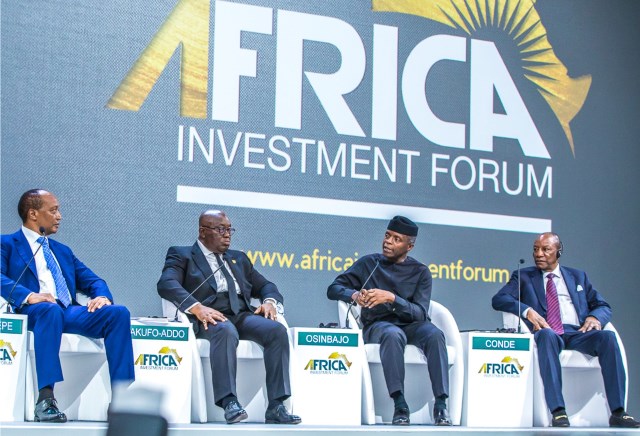
The African Development Bank (AfDB) says Nigeria and other economies of Africa is projected to grow by 4.1 per cent in 2023 and 4.3per cent in 2024.
The AfDB President, Dr Akinwumi Adesina, said this while inaugurating the African Economic Outlook (AEO) 2023 at the on-going 2023 AfDB Annual Meetings in Sharm El Sheikh.
According to him, the economies on the continent have shown remarkable resilience in spite of the multiple and dynamic shocks it faced.
“These multiple and dynamic shocks have weighed on Africa’s growth momentum, with growth in real Gross Domestic Product (GDP) estimated at 3.8per cent in 2022.
“This is down from 4.8per cent in 2021. The GDP growth in 2022 is above the global average of 3.4per cent.
“Africa has also shown remarkable resilience, evident in the projected consolidation of economic growth in the medium term.
“The outlook remains positive and stable, with a projected rebound to four per cent in 2023 and further consolidation to 4.3percent in 2024”, he said.
The AfDB boss attributed the slowed growth on the continent to the tightening global financial conditions, and supply chain disruptions exacerbated by Russia’s invasion of Ukraine, which subdued global growth.
He said growth was also impaired by the residual effects of the COVID-19 pandemic and the growing impact of climate change and extreme weather event.
Adesina said Africa had a great potential to pursue green growth and climate objectives to accelerate economic growth, given its enormous advantages.
He said the continent had some of the world’s fastest-growing economies and its real GDP growth was projected to surpass the global average in 2023 to 2024, even as headwinds persist.
He further said the continent also had an important human capital base, with its population projected to increase to 2.4billion by 2050.
“As most of the current population is young, compared with other regions’ aging population, Africa is the current and future frontier market in green growth opportunities.
“Africa hosts 25per cent of the world’s natural biodiversity and 30per cent of the world’s mineral resources, most of which will be essential for a green transition.
“Africa has a large renewable energy potential, including wind, solar, hydropower and geothermal and the world’s highest solar energy potential.
“Countries in the continent also have the greatest potential for investments in green infrastructure and technology”, Adesina explained.
The AfDB president said this was due to their low levels of development, low legacy high-emissions infrastructure, and low frequency of infrastructure and project finance default rates, estimated at 5.5per cent.
Also, the AfDB Vice President for Economic Governance and Knowledge, Prof Kelvin Urama, said the deceleration was broad-based, with 31 of the 54 African countries posting weaker growth rates in 2022 relative to 2021.
Urama said the continent, however, performed better than most world regions in 2022.
He said the continent’s resilience projected to put five of the six pre-pandemic top performing economies, Benin, Côte d’Ivoire, Ethiopia, Rwanda, and Tanzania, back in the league of the world’s 10 fastest-growing economies in 2023–24.
“Growth is projected to rebound to four per cent in 2023, and consolidate at 4.3per cent in 2024, underpinning Africa’s continued resilience to shocks.
“In spite this, climate change, elevated global inflation, and persistent fragilities in supply chains will remain on the watch-list as potential factors for possible slowdowns of growth in the continent,’’ he said.
Urama said while most African currencies weakened, others appreciated or remained stable.
According to him, countries with appreciating currencies include Angola (27.1per cent), Seychelles (15.6per cent), and Zambia (15.3per cent).
Urama said depreciation rates could ease in 2023 and 2024, but continued strengthening of the U.S. dollar would keep African currencies under pressure.
The bank’s annual meeting which began on May 22 will end today.
The theme of the 2023 Annual Meeting is “Mobilizing Private Sector Financing for Climate and Green Growth in Africa.
The meeting provides a framework for Bank Group Governors to share their experiences with galvanizing private financing domestically and internationally and harnessing natural capital to bridge the climate financing gap and promote the transition to green growth in Africa.



The Katsina State Police Command has cautioned applicants for the upcoming police constable recruitment examination to adhere strictly to laid-down procedures and avoid falling victim to fraudsters.
The Commissioner of Police, Ali Umar-Fage, issued the warning in a statement released on Sunday by the command’s spokesperson, Abubakar Sadiq-Aliyu.
He disclosed that the nationwide examination is scheduled to take place from April 28 to April 30 in Katsina State and that the exercise will be conducted at Hassan Usman Katsina Polytechnic along Dutsin-Ma Road.
According to the commissioner, only candidates who successfully passed the recently concluded physical and credential screening will be eligible to sit for the examination.
Applicants have been directed to log on to the official recruitment portal from April 24 to print their coloured examination invitation slips, which contain details of their specific date, time, and venue.
Mr Umar-Fage stated that candidates must present a valid National Identification Number (NIN) slip issued by the National Identity Management Commission (NIMC), bearing a clear photograph, alongside their printed coloured invitation slip and a writing pen at the examination centre.
He added that the approved dress code for the exercise is a white T-shirt, white shorts, and white canvas shoes.
Reiterating that the recruitment process is entirely free of charge, the police chief warned applicants to be wary of individuals or groups seeking to extort money under the guise of facilitating recruitment.

The Rivers State Traditional Rulers Council has pledged to take decisive action to curb the rising cases of gender-based violence (GBV) across the state, in partnership with ActionAid and other relevant organisations.
The commitment was made during an event organised by ActionAid in collaboration with the Rivers State Ministry of Social Welfare and Rehabilitation in Port Harcourt. The programme, titled “Convening of Traditional Rulers for GBV Prevention,” carried the theme, “From Custodians to Champions: Redefining Culture for GBV Prevention and Community Protection.”
Speaking on behalf of the council, the Okilomuibe of Engenni Kingdom, HRM King Moore MacLean Ubuo, said traditional rulers are determined to move beyond mere responses to incidents of violence by adopting proactive strategies.
“We will establish and empower community-led structures, including traditional cabinets and women leaders, to identify early warning signs of violence and intervene before harm occurs,” he said.
King Ubuo added that traditional institutions are committed to enforcing the Violence Against Persons Prohibition (VAPP) Law within their domains, stressing that the longstanding culture of silence surrounding abuse would no longer be tolerated.
“We will ensure that our subjects understand their rights and that the law is respected as the ultimate standard for justice,” he added.
Also speaking, the Rivers State Government emphasised that tackling GBV requires more than policies and enforcement, noting that a transformation in societal attitudes is essential.
Permanent Secretary of the Ministry of Social Welfare and Rehabilitation, Mrs. Lauretta Dimkpa, who was represented by the Director of Child Welfare, Mrs. Fumilayo Adebayo, highlighted the critical role of traditional rulers in shaping societal values.
“As traditional rulers, your voices command respect, your decisions influence behaviour, and your institutions are trusted platforms for conflict resolution and social guidance,” she said.
She urged them to promote cultural norms that uphold dignity, respect, and equality, while also encouraging victims to report abuse without fear of stigma.
In his remarks, the Country Director of ActionAid Nigeria, Dr. Andrew Mamedu, described the gathering as timely, noting that GBV remains a widespread violation of human rights and a major obstacle to sustainable development.
Represented by Dr. Adedeji Ademefun, he cited data showing that 31 per cent of Nigerian women aged 15 to 49 have experienced physical violence, with many cases going unreported due to fear, stigma, and cultural silence.
“National surveys indicate that nearly three in ten women have experienced physical or sexual violence, underscoring the scale and urgency of this crisis,” he said.
Earlier, the Coordinator of the Rivers State Multi-Stakeholders Action Committee, Barrister Evelyn Asimie Membere, described GBV as one of the most persistent human rights violations, cutting across age, class, and geography.
According to her, traditional rulers are uniquely positioned to influence behaviour and drive meaningful change at the grassroots level.
“In many of our communities, your voice carries more weight than any policy or legislation,” she said.
The event brought together key stakeholders committed to strengthening community-based approaches to preventing GBV and protecting vulnerable groups across Rivers State.

A socio-political group, the Tinubu Youths Vanguard Organisation (TYVO), Rivers State chapter, has called on Nigerians to support the re-election of President Bola Ahmed Tinubu in 2027, citing the need to consolidate ongoing economic and infrastructural reforms.
The State Coordinator of the group, Hon. Emmanuel Fubara, made the appeal over the weekend in Port Harcourt on the sidelines of a meeting of the Southern Traditional Rulers Council.
He said granting the Tinubu administration a second term would enable it to fully implement its transformation agenda, particularly under the Renewed Hope initiative.
“It is important that the Tinubu administration is given another opportunity to complete its economic and developmental programmes for the benefit of the country,” he stated.
Fubara disclosed that the group is preparing for its formal inauguration in the State, along with the unveiling of its local government, ward and unit structures, including student and market women wings.
According to him, the organization will be fully mobilised to promote the policies and achievements of the current administration, with a focus on issue-based campaigns aimed at restoring public confidence in the nation’s economy.
He noted that the administration has made strides in revamping the economy and executing key infrastructure projects, including the ongoing coastal road development in parts of the country.
Fubara expressed confidence that the group’s campaign strategies would resonate with Nigerians, adding that opposition voices would be effectively countered through sustained grassroots engagement.
He also urged members of the group to intensify sensitisation efforts across communities, highlighting what he described as visible results of the administration’s reforms.
On security challenges facing the country, Fubara said the situation was inherited from previous administrations but maintained that the current government is taking decisive steps to address it.
He expressed optimism that ongoing efforts, including international collaborations, would significantly curb insecurity in the near future.
When asked whether the group would also campaign for Rivers State Governor, Sir Siminalayi Fubara, the TYVO coordinator said the organisation would take a position at the appropriate time, noting that directives from the All Progressives Congress (APC) would guide its activities.
-

 Sports1 day ago
Financial Issues Stall Chelle’s Eagles Contract Talks
-

 Sports1 day ago
NFF mourns ex-Eagles striker Eneramo
-

 Maritime1 day ago
CILT Nigeria Seeks Anti- graft Agency Collaboration
-
Sports1 day ago
Four Private Clubs Gain Promotion To NPFL
-

 Sports1 day ago
Tennis Event Boosts Grassroots Development Push
-

 Sports1 day ago
W/Cup Qualifier: Flamingos In Impressive Opener
-

 Sports1 day ago
European Giants Circle For Osimhen
-

 Sports1 day ago
Chelle Confirms Financial Issues in Eagles Contract Discussion