
Featured
Wike, Ortom, Ikpeazu, Ugwuanyi Storm Ibadan For Makinde

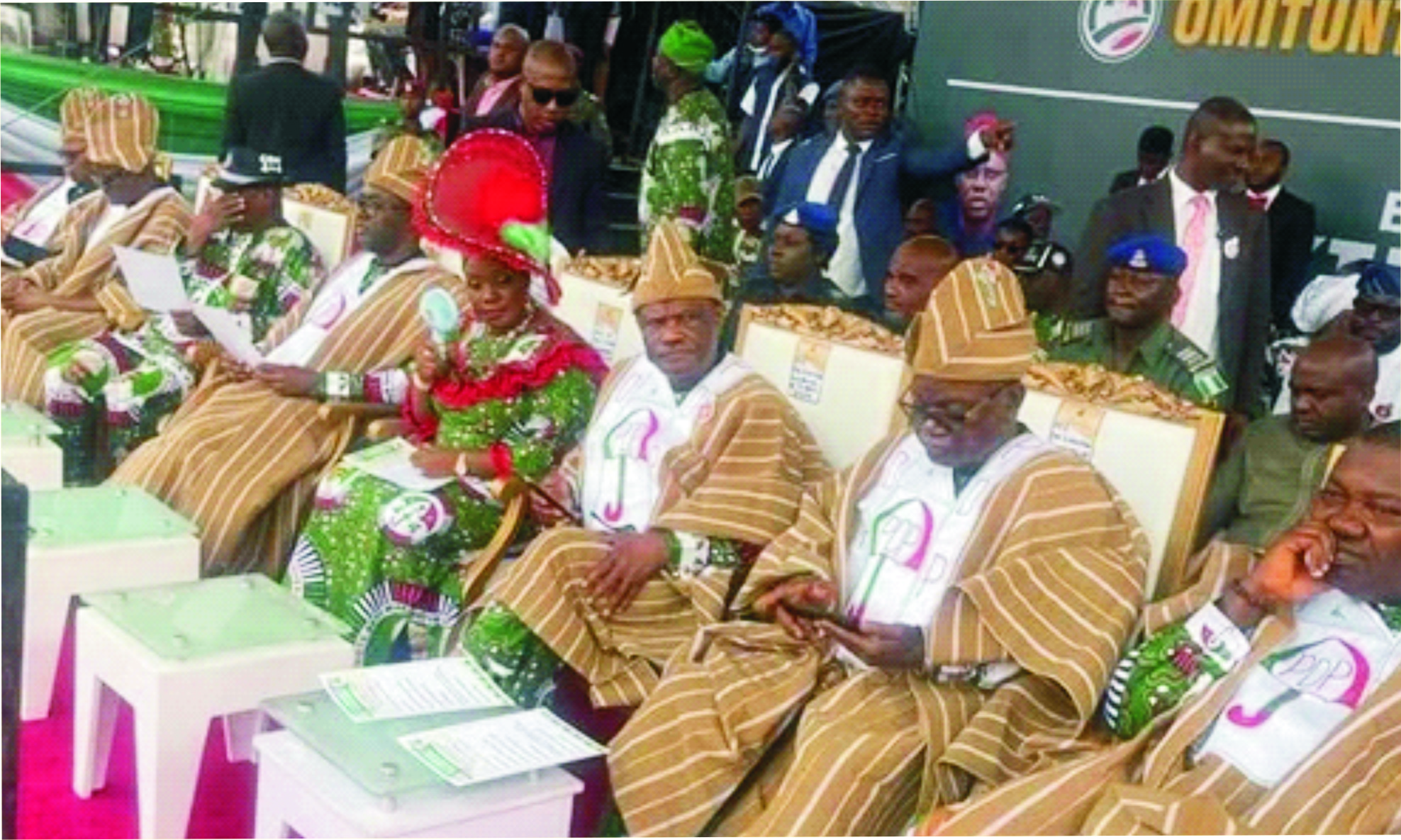
Rivers State Governor, Chief Nyesom Wike, yesterday, led the G5 Governors to storm Ibadan, Oyo State capital for the flag-off of re-election campaign of Governor Seyi Makinde.
Other G5 governors at the event held at the Mapo Hall, Ibadan, were: Abia State Governor, Dr Okezie Ikpeazu; Benue State, Samuel Ortom and Enugu State, Hon Ifeanyi Ugwuanyi.
The G5 governors came to the venue around 1.00am to show solidarity for Makinde’s re-election.
Also at the event were former Governor of Ekiti State, Ayodele Fayose; and former Governor of Ondo State, Dr. Olusegun Mimiko.
Also present were party faithful from 33 local governments of the state.
As the governors arrived, party loyalists from all the 33 local government areas of the state, thronged the major roads leading to Mapo Hall.
The major roads leading to Mapo Hall were jam-packed with party loyalists from all the 33 local government areas of state, while the security operatives made serious efforts to control the crowd.
Speaking against the expectation that the G5 governors under the aegis of the Integrity Group, are likely to announce their choice of presidential candidate in Ibadan in the forthcoming general election, the Rivers State Governor, Chief Nyesom Wike, disclosed that members of the Peoples Democratic Party (PDP) in Oyo State will be told who to vote for in the presidential election soon.
Wike urged people of the state to cast their votes for all contestants vying for various seats in the 2023 general election on the platform of the party.
He described Makinde as a person who believes in fairness, equity and justice and has done well to deserve a second term in office.
Wike said: “Governor ‘Seyi Makinde has done well, the only way is for him to go back to complete the good work he has started.”
“Vote for Governor ‘Seyi Makinde, vote for all the candidates on the platform of the party, but the other one, Seyi Makinde will tell you.”
“We believe in justice, fairness, honesty and equity, hence our reason for urging you to support the just governor God has given you in Oyo State. Makinde has done well since 2019 and the only way we appreciate him is to return him to government to enable him complete the good works he had started.”
In a similar vein, other members of the G5, in their separate remarks at the programme, thanked members of the party for their unflinching support for Makinde, describing him as a vibrant leader who has what it takes to move the state to enviable heights.
In his remark, Abia State Governor, Dr. Okezie Ikpeazu, described Makinde as the youth leader of the G5, saying what the people of the state will see in the next four years will be greater than what the governor has done in his first four years.
Speaking at the flag – off of the PDP Gubernatorial campaign in Ibadan on Thursday, the Oyo State capital, leader of the G-5 , Governor Samuel Ortom of Benue State said the group is more than ever united and would deliver all PDP candidates for governor, Senate, House of Representatives and Assembly in their various states.
He reiterated the genesis of their course which is premised on breach of the party constitution after the party National convention in May 2022.
“We want to assure you that the integrity group and the G-5 governors are committed members of PDP in our various states.
“We have a challenge with the national leadership of our party because they have failed to deploy its internal conflict resolution mechanism to resolve the problem that arose after the convention. At the appropriate time, we are going to let you know where and what to do. We are united, we are together, don’t listen to gossip and social media hypes. We are committed to PDP and we are working for all our candidates in our states.
“All our candidates in our states by the grace of God, they are going to win the governorship, the Senate, House of Reps, the House of Assembly. We are going to deliver to PDP”.
Making his remarks at the presentation of flags to candidates of the party, the Deputy National Chairman of the PDP, Mr Taofeek Arapaja said Makinde’s performance was the reason behind the solidarity, and clarion call for his re- election by the people of Oyo State.
While speaking, Governor ‘Seyi Makinde, urged people of the state to vote him for a second term to enable him complete the good projects he had started since 2019.
According to him, since his assumption of office in 2019, his administration has continued to deliver dividends of democracy to the people both in health, education, agriculture, security and in infrastructural development.
He said: “Under Omotitun 1.0, we promised Emmanuel Alayande University and we delivered, we secured full ownership of Ladoke Akintola University of Technology, (LAUTECH) Ogbomoso, we carried out rehabilitation and reconstruction of roads across the state, we have delivered but we are not stopping.
“Under Omotitun 1.0, we improved the standard of education, health, security through the introduction of Amotekun, as well as agricultural development and many others. Workers salaries and pension arrears are being paid as and when due, and many others.”
“Now, it is time for Omotitun 2.0 to upgrade. I am, therefore, seeking your support for my re-election to enable me complete the good projects I started in 2019,” Makinde pleaded with people of the state.
He then expressed appreciation to the people and party faithful for entrusting the destiny of the state under his care, assuring that more developmental projects and programmes will be witnessed in the state.
Makinde, who boasted of jerking up the state’s Internally Generated Revenue of the state from about N1.7billion to N3.8billion as of November ending, 2022, among other achievements, promised to do more for the people of the state.
The venue of the event was filled with a lot of dignitaries which include, wife of the governor, Mrs Tamunomnini Makinde; the Deputy Governor, Bayo Lawal; PDP South-West Deputy National Chairman, Amb. Taofeek Arapaja; former Ekiti State Governor, Mr. Ayodele Fayose; former Ondo State Governor, Olusegun Mimiko; the party’s senatorial candidate for Oyo South, Mogaji Joseph Tegbe; Sen. Stanley Odidiomo, Abass Agboworin, Chief Jumoke-Akinjide, Sen. Monsurat Sunmonu, PDP state executives, other PDP candidates and members of the party from within and outside the state.
The flag-off witnessed the heavy presence of personnel of the Nigeria Police, the Nigeria Security and Civil Defense Corp, NSCDC, Department of Security Service, DSS, Amotekun Corps and Operation Burst.



Governor of Rivers State, Sir Siminalayi Fubara, has reaffirmed the unwavering commitment of his administration to peace, unity, security, and inclusive development as Rivers State marked its 59th anniversary, last Wednesday.
In a goodwill message issued on Wednesday to commemorate the anniversary, Governor Fubara stated that despite the challenges faced over the years, the people of Rivers State have continued to demonstrate resilience, strength, and an enduring spirit of unity that has sustained the state since its creation.
The Governor noted that the strong bond of brotherhood among the various ethnic nationalities of the state, including the Ijaw, Ikwerre, Ogoni, Etche, Ekpeye, Andoni, Kalabari, and others, remains one of Rivers State’s greatest strengths and a critical foundation for peace, stability, and progress.
He further observed that Rivers State has remained a major driver of Nigeria’s economy for decades, not only because of its abundant oil and gas resources, but also because of the exceptional contributions of its people across diverse sectors including academia, jurisprudence, business, entertainment, public service, and sports.
Governor Fubara assured the people that his administration will continue to prioritize policies and programmes that promote peace, protect lives and property, and expand development across all parts of the state. He emphasized that governance must be people centered and impactful, with equal attention given to every Local Government Area of the state.
The Governor also paid tribute to the elders and founding leaders of the state for preserving the spirit of unity and coexistence over the years, while urging the youths to remain hopeful, responsible, and actively committed to building a greater Rivers State through innovation, hard work, and patriotism.
He equally acknowledged the invaluable role of women in strengthening families, communities, and society, describing them as indispensable partners in the continued growth and stability of the state.
Governor Fubara called on all Rivers people to use the occasion of the anniversary as a moment of reflection and renewed commitment to peaceful coexistence, mutual respect, dialogue, and collective progress, stressing that the unity and future of Rivers State must always rise above personal interests and political differences.
Rivers State was created on May 27, 1967, by General Yakubu Gowon.


The Rivers State Government has distributed science equipment and materials to all senior secondary schools across the state to support students during the ongoing West African Examinations Council exams and to strengthen practical learning.
Flagging off the distribution at the Rivers State Senior Secondary Schools Board premises in Port Harcourt, on Monday, the State Commissioner for Education, Dr. Peters Nwagor, said the move demonstrates Governor Siminalayi Fubara’s commitment to improving education standards in the State.
Nwagor said the materials were approved and provided by the state government specifically to boost the teaching and learning of science subjects, describing science education as the foundation for technological advancement, innovation, and national development.
“No society can compete globally without deliberate investment in science and technology,” the Commissioner stated.
He commended the governor for consistently prioritising the education sector by providing tools needed for effective teaching and hands-on learning.
The Commissioner directed principals to ensure that the equipment are used strictly for practical lessons in their schools, warning that any principal or administrator found diverting, hoarding, or selling the materials wil face disciplinary action under public service regulations.
Nwagor also warned against examination malpractice, saying any principal found aiding or encouraging malpractices will be decisively sanctioned.
“We must collectively restore the dignity and credibility of our educational system,” he said.
Also speaking, Chairman, Rivers State Senior Secondary Schools Board, Tony Egwurugwu, urged school heads to make judicious use of the materials for students’ benefit.
He thanked the State Government for providing the resources, and assured that monitoring mechanisms would be put in place to ensure the materials serve their intended purpose.
In his own remarks, a Board Member for Technical Education, Nwisabari Bani Samuel, expressed appreciation to the governor for prioritising education and acknowledged the Commissioner’s role in advancing education development in the State.
He said the distribution covers all senior secondary schools in the State and is intended to improve students’ performance in both internal and external science examinations.
Akujobi Amadi
-
News4 days ago
Obuah’s Victory Excites Former Lawmaker as APC Primaries Conclude in Rivers West
-
News4 days ago
105 Nigerians Killed In S/Africa In Seven Years
-

 Niger Delta4 days ago
Royal Father Endorses PH Arsenal Community, Pledges To Support
-

 Sports4 days ago
Khana, Akpajo All-Stars Set For Friendly Match ” Morrow”
-
Business4 days ago
Dangote Refinery Ending Nigeria’s Dependence on Imported Fuel – EIU
-
Sports4 days ago
PH To Host 2026 NWFL Super Six
-
Business4 days ago
Commercial Aviation: Bayelsa Begins Operations As Pioneer Airline Launches Maiden Flight
-
Sports4 days ago
FG Approves Nationwide Stadium Overhaul