
Business
Ondo Earmarks N3.2bn For Security

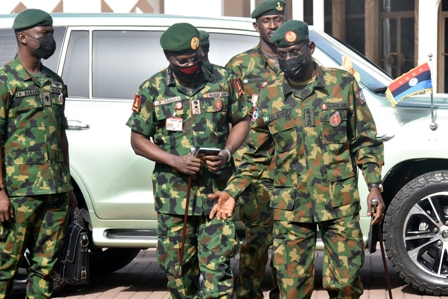
The Ondo State Government said it would be spending N3.2 billion on security this year.
The State Commissioner for Economic Planning and Budget, Mr Emmanuel Igbasan, said the sum of N2 billion was earmarked to provide security hardware for the Ondo State Security Network Agency also known as Amotekun.
Egbadan disclosed this while presenting the 2023 budget analysis to journalists in Akure, the state capital,
Governor of the state, Mr Rotimi Akeredolu, on December 5, 2022, presented a total budget proposal of N272.73 billion to the State House of Assembly but the lawmakers passed N275. 98 billion, which he signed into law in December.
The commissioner said, “Provision of security hardware for Amotekun, N2 billion; procurement of security vehicles, N500 million; provision of security equipment/infrastructure, N700 million and purchase of 10 motorcycles for bailiff and security personnel and other courts’ staff, N5 million”.
He explained that the budget was prepared on the basis of inputs garnered during the town hall meetings in nine federal constituencies.
According to Igbasan, the stakeholders consulted before the budget was prepared to include farmers, women groups, youth groups, artisan unions, professional bodies, persons with disabilities, organised private sectors, among others.
He said, “Ondo State recently ranked the least in multi-dimensional poverty index in the country in a survey conducted by the National Bureau of Statistics in conjunction with UNICEF and others.
“This feat is occasioned by people-oriented programmes embarked upon by this administration which paid due attention to economic drivers and enablers during the year.
“There is the need to deepen the economic impact of various programmes which earn the state this recognition. The next step will be to ensure that more people are enlisted in the production loop and taken out of poverty.
“Mr Governor has, therefore, approved that programmes that will affect the majority of our people be prioritised in the year. Hence, the budget is titled a ‘Budget of shred prosperity’.”


Nkpemenyie Mcdominic
Reports say that the training is designed to equip youths with practical technical skills for employment in the oil and gas and construction sectors, with emphasis on employability, safety, competence and self reliance.
In attendance at the flag-off ceremony this week, at the Petroleum Training Institute (PTI) Conference Hall, Effurun, were stakeholders, dignitaries, and political representatives, among others.
Dafinone, represented by his Chief of Staff, Adelabu Bodjor, said the initiative reflects a deliberate political investment in human capital development across Delta Central.
He explained that the training focuses on rigging and scaffolding, noting that “both are essential technical competencies required in industrial operations, construction projects, and oil and gas installations”.
Bodjor added, “The programme is intended to reduce dependency among youths by providing job-ready skills capable of supporting long-term economic opportunities and self-sufficiency. The initiative aligns with Senator Dafinone’s broader development agenda, which prioritises practical skill acquisition as a pathway to sustainable empowerment.”
Also addressing the participants, the NCDMB, Felix Omatsola Ogbe, represented by Mr. Teddy Bai, commended Dafinone for sponsoring the programme, describing it as “a timely response to critical manpower gaps in the industry”.
Bai explained that rigging and scaffolding remain safety-sensitive skills required across fabrication yards, offshore platforms, and construction sites, stressing that the programme bridges the gap between certification and practical competence.
He also charged the training consultant, OROH Contractors Limited, to maintain strict standards of professionalism, safety, and discipline, while urging participants to remain committed, focused, and disciplined throughout the exercise.
The Senate Liaison Officer for Sapele Local Government Area, Chief Patrick Akamuvba, , described the programme as a major step in strengthening human capital development in Delta Central.
Akamuvba said scaffolding and rigging skills are in high demand across residential, commercial, and industrial construction projects, noting that the training offers real employment opportunities for beneficiaries
He urged participants to prioritise knowledge and certification over short-term material expectations, stressing that discipline and seriousness would determine their long-term success.
He also cautioned youths against social vices and distractions, advising them to remain focused to maximise the opportunities provided by the programme.
-
News1 day ago
Obuah’s Victory Excites Former Lawmaker as APC Primaries Conclude in Rivers West
-

 Politics3 days ago
APC PRIMARIES: FUBARA’S WITHDRAWAL, HISTORIC SACRIFICE FOR NATIONAL STABILITY ……. GROUP
-

 News4 days ago
Court Sentences Seven To Death Over Murder Of Cleric In Rivers
-
News2 days ago
105 Nigerians Killed In S/Africa In Seven Years
-

 Sports3 days ago
PH Arsenal Community Set For Streets Procession, Saturday
-

 Politics3 days ago
IPAC Flays INEC Over Election Guidelines Judgement
-

 Politics3 days ago
NDC To Adopt Electronic Voting For Future Primaries
-

 Niger Delta1 day ago
Royal Father Endorses PH Arsenal Community, Pledges To Support