
Featured
RSG Clears Air On Arrest Of Caverton Pilots …Accuses FG Of Politicising Efforts To Prevent COVID-19 Spread …As Nsirim Affirms Wike’s Commitment To Care Of Underprivileged

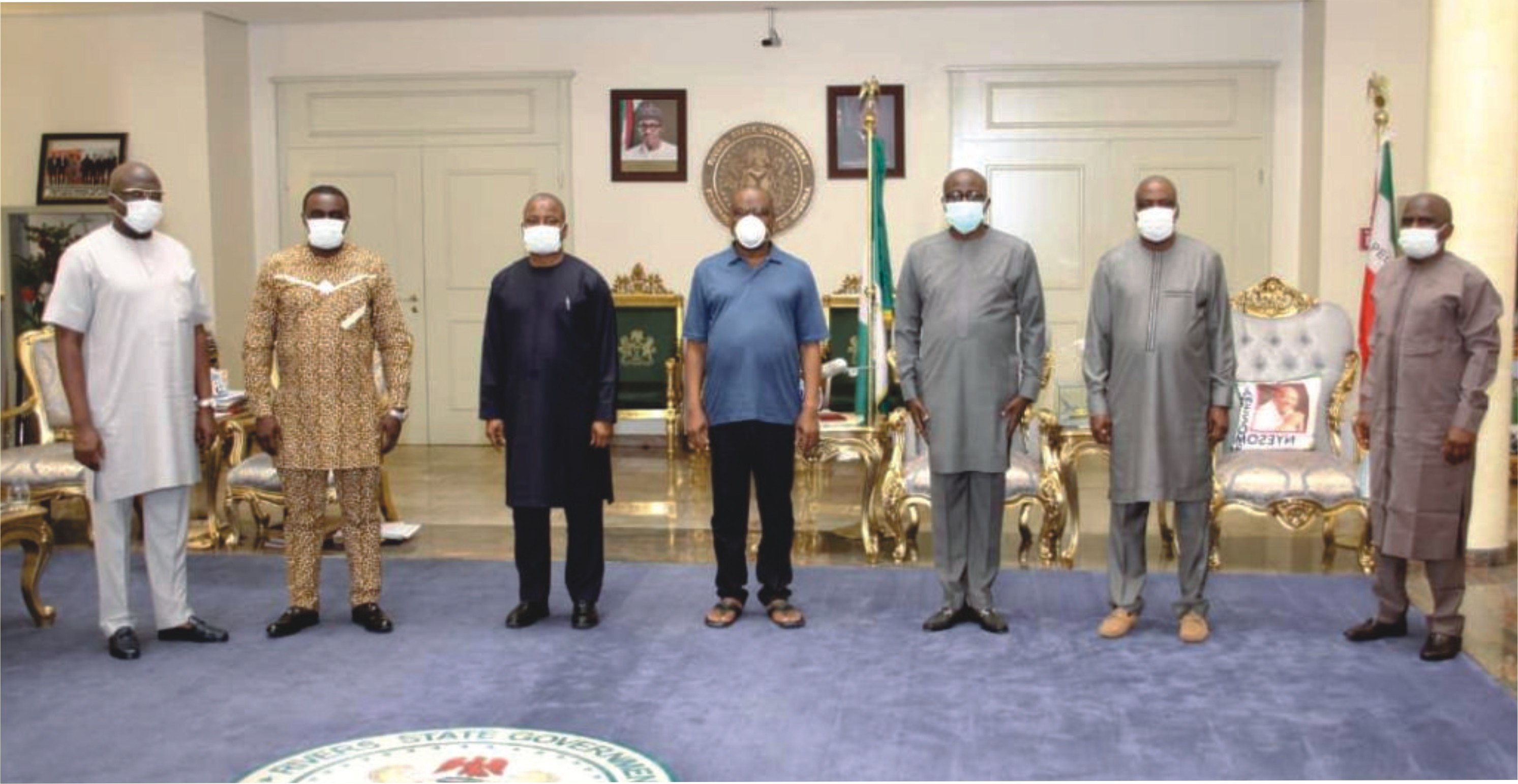
The Rivers State Government has stated that the story being carried in some media that the two pilots and 10 passengers of Caverton Helicopters who were arrested by the state government because they acted to the directives of the Ministry of Aviation, is misleading.
Stating this in a press briefing, last Saturday, the state Commissioner for Information and Communications, Pastor Paulinus Nsirim, said that on the contrarily, the arrest was made because the pilots repeatedly disobeyed the Executive Order of the governor to the effect that everyone coming into the state must present themselves for health checks to determine their Coronavirus status.
According to Nsirim, “Contrary to the view being peddled by the Minister of Aviation, Senator Hadi Sirika, the two pilots of Caverton Helicopters and their 10 passengers were not arrested because they operated a permit granted them by the Ministry of Aviation.
“They were arrested because they constantly contravened the Executive Order issued by the Governor of Rivers State, Chief Nyesom Wike, which requires that everyone coming into the state for essential duties subject themselves to mandatory health checks to ascertain their Coronavirus status”.
He stated that before their arrests, the Rivers State Government had issued several warnings to Caverton and other operators to ensure that their pilots and passengers are tested by Rivers State Health Authorities, but that Caverton Helicopters had disregarded the warnings.
“At the last count, Caverton Helicopters ferried over 220 passengers into the state without allowing health professionals of the Rivers State Government ascertain their Coronavirus status. They also refused to avail the state government their contacts, so they can be traced and tested”, he said.
While stating that the state government was more committed to the protection of the lives of over six million Rivers people, rather than issue landing permits to airlines, or contending for the control of the airspace, Nsirim said, “The issue on ground has nothing to do with the Exclusive List.
“The focus of the Rivers State Government is to ensure that nobody under the guise of transporting workers on essential services, ferry in persons who will compromise our health system. Therefore, these pilots and passengers must be subjected to health checks before they carry out their responsibilities. That is standard practice”.
It is for the same reason, Nsirim noted, that the Federal Government has isolated Chinese doctors they invited into the country to assist in the fight against the Coronavirus.
“The Federal Government, as we speak, has quarantined Chinese doctors who are in the country on invitation of the operators of the Exclusive List. These Chinese doctors will be isolated for 14 days as a precaution before they mix with Nigerians. If the Federal Government has done that in Abuja for Chinese officials that they invited, why do they insist that persons coming into Rivers State must enter the state without health checks?”, Nsirim asked.
He noted that, given the foregoing, the aviation minister’s claim that the arrest was effected because Caverton Helicopters’ operations were based on permit granted them by the Ministry of Aviation amounts to an “indecent and reckless politicisation of the fight to check the spread of Coronavirus by agents of the Federal Government, especially as it relates to Rivers State”.
The information boss added that, “From all indications, it is clear that there is a plot to compromise the health of Rivers people. Otherwise, what is the motive for the grandstanding and the sponsorship of false editorials to mislead Nigerians by agents of the Federal Government?
“The Rivers State Government urges the Federal Government to direct all their business associates to subject themselves to health checks to ascertain their Coronavirus status. On this premise, the Rivers State Government is not prepared to compromise.
“The safety of Rivers people is beyond any other consideration. No amount of yellow journalism will diminish the leading role Governor Nyesom Wike has provided the entire country since the outbreak of Coronavirus.
“Governor Wike, through the various prevention strategies he had initiated, has demonstrated to the entire world that he is prepared for leadership. The truth is that it is in time of crisis like the whole world is facing now, that you know genuine leaders.
“The Rivers State Government respects the rule of law and has acted within the ambit of the law,” he added.
Meanwhile, as the lockdown on markets alongside the stay-at-home order by the Rivers State Government continues, the Commissioner for Information and Communications, Pastor Paulinus Nsirim, has assured that the underprivileged people living and doing business in the state would be catered for.
Making this known, last Saturday, during the distribution of food items to the people of Ward 18, Nkpolu-Oroworukwu in Port Harcourt City Local Government Area, as part of palliative measures by the state government, the commissioner stated that it was part of the governor’s commitment towards alleviating the suffering of the downtrodden in the state.
“The governor of Rivers State said that he has seen the hardships the people of Rivers State are facing, because of COVID-19, and as a man, who has sworn an oath to protect lives and properties of Rivers people; he would do all within his powers to ensure that nobody suffers from hunger in this period. This is what a visionary leader would do”, he said.
It is in pursuant to this stance, Nsirim explained that the governor has taken various steps in not only checking Coronavirus infection in the state since it came to the fore in Nigeria, and food items are made available to the downtrodden.
“You will recall that since this Coronavirus broke out in Nigeria, the Governor, Chief Nyesom Wike, has played a leading role in showing leadership in terms of strategies for prevention and other things. Right now, he is also showing leadership in terms of catering for the downtrodden and less privileged in the state”, the commissioner stated.
He noted further that for this purpose, the governor had set aside the sum of N2billion to ensure that “no matter where you are in Rivers State, as long as you live and do business in Rivers State, you’ll not die of hunger. There’s a committee that he (governor) has set up again to purchase all the foodstuffs that are produced in Rivers State: yam, garri, plantain, fish, etc. All those things that are edible that Rivers people like to eat, that committee is going round now in all the LGAs in Rivers State to buy them”.
While expressing appreciation over the leadership style of the governor, Nsirim also noted that Rivers people in Diaspora, in countries such as the United States and United Kingdom, have at various times, expressed the same appreciation since news of COVID-19 broke out in Nigeria.
Receiving the food items on behalf of the ward, a religious leader, Prophet Michael Ichemati, expressed gratitude to the governor, and promised that they would ensure the food items get to the needy in the ward.
Ichemati said: “I want to use this opportunity given to me to express our gratitude to our governor, who has been so much forthcoming to reach out to the people. We want to also thank the committee for their time, and, having seen what they have presented to the ward, we want to say God will reward you all.
“We’re promising that what you have given to us today will get to those that need it most. We sincerely appreciate what you people have given to us. God bless you”, he added.
In his response, the state Commissioner for Transport, Sunny Ejeku, who is a member of the ward, said “This is my community, this is my ward, and I know the impact of what HE has done will create in the lives of the people here. When you give a man food, you’re preserving his life. The COVID-19 pandemic has come with all other side effects, most of which have to do with complaint of hunger. Social distancing has to be maintained.
“Thank God that His Excellency has the drive and the leadership style, which he has employed to save the lives of Rivers people”.
On his part, the traditional head of the ward, Eze Omunakwe Innocent Ejekwuaka, also thanked the governor for the food items, praying that God should grant him more ideas to cater for the needy.
Also present at the presentation were the Councillor of the ward, Henry Ichemati, and the Women Leader of Oro-Obaziolu Community, Madam Mercy Orlu.










Rivers State, Sir Siminalayi Fubara, has assured members of the National Youth Service Corps (NYSC) of his administration’s commitment to supporting and strengthening the scheme in the State.
Fubara gave the assurance last Friday at the NYSC permanent orientation camp, Nonwa-Gbam, Tai Local Government Area in the State, during the swearing-in ceremony of 2026 Batch B Stream II orientation course.
Represented by the Permanent Secretary, Cabinet Bureau, Office of the Secretary to the State Government, Dr. Promise Oguzie, the governor said the State Government would remain intentional in providing the necessary support to improve the NYSC scheme and enhance the experiences of corps members deployed to the state.
He charged the corps members to be role models and quality nation-builders in their service to the good people of Rivers State in particular, and Nigeria at large.
“I charge you to be exemplary, dedicated and committed in all you do. Take full advantage of all the camp programmes and activities to enrich yourselves”, he said.
In his welcome address, the State Coordinator of NYSC in Rivers State, Mr. Moses Oleghe, urged corps members to see their deployment to Rivers State as a “veritable opportunity to make meaningful contribution to the growth of the State in particular and Nigeria at large.”
He further charged them to serve with all sense of “integrity, discipline, and the fear of God, especially when they will be engaged as INEC ad-hoc staff that will conduct the 2027 general elections.”
A total of 3,584 corps members composed of 1,421 males and 2,163 females were sworn in by the Chief Judge of Rivers State, who was represented by Justice Godspower Aguma.

Governor of Rivers State, Sir Siminalayi Fubara, says Nigeria needs God-fearing leaders for the nation to move in the right direction and make meaningful progress.
The Governor stated this yesterday when he received in audience, the World President of the Seventh Day Adventist Church, Pastor Erton Kohler; his wife, Andriene Marques Kohler; daughter Mariana Marques Kohler and a retinue of ministers of the church at Government House, Port Harcourt.
Fubara who hailed the Seventh Day Adventist Church for its contributions to education and the grooming of future leaders in Nigeria, expressed delight that the Church had over the years, been investing in education at various levels and currently runs two universities in the country.
He commended the church for not only using its institutions to spread the gospel of Christianity but to groom future leaders for the country.
According to him, religion should not be just about defending one’s faith, but also making meaningful impact on the lives of the people.
He said that by floating these educational institutions, the church has demonstrated capacity to support Nigeria in the task of producing not only educated people but a breed of God-fearing leaders.
“Our country is where it is today because we lack the fear of God. If you have the fear of God, there should be a limit to what you can do because you understand the supremacy of God. But when God is not in your equation, you’ll go beyond the line and that is what has brought us to where we are today.
“So, I feel very happy that you are contributing to the development of our future leaders in this country. We need the right people being in the right place; prepared properly with good minds; that is what we need, not just in Nigeria but round the whole world.,” he said.
Governor Fubara further observed that the absence of God-fearing people in high places to take the right decisions that could impact positively on the society, has also given rise to other problems such as social inequality, poverty, corruption and criminality. According to him, Nigeria needs a system where the average parent could afford quality education for their children and a guarantee that upon graduation, the average child will have the capacity to compete favourably with anybody, anywhere in the world.
“If we have a situation where the little money that you’re being paid as wage can also afford you quality healthcare and after working at least for 15-20 years, you have a roof over your head, tell me why you should be involved in any kind of crime? At that point, you’ll feel secured and this attitude of insecurity about the future that leads to all the social vices we have today won’t be there,” he said.
Governor Fubara expressed appreciation to the delegation for the visit and for their prayers for Rivers State, assuring them of his continued support for their programmes in the state.
Leader of the delegation and World President of the Seventh Day Adventist Church, Pastor Erton Kohler said he was in Nigeria for a special conference of the church during which thousands of the church’s ministers will be undergoing an empowerment programme to further equip them for the task of herding their flocks and serving the society.
He expressed gratitude to the Governor for the warm reception accorded his entourage, saying the memory of the visit will linger in his mind for a lifetime.
Kohler disclosed that the Church has over twenty -four million (24,000,000) members and more than 182,000 places of worship, spread across 212 countries of the world.

The Rivers State House of Assembly has approved the 2026–2028 Medium Term Expenditure Framework (MTEF) submitted by Governor Siminalayi Fubara.
This reaffirms the lawmakers’ commitment to enacting laws and taking legislative actions geared towards the overall development of the State.
The Assembly gave the approval during its Second Legislative Sitting of the Fourth Session held last Friday.
Speaking on the MTEF document during plenary, the House Speaker, Rt. Hon. Martin Amaewhule, noted that by the provision of Section 10(1)(b) of the Rivers State Fiscal Responsibility Law No. 8 of 2010, the MTEF ought to have been laid before the House in September 2025.
Amaewhule explained that traditionally, the document is expected to be presented four months before the commencement of the next financial year and immediately after the expiration of every three-year fiscal cycle.
He, however, stated that in the interest of the State and its people, the House considered it necessary to deliberate on the document, describing it as a precursor to the 2026 Budget Estimates.
The Speaker expressed concern that the year had already progressed significantly before the presentation of the framework.
During deliberations on the document, members examined the assumptions and projections contained in the MTEF and observed that strict adherence to the outlined fiscal parameters would ultimately serve the interest of Rivers people.
The lawmakers maintained that effective implementation of the framework would promote prudent financial management and enhance developmental planning across the State.
Following the debate and positive consideration by members, the Speaker put the question to the House and members voted overwhelmingly in support of the approval of the MTEF.
Meanwhile, during the same sitting last Friday, the House also received a petition from the Chairman of Obio/Akpor Local Government Council, Dr. Gift Worlu.
The petition was presented by the member representing Obio/Akpor Constituency II, Hon. Emilia Amadi.
According to the petition, concerns were raised over an imminent security breach, threats to lives, destruction of property and alleged forceful takeover of property by some lawless persons within parts of the Local Government Area.
Presenting the petition before the House, Hon. Amadi appealed to the lawmakers to revisit the matter and take necessary steps aimed at safeguarding lives and property in the affected communities.
The House is expected to further deliberate on the petition and consider measures to address the concerns raised in order to sustain peace and security in the area.
King Onunwor
-
 Editorial4 days ago
That Oshiomhole’s Call On FG’s Road Projects
-
Education4 days ago
Environmental Education Remains Critical Tool To Address Environmental Challenges Says Experts
-

 City Crime4 days ago
Tinubu Appoints Ex-Tide Staff Registrar Of Chartered Chemists
-
Education4 days ago
UNIPORT VC Receives Probe Report on Student Union Crisis
-

 Sports4 days ago
Rivers-born Chess Player Clinches Third Position At World Amateur Rapid Chess Championship
-
News4 days ago
RIFF 2026: RIFF Takes Film Tourism To Bonny Island
-
Oil & Energy4 days ago
NCDMB, BOI Unveil $100m Nigerian Content Equity Fund …Set To Invest $5m In Oil Firms
-
Business4 days ago
PTDF Committed To Tinubu’s Development Plan – CEO