
Sports
Nigerian Heroes Of The Winter Olympics

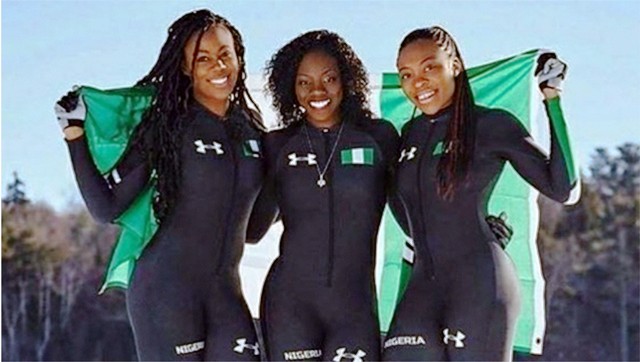
For a few weeks, before and during the 2018 Winter Olympics, Nigeria was a hot subject in the global media.
The reason was the audacious decision of four Nigerian female athletes based in the United States of America to take up an unusual sport, bobsleigh and skeleton, and to become the first set of Africans to participate in the Olympics-on-ice since it started in 1924
The Games were a true feast of super human feats and skills on ice, although Nigeria returned home without a medal of any colour, the country’s participation was one of the most inspiring stories of the games.
Even as the various teams in their national dresses and colours walked onto the tracks of the magnificent Pyeongyang Olympic Stadium during the opening ceremony, the thunderous applause that welcomed the all-black and beautiful, green and white clad Nigerian girls that punctuated the monotony of white faces was a spontaneous reaction to an unfolding historical drama.
After the games the girls reminded the world of the real essence of the Olympic Movement through their conduct and spirit. They did not win any medals. They did not even come near winning one. Yet, with sheer grit and exuberant celebrations when they improved their personal best times even without winning, they taught the world how to celebrate the personal victories, and that ‘at the Olympics you do not have to come first to win’.
The Nigerian girls became some of the most celebrated, most publicised and most followed athletes at the Games, without mounting the medal rostrum.
The reception back home is shockingly different since after the games. And the girls are back in Nigeria.
One would have expected that the sports authorities will ride on the back of the momentum generated by the rest of the world during the games, to make further capital at home by welcoming them to Nigeria like the heroes they really are.
This would also help to shore up the confidence and spirit of new athletes preparing to go for a new ‘war’ at the Commonwealth Games in the Gold Coast in Australia to which Nigeria is preparing to send athletes in April.
Unfortunately, I have not read any reports that the country has shown as much love and appreciation for the girls as the rest of the world did.
I am not certain if anything, even a small reception, is being planned for these heroes.
I hate to think that the girls with their unprecedented and historic participation at the Games, one that brought positive global attention to the country, will now be left to wander into the wilderness of their own narrow interests.
As the country prepares for Australia, the atmosphere is fouled with pungent smell of poorly motivated athletes, poor camping conditions and even ‘disappearing’ athletes.
It is being reported that one of the country’s bright stars and hopes for a medal, the national men’s 400 metres champion, may have ‘decamped’ to another country because of the poor treatment meted to the team during the preparations.
The only sport that may have the athletes to compete and win medals during the Games is wrestling. The influence of a former Olympian, and Olympic Gold medalist himself, the current president of the Nigeria Wrestling Federation, has a lot to play in the expected haul of some medals in the sport.
The prospects for more medals in other sports are anchored to prayers and miracles.
Meanwhile, let me take a moment to salute Chief Solomon Ogba for his vision, and Honourable Gbenga Elegbeleye for supporting him for creating the fairy tale of the Winter Olympics.
The Eagles of the future!
I have never done this before. I also feel reluctant to do so now. But when certain things fall into place like a jigsaw puzzle, totally unplanned and unexpectedly, and point you in a direction that may have hidden blessings, you take a chance, as I am doing right now, and do it.
A week ago, I read about Nigeria beginning the campaign for the 2019 World Youth Championship for the under-20s, in short, the next generation of Super Eagles after the 2018 World Cup!
I am very interested to have a ring side opportunity to see some exceptional talents and add my voice to the assembling process.
There is a young man called Tolu Arogundade.
He graduated from SOCA, the Segun Odegbami International College and Sports Academy in 2016.
In the 10 years of running the academy, the school prides itself with assisting graduating students to colleges and universities in America to complete their education. The goal has always been to complete and pocket at least a first degree, whilst playing and enjoying a full academic scholarship. Thereafter, the players can move to Europe and even remain in the USA to pursue their passion, a professional football career when they are still only 21 or 22 years of age.
That would give them a good 12 to 15 years of time to play football full time at the highest levels.
That’s the plan we sell to parents and have always followed, until Tolu came along.
Tolu Arogundade, an extremely academically brilliant student and an exceptional football player, decided he wanted to pursue a football career first and straight from school.
In 2017, he was invited on merit to the national Under-17 team. It was a confirmation of how good he is, apart from reinforcing his confidence and determination that he can make it to the professional ranks in football. This past week he has taken another giant step. He has been snatched by a German first division club, Tolu just signed a contract with SC Freiburg, in the German Bundesliga.
The second player in my radar is also 19. He has also just signed and plays for the time being, in the reserves of Club Atletico Banfield, Buenos Aires, in the Primero national league, in Argentina.
I know of only two Nigerians that have ever played in the Brazilian Premier league – Benjamin Ezeakor and Richard Owuobokiri.
To play in the premier division of a South American league can never be easy for an African player, because of the depth and number of exceptionally talented players in that environment. So, when I learnt that a Nigerian youngster had just signed for a premiership Club in Argentina, and is already playing in the reserves at age 19, all my sensors went into alert.
That’s how Feyiseitan Asagidigbi came into my radar.
I learnt had Feyi actually played for Nigeria at under-15 in 2014. He may probably be the first professional player from Nigeria to play in Argentina. Anyone that can achieve such a feat deserves some attention.
Then, there is this third player. He is also 19 and a true journeyman.
He is of Nigerian parentage but may have been born in Canada because the Canadians are dying to have him play for the national team. He was briefly in the under-20 squad last year but ‘ran’ back to Europe to pursue a more lucrative professional career.
Early last year, he played for Crystal Palace FC under-18 team in England. He has now relocated to France where he has signed to play in the national under-19 Championat.
My enquiry revealed his roots.Emmanuel Okorougo is a brilliant and exceptional talent.
As Nigeria starts her preparation for the Under-20 World Youth Championship qualifiers, I am directing the radar of Nigerian scouts to these three players, who could just be what the country needs to kick-start the next generation of Super Eagles after the 2018 World Cup.



In a statement released by the league, the competition is scheduled to take place from Friday, June 5 to Sunday, June 14, 2026, with six clubs set to battle for the league title at the end of the 2025/26 season.
NWFL Chief Operating Officer, Modupe Shabi, said the choice of Port Harcourt reflects the Rivers State Government’s continued support for women’s football and its successful hosting of the league’s Annual General Assembly last year.
The Super Six tournament will feature the top three teams from Group A and Group B of the regular season competing in a round-robin format, with each club playing five matches over nine days.
Qualified teams for the competition include defending champions Bayelsa Queens, Edo Queens, Rivers Angels, Robo Queens, Nasarawa Amazons, and debutants Abia Angels.
The NWFL Premiership has produced four different winners in the last five editions, with Rivers Angels winning in 2021, Bayelsa Queens claiming the title in 2022 and 2025, Delta Queens triumphing in 2023, and Edo Queens emerging champions in 2024.
The league also urged participating clubs to comply with all competition regulations and directives ahead of the championship. The Super Six will determine Nigeria’s representative for the WAFU-B qualifiers for a place at the 2026 CAF Women’s Champions League and ultimately the 2027 FIFA Women’s Champions Cup.
Teams are expected to arrive on Friday, June 5, when the draw ceremony and pre-match meeting will also take place. Matchdays are scheduled for June 6, 8, 10, 12, and 14, with rest days in between before the tournament concludes with the trophy presentation ceremony.

-
News1 day ago
Obuah’s Victory Excites Former Lawmaker as APC Primaries Conclude in Rivers West
-

 Politics3 days ago
APC PRIMARIES: FUBARA’S WITHDRAWAL, HISTORIC SACRIFICE FOR NATIONAL STABILITY ……. GROUP
-

 News3 days ago
Court Sentences Seven To Death Over Murder Of Cleric In Rivers
-
News1 day ago
105 Nigerians Killed In S/Africa In Seven Years
-

 Sports3 days ago
PH Arsenal Community Set For Streets Procession, Saturday
-

 Politics3 days ago
IPAC Flays INEC Over Election Guidelines Judgement
-

 Politics3 days ago
NDC To Adopt Electronic Voting For Future Primaries
-

 Politics3 days ago
Ex-IGP Defects To SDP After APC Primary Fiasco