
Opinion
Child Labour: Any Hope For Nigerian Child?

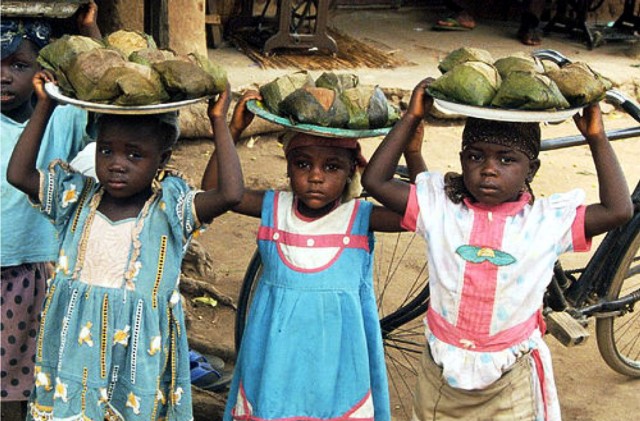
Two weeks ago, I listened to a conversation between two women at a bus stop where we were all taking shelter from the rain. One of them was assuring the other that she would supply the “goods”, but warned that upon the delivery of the “goods” her money must be paid in full, otherwise the “goods” would be taken to a more ready customer.
Initially, I was not interested in the discussion as other peoples’ conversation shouldn’t be my business. However, I became curious when the first woman, once again warned the other “not to ever give the salary to the goods at the end of the month. You pay to me,”
I wondered how a commodity could be entitled to a monthly salary. But the picture became clearer when the other woman who appeared well-to-do, promised to keep to the agreement but insisted that the “goods” must be of high quality and ready to work. I paid more attention and was shocked to realise that the “goods” being referred to all along in the conversation was a house servant.
The goods supplier was in the business of getting children from villages and supplying them to house- holds in cities who were in need of them. While the house helps worked for their employers, the woman who brought them from villages, received their salaries at the end of the month, took her percentage and gave the remaining paltry sum to the house helps.
This is the sorry story of several underage Nigerian children who are daily being subjected to all kinds of inhuman treatment.
They suffer despair in private homes as domestic servants, among artisans as apprentices, persecuted as child-sorcerers by religious organisations. Many of them know no home other than the streets where they beg, hawk and labour for a living. They lack the basic things of life; no role model, poor education, lack of proper nutrients and many more.
A recent UNICEF Information sheet paints a gloomier picture. It puts the number of under -14 child labourers across Nigeria at 15 million. “Many are exposed to long hours of work in dangerous and unhealthy environments, carrying too much responsibility for their age,” it disclosed. “Working in these hazardous conditions with little food, small pay, no education and no medical care establishes a cycle of child rights violation,” it further stated.
In the next four days ago, Nigeria will join other countries of the world to celebrate this year’s World Day Against Child Labour.
Occasions like this should provide a spotlight on the right of all children to be protected from child labour and other violations of fundamental human rights.
It should be an opportunity to really assess the extent of domestication and enforcement of the Child Rights Act already signed into law in many states. How has this act changed the ugly stories of many Nigerian children who are more or less slaves in their land?
In 2010 the international community adopted a roadmap for achieving the elimination of the worst form of child labour by 2016, which stressed that child labour is an impediment to children’s right and barrier to development. 2016 has come and gone but the issues are still there. The question then is what effort did Nigeria make to achieve this target?
Former President Goodluck Jonathan’s effort in removing the almajiris’ from the streets in some northern states and putting them in schools must be commended. Commissioning the first of the series of schools for the almajiri children in Sokoto State, he promised to build over 400 of such schools across the 19 Northern states.
This move many believe, yielded a lot of positive results and spurred development in the region. Continuing this project by the present administration will no doubt help in reducing the growing insecurity in the country, particularly in the north as an uneducated child-street beggar is more susceptible to the wiles of religious fanatic.
However, a lot still needs to be done, especially in the area of providing good and responsible governance that will ensure good life for Nigerians. Unless some drastic measures are taken to reduce the level of poverty in the country, abolishing child labour in Nigeria would merely turn to a wishful dream as poor parents would continue to use their children to provide food for their families.
The senseless looting and corruption that characterise our system will further make the elimination of child labour a mirage.
The 14th world day against child labour should therefore challenge government, parents and other stake holders on ways of creating better living conditions which still elude the children. Parents should be more interested in the welfare and education of their children to complement the efforts of government and other stake holders to end child labour and offer better protection for the rights of children in Nigeria.
Calista Ezeaku



-

 Business3 days ago
NERC Amends Order on Meter Tampering, Power Bypass For Discos
-

 Business3 days ago
NCDMB Signs Mgt Deal With Radisson, Edison…As Board’s 204 Rooms Hotel Open December 2026
-

 Rivers3 days ago
KENPOLY Rector Promises To Prioritise Students’ Welfare
-

 Business3 days ago
Nigeria, AFC sign $1.3 billion deal to build alumina refinery
-

 News4 days ago
Police Arrest Nigerian, Two Others For Kidnapping In Edo
-

 Rivers3 days ago
Don, Stakeholders Urge Environmental Laws In N’Delta
-

 Rivers3 days ago
ADIAFRICA Flags-off Free Eye Screening Outreach In PH
-

 Environment3 days ago
IWD: NGO promotes clean energy access for women in Kaduna