
Politics
Beyond Nnamani’s Electoral Reform Committee

In a bid to streamline the
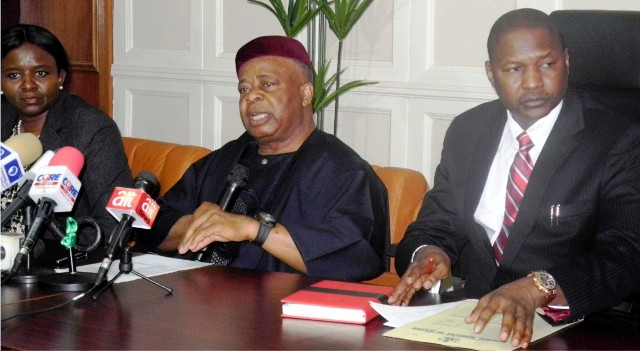
electoral process of Nigeria, the federal government recently set up a 24-man committee headed by former President of the Senate, Chief Ken Nnamani to handle the task of articulating how to reform the electoral process. The committee is to review existing electoral laws and past reports.
A statement by the Attorney-General and Minister of Justice, Abubakar Malami said “Chief Nnamani is expected to bring his wealth of experience to bear on the reform process”, while the committee is expected to review electoral environment, laws and experiences from recent elections conducted in Nigeria and make recommendations to strengthen and achieve the conduct of free and fair elections in the country.
Among other things, the committee’s assignment which is expected to last for 16 weeks will review conflicting court judgments on legal disputes on past elections. The scope of the committee’s work reads in part, “Review the laws impacting elections in Nigeria, in relevant provisions of the 1999 constitution as (amended) and the Electoral Act, 2010 (as amended) to assess their impact and adequacy for the administration of elections in Nigeria.
“Review of recent judicial decisions on election petitions as they relate to conflicting judgments, absence of consequential orders, delay in issuing certified true copies of judgments, harmonization of the Electoral Act in view of the judgements with a view to enhancing the electoral process. “Review of the lessons learnt from the 2015 general elections and make recommendations for the improvement as they relate to the judicial decisions and experience from field operations.
“Identify and assess international best practices on electoral system relevant to Nigeria’s experience and identify best practices that would impact positively on the quality and credibility of the nation’s electoral process. Review the extent of the implementation of the recommendations of the 2008 Election Reform Commission headed by the Justice Muhammed Uwais and advise on outstanding issues for implementation”.
The decision by the Muhamadu Buhari-led administration to reform the country’s electoral system, to some Nigerians, may be a welcome development but to others, a misplaced priority considering the current economic quagmire in which we find ourselves. Electoral reform in Nigeria has always been seen as a wasteful exercise.
We all know that a similar committee headed by the former Chief Justice of Nigeria (CJN), few years ago did the same job. The work done by the committee headed by Uwais in 2008 was hailed by many Nigerians but the reports has not seen the light of the day till date.
The Uwais reports focused on key issues about the nation’s electoral system including the recurring debate about how best the Independent National Electoral commission (INEC) can be truly independent. The argument has always centered around whether or not the President should be allowed to appoint the Chairman of the electoral empire as entrenched in the constitution. This is because since the President is given the constitutional powers to appoint the chairman, the INEC can be partial when the President wants elections to be manipulated.
A university don and right crusader, Dr Ibrahim Dauda, in an interview explains why it is difficult for INEC to deliver free and fair election. “The truth is that since 2003, the body language of INEC has always showed that it can hardly go against the wish of the ruling party. That the 2015 presidential election was in favour of the opposition was because the incumbent President wanted it that way and not because the commission resisted manipulation by the Presidency. President Jonathan chose to do the right thing. Those who praised Jega’s INEC as being wonderful or performing well did that out of ignorance”.
In democracies, the choice of political leaders at all levels is made by competitive elections and in doing that, there must be some rules for translating peoples’ votes into a particular selection of the leaders. In any democratic state like Nigeria, rules are designed to determine which people win office, these rules are called the electoral system of the state. The rules are written with differences, spelling out all that is required to achieve free and fair election.
A nation’s electoral system can be reformed if it cannot guarantee credible elections at any given time. In the case of Nigeria, it is clear that the inability of INEC to conduct free and fair election is not a matter of wrong electoral process. It is a systemic failure that has undermined democracy in the country. The electoral umpire has denigrated its value and the people are fast losing confidence and interest in it.
This is why a one-time Deputy Speaker of the Rivers Sate House of Assembly, Hon. Iyk Oji, during an interview with The Tide in Port Harcourt said that INEC’s poor performance makes it difficult for Nigerians to trust the commission. This is more so as they have not been able to efficiently conclude elections in any one state since its present leadership assumed office.
“It started from inconclusive to postponement, to no election. It’s a gradual degeneration as it were, Oji said, adding that “INEC is not ready to run an election as it is”.
He advised INEC to organize themselves and act in the interest of Nigeria and stop pandering to sectional and partisan considerations. “A situation where appointed officials of INEC function as apologist to those who appointed them instead of carrying out their constitutional duties professionally is worrisome.
The Nnamani committee should be able to consider and make strong recommendation on inconclusive, postponement and cancellation of elections. It is also important that the committee includes in the reform a recommendation that will make it mandatory for those seeking elective positions to participate in pre-election debates. The Senate, according to reports, is already working on a bill to that effect. The bill presented by Senator Abdulfatai Buhari has been read for second time and referred to the committee on Establishment and Public Service as well as committee on INEC.
During the 2015 presidential election, many irregularities were observed by Nigerians, especially in the Northern parts of the country where under-aged children who were not eligible to vote were glaringly noticed casting their votes in favour of the opposition APC, which is now the ruling party at the centre. The powers to appoint the chairman of INEC and chairman of state Electoral Commission as well as Resident Electoral Commissioners (RECs) should be removed from the President and Governors.
Now that a new committee has been set up to reform the nation’s electoral process, it is worthwhile to invite all former chairmen of INEC like Humphrey Nwosu who was acclaimed the best in the conduct of 1993 general elections, to make their inputs, to say what happened during their days and the constraints they had. Nwosu has been known to have conducted the most credible elections in Nigeria.
The reform should take care of refusal by lawmakers or any other body to swear-in opposition candidates who win elections. Issues concerning independent candidature and electronic voting as well as snatching of ballot box and destruction of voting materials must be seriously looked into while our electoral system must be tailored towards the needs of our society.
The question on the lips of Nigerians is: If the reports of the Uwais-led committee were implemented, would the nation have had any need for electoral reforms now? The answer may be yes, may be no. for Uwais, the answer is the latter. This is why he accused the authorities of lacking the political will to implement his committee’s reports. He regretted that his committee’s report died on the altar of politics.
Uwais, while speaking at a dialogue on the review of the Electoral Law and process organized by the Policy and legal Advocacy Center (PLAC) in Abuja, noted that instead of implementing the recommendations of his committee holistically, the Federal Government decided to “pick and choose”. As he puts it, “As we know, the bill that was produced by the National Assembly, though reflected on some of the recommendations of the Electoral Reform Committee, but not all of these recommendations were adopted. As far as the Electoral Reform Committee was concerned, the recommendations were intended to be in tandem with one another”.
Now that the Nnamani committee has swung into action, it is expected that a thorough job would be done while the Federal Government must bear in mind that it is not just enough to set up such a body in motion, but the basic thing is the political will and interest to implement its reports and recommendations for the good of the nation’s democracy.
Shedie Okpara



The Independent National Electoral Commission (INEC) has extended the deadline for political parties to submit the list of candidates for the 2027 governorship and state Houses of Assembly elections from Saturday, August 8, to Tuesday, August 11, 2026.
The commission announced the extension in a statement issued on Saturday and signed by the National Commissioner and Chairman of its Information and Voter Education Committee, Mohammed Haruna.
According to INEC, the decision followed appeals by political parties for additional time to complete the submission process through the dedicated online portal.
“The submission window, which according to the revised Timetable and Schedule of Activities for the General Election was originally scheduled to close on Saturday, 8th August, 2026, has been extended to Tuesday, 11th August, 2026,” the commission said.
In a a related development, INEC announced the suspension of PVC collection in Osun State ahead of the August 15 governorship election.
The commission said voters who applied for replacement of lost, damaged or defaced Permanent Voter Cards would have until midnight on Sunday, August 9, to print downloadable copies of their cards.
The electoral body explained that the deadline was necessary to enable it compile data on downloaded PVCs and produce final statistics on the total number of cards collected ahead of the election.
INEC said PVC collection in Osun commenced at the Registration Area level from July 22 to 28, 2026, but was extended to July 31 following complaints about large crowds and difficulties experienced by voters at collection centres.
The exercise subsequently moved to the local government level and ran from August 1 to 7.
The commission also disclosed that replacement downloadable PVCs had been made available to voters in Odo-Otin and Ife Central Local Government Areas following the theft of cards during attacks on the two collection centres.
It stressed that the stolen cards could not be used to vote.
INEC reassured Osun residents of its preparedness for the August 15 governorship election.
“The commission reiterates that the stolen cards cannot be used to vote.
“INEC reassures the people of Osun State of its readiness to conduct a free, fair, credible and inclusive governorship election on 15th August, 2026,” the statement said.
The commission said the deadline, initially set for Saturday, 8 August, has been extended to Tuesday, 11 August 2026, following appeals from political parties for more time.
INEC also announced that the window for voters who applied to replace lost, damaged or defaced PVCs to download their replacement cards will close at midnight on Sunday, 9 August.
The move is to enable the commission compile final PVC collection figures ahead of the 15 August Osun governorship election.
INEC said replacement downloadable PVCs have also been provided to affected voters in Odo-Otin and Ife Central Local Government Areas after hoodlums carted away cards from two collection centres, stressing that the stolen cards cannot be used to vote.
The commission reaffirmed its readiness to conduct a free, fair, credible and inclusive election in Osun State.
Gov. Kefas made the remarks over the weekend at the Federal Medical Centre (FMC), Jalingo, during the flag-off of the second phase of the Renewed Hope Medical Outreach in Taraba State, organised as part of activities marking Prof. Yilwatda’s 58th birthday.
The governor commended Prof. Yilwatda for choosing to mark his birthday by providing medical care to people in need.
“What Professor Nentawe did is a powerful demonstration of what leadership should be,” Gov. Kefas said.
He assured that his administration would continue to support initiatives that complement government efforts to improve healthcare delivery and the wellbeing of residents.
Speaking at the event, Prof. Yilwatda called on Nigerian leaders to embrace the culture of giving and use their positions to touch the lives of the less privileged.
He said his decision to celebrate his 58th birthday in Taraba State was deliberate and informed by the needs of underserved communities, particularly people who face difficulties accessing healthcare because of distance and financial constraints.
According to him, the intervention followed a needs assessment and was extended across the three senatorial districts of the state.
He said the exercise commenced on August 3 at Takum General Hospital and covered the Federal University Teaching Hospital, Wukari; First Referral Hospital, Sunkani, Ardo-Kola Local Government Area; General Hospital, Bali; General Hospital, Gembu; and FMC Jalingo.
Prof. Yilwatda said the intervention provided medical services to thousands of beneficiaries, including people who required surgical procedures.
He said sustainable national development could only be achieved when strong institutions placed Nigerians at the centre of development.
“Leadership is about service,” he said, urging political and public leaders to make giving back to society an important part of their responsibilities.
He reaffirmed his commitment to serving Nigeria and its people, saying his personal vision was to make every day of his life useful to humanity.
“Every day that I live, the vision is: let it be useful to humanity,” he said.
The Taraba State Commissioner for Health, Dr. Bordiya Buma, commended the initiative, saying it was consistent with the Renewed Hope agenda and efforts to strengthen healthcare delivery in the state.
Dr Buma said the second phase followed the successful completion of the first phase, which was conducted simultaneously in six local government areas, with two LGAs selected from each of the three senatorial districts.
According to him, more than 10,000 patients were attended to during the first phase, including people with medical and surgical conditions.
He disclosed that 327 general surgeries, 71 eye surgeries and 575 dental procedures were carried out during the exercise.
The commissioner expressed appreciation to President Bola Tinubu for the Renewed Hope Medical Outreach and thanked Prof. Yilwatda for supporting the initiative and choosing Taraba State as a beneficiary.
The Minister of Health and Social Welfare, Prof. Muhammad Ali Pate, also commended Prof. Yilwatda for choosing Taraba State to mark his 58th birthday through a medical outreach.
Prof. Pate said making healthcare the centrepiece of the birthday celebration was significant because health affects everyone.
-

 News2 days ago
RSG Targets Nine Million Residents in Mosquito Net Distribution Campaign
-

 Oil & Energy2 days ago
Aiyedatiwa Signs New Electricity Bill
-

 Oil & Energy2 days ago
NLNG Commissions Research And Innovation Centre In RSU
-

 Maritime2 days ago
Marine Minister Commends President Tinubu On NPERA Bill Assent
-

 News2 days ago
KenPoly Holds Eight Convocations, August 29
-

 News2 days ago
RSG Begins Another Phase of Projects Commissioning Today
-

 News2 days ago
RMAFC Completes Revenue Sharing Review, Proposes New Pay
-

 Maritime2 days ago
NAGAFF Petitions IGP Over Alleged Maritime Police Harassment