
News
‘Why INEC Suspended Polls In Rivers, Others’

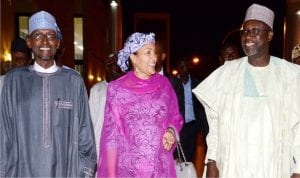
L-R: Minister of FCT, Mohammed Bello, Environment, Amina Mohammed and Water Resources, Suleiman Adamu, at a reception dinner organised by Association of Consulting Engineers in Nigeria (ACEN) for its President, Engr. Suleiman Adamu, on his appointment as the Minister of Water Resources in Abuja on Friday
The Independent National Electoral Commission (INEC) has announced the suspension of the outstanding 2015 elections in some five states of the federation till there is guarantee of peace in the affected states.
The states include Kano, Bayelsa, Kogi, Anambra and Rivers.
The commission, in March shortly after the rerun legislative elections in Rivers State, alerted that it would no longer conduct elections in violence-prone states and areas.
A statement at the weekend, signed by its Secretary, Mrs Augusta C. Ogakwu, and made available to The Tide, indicated that the commission would only conduct further elections in those states if it gets a “firm and unequivocal” commitment to violence-free polls by political parties and relevant stakeholders.
The statement said INEC took the decision pursuant to its powers under Section 26 of the Electoral Amendment Act, 2015, and after consultation with the security agencies.
It said, “INEC needs assurance by the security agencies that it is safe to return through the guarantee of peace, order and safety of all election officials, voters, other stakeholders, materials, polling units and facilities to be used for the elections by the security agencies.”
The statement said that the decision followed disruptions of court ordered rerun elections arising out of petitions challenging the conduct of elections in 2015 into various legislative seats in the states.
It stated that INEC had met to consider the options open to it to resolve the impasse in the states.
It stated that the inability of INEC to conclude the elections arose out of violent resistance to the commencement of the polls in Imo North Senatorial district and three state constituencies in the state.
“There was the disruption of polls after commencement (as in Kogi East Senatorial Idah State Constituency), and all senatorial and some House of Representatives and state House of Assembly elections in Rivers State
It added that INEC would enlist the intervention of relevant governmental agencies as well as civil society organisations, religious bodies and traditional institutions, among others.
The efforts are aimed at securing a conducive atmosphere for the peaceful conduct of the elections, the statement added.
Last week, a renowned public affair analyst, Mr. Martins Ikhilea, had raised an alarm that Rivers State may not have representatives in the upper chambers of the National Assembly till after 2019 general elections.
It would be recalled that the Appeal tribunal had last December nullified all three senatorial elections held last year and ordered for a rerun in the state, but unfortunately, some of the rerun elections were cancelled following violence that characterized the process.
Twelve out of 13 seats in the House of Representatives were also nullified while the three Senatorial seats were ordered for a rerun on March 19, 2016. Twenty two state House of Assembly seats were also ordered for rerun.
The March 19 exercise resulted in the presentation of certificates of return to only 12 state House of Assembly and three House of Representatives winners.
With INEC decision, 10 state House of Assembly seats, nine House of Representatives and three Senatorial seats are now pending.

City Crime
Ministry Raises Concern Over Rising Teenage Pregnancies, Begins Adolescent Sensitisation Campaign


The Department of Public Health in the Rivers State Ministry of Health has raised concern over the increasing cases of teenage pregnancies in society as it intensifies efforts to educate adolescents across the state.
Programme Manager for Adolescent Health and Development in the department, Mrs. Tammy Briggs, expressed the concern during a sensitisation programme held at Government Girls Secondary School Rumueme in Obio/Akpor Local Government Area of Rivers State.
Briggs explained that the campaign was designed to educate adolescents on the dangers of teenage pregnancy and other health-related issues affecting young people.
According to her, teenage pregnancy is currently on the rise, making it necessary for the ministry to step up awareness programmes among students.
“This is something that is on the rise for now. We have observed that there are many cases of teenage pregnancies, so we are here to sensitise them on ways to prevent it entirely,” she said.
She disclosed that the sensitisation campaign is being carried out in selected schools across four local government areas of the state, namely Obio/Akpor Local Government Area, Port Harcourt City Local Government Area, Ogba/Egbema/Ndoni Local Government Area and Eleme Local Government Area.
Briggs noted that the programme focuses on several key issues affecting adolescents, including sexual and reproductive health, gender-based violence, teenage pregnancy, substance abuse, emotional health and proper nutrition.
She added that the outreach programme also featured tuberculosis screening for students as well as the distribution of sanitary pads and mathematical sets to support their health and academic development.
The programme manager commended the management of Government Girls Secondary School Rumueme for their cooperation and support in hosting the sensitisation exercise. She also advised the students to avoid behaviours that could jeopardise their future.
Speaking during the session, Dr. Nwadike Chinonso urged the students to make informed decisions about their lives and remain focused on their education.
He cautioned them against engaging in early sexual activities, stressing that abstinence remains one of the most effective ways to prevent sexually transmitted infections and unintended pregnancies.
Some of the students who participated in the programme expressed appreciation to the team for the awareness campaign and pledged to apply the knowledge gained to make responsible life choices.

Disturbing allegations of extortion, intimidation and the smuggling of prohibited items have unsettled the Kwale Medium Security Custodial Centre (MSCC) in Delta State, prompting calls for urgent intervention by the national authorities of the Nigeria Correctional Service amid fears of potential security breaches within the facility.
The development was disclosed by a senior officer at the Delta State custodial facility, who expressed concern over what was described as entrenched irregularities capable of undermining discipline and operational standards at the centre.
According to the source, detailed findings compiled between December 2025 and January 2026 highlighted patterns of misconduct and warned of possible security consequences should the allegations remain unchecked.
At the centre of the claims is a powerful corrections official serving as Officer in Charge of the Kwale facility, accused of presiding over persistent financial extortion, high-handedness and the victimisation of inmates under his supervision.
The document further indicated that the alleged practices may have originated during the tenure of a former General Provost, reportedly with the collaboration of another senior custodial official within the system.
Intelligence details suggested that inmates were allegedly compelled to contribute funds for projects and items considered outside the statutory framework of inmate welfare, raising questions about compliance with established correctional guidelines.
Among the financial demands reportedly imposed were ¦ 300,000 for the repair of a Hilux vehicle, ¦ 600,000 for the purchase of a freezer and ¦ 750,000 for a generator allegedly designated for the Officer in Charge’s residence.
The report also alleged that inmates were required to make payments before being conveyed to court, while Awaiting Trial Persons in Cells One to Nine were directed to raise ¦ 30,000 per cell, with Convict Cells One to Three, including a designated VIP cell, similarly mandated to pay ¦ 30,000 monthly.
Observers noted that if substantiated, such practices would amount to grave breaches of professional ethics and custodial administration standards, eroding principles of fairness, transparency and inmate welfare within correctional institutions.
Beyond the financial allegations, the intelligence brief raised concerns over the purported possession of unauthorised communication devices, alleging that a serving General Provost had two Android phones while another influential inmate was also reportedly found with a mobile device.
The document further alleged that prohibited items, including alcoholic beverages, Indian hemp and other hard substances, may have been smuggled into the custodial yard under the guise of routine supervision duties, with security sources warning that the cumulative effect of extortion, intimidation and contraband trafficking has heightened tension within the facility.
In view of the gravity of the allegations, they called for an immediate and discreet investigation by the minister of Interior for immediate action to safe the life of inmates.
The administrative review of implicated officers, even as officials of the Nigeria Correctional Service had yet to issue an official statement, with stakeholders insisting that a transparent probe and decisive action are essential to restoring confidence and safeguarding institutional integrity at the Kwale Medium Security Custodial Centre.

The Socio-Economic Rights and Accountability Project (SERAP) has filed a lawsuit against the government of President Bola Tinubu at the ECOWAS Community Court of Justice over the government’s alleged failure to withdraw “unlawful mass phone-tapping rules” known as the Lawful Interception of Communications Regulations, 2019.
LICR 2019 is a regulation that authorises telecom licensees to install technology for security agencies to monitor communications, including voice, data, text, email, and browsing, for national security and to combat crime.
SERAP, in a statement signed by its Deputy Director, Kolawole Oluwadare, yesterday, said the suit followed allegations by former Kaduna State Governor, Nasir El-Rufai, that the phone conversation of the National Security Adviser, Nuhu Ribadu, was intercepted.
El-Rufai reportedly claimed, “The NSA’s call was tapped. They do that to our calls too, and we heard him saying they should arrest me.”
In the suit numbered ECW/CCJ/APP/11/26, filed last Friday at the ECOWAS Community Court of Justice in Abuja, SERAP is seeking “a declaration that the failure of the government to withdraw the Interception of Communications Regulations is unlawful and a violation of Nigeria’s international human rights obligations.”
The organisation is also asking the court to declare that the government’s failure to withdraw the regulations “constitutes an official endorsement of unlawful mass phone-tapping rules, as the Regulations are patently unlawful, and violate the rule of law, democratic principles, and the right to privacy.”
It is further seeking “an order directing and compelling the Nigerian government to immediately withdraw the Interception of Communications Regulations, and to commence a legislative process to ensure that any interception regulations are in conformity with Nigeria’s international human rights obligations.”
The suit, filed on behalf of SERAP by its lawyers Kolawole Oluwadare, Oluwakemi Oni, Valentina Adegoke and Maryam Mumuni, argued that “the Regulations establish a sweeping mass phone-tapping regime that violates Nigerians’ constitutionally and internationally guaranteed human rights, including to privacy and freedom of expression.”
“Where powers affecting fundamental human rights are exercised in secrecy and concentrated in political authorities without independent supervision, the risks of arbitrariness are substantial.
“Surveillance measures that lack strict necessity, proportionality and independent judicial oversight can easily be weaponised against political opponents, journalists, civil society actors and election observers,” it added.
SERAP also warned that the regulations raise concerns as Nigeria approaches the 2027 general elections, noting that broad interception powers could be abused during politically sensitive periods.
“In an electoral climate, even the perception that private communications are being monitored can chill political organising, investigative reporting and voter mobilisation.
“Free and fair elections depend on confidential communications, protected journalistic sources and open democratic debate. Any misuse of intercepted data for intimidation, political advantage or disinformation would fundamentally undermine Nigerians’ right to political participation and electoral integrity.
“As 2027 approaches, interception powers must be narrowly defined, subject to prior independent judicial authorisation and backed by effective remedies. Without robust safeguards, these Regulations risk threatening privacy rights, freedom of expression and the credibility of Nigeria’s democratic process,” the suit stated.
SERAP maintained that any restriction on the right to privacy must comply with the principles of legality, necessity and proportionality, arguing that the regulations fail to meet these requirements.
SERAP also cited the Office of the United Nations High Commissioner for Human Rights as stating that mass surveillance programmes based on indiscriminate and blanket collection of personal data are arbitrary and cannot satisfy the requirements of legality, necessity and proportionality.
The group said the Nigerian government has a duty to adopt clear laws, safeguards, independent oversight mechanisms and accessible remedies to prevent abuse by state agencies and private actors, including telecommunications providers and technology companies.
According to SERAP, the Nigerian Communications Commission (NCC) adopted the Lawful Interception of Communications Regulations, 2019 while exercising its powers under Section 70 of the Nigerian Communications Act, 2003.
The organisation argued that Regulation 4 grants broad discretionary interception powers to the National Security Adviser and the State Security Services, with little clarity on the scope or limits of such authority.
SERAP also pointed to inconsistencies within the regulations, noting that while Regulation 4 and Regulation 12 restrict interception powers to the NSA and SSS, Regulation 23 expands the category of authorised agencies to include bodies such as the Nigeria Police Force, National Intelligence Agency, Economic and Financial Crimes Commission, National Drug Law Enforcement Agency, and any other agency the commission may designate.
The organisation said this ambiguity undermines legal certainty and creates the risk of arbitrary application and abuse.
It also criticised provisions allowing interception without a warrant in certain circumstances, arguing that such powers are overly broad and susceptible to misuse.
SERAP further expressed concern that the regulations do not require authorities to notify individuals who have been subjected to surveillance, which it said weakens the ability of citizens to challenge unlawful monitoring.
The organisation warned that requirements compelling telecommunications licensees to install interception equipment and disclose encryption keys could undermine cybersecurity and discourage privacy-enhancing technologies.
SERAP acknowledged the government’s responsibility to address national security and organised crime but argued that such measures must remain within constitutional and international human rights limits.
No date has been fixed for the hearing of the suit.
-

 News5 days ago
Don Savours Inaugural Lecture Presentation, Commends VC
-

 News19 hours ago
Police Arrest Nigerian, Two Others For Kidnapping In Edo
-

 Business9 hours ago
Nigeria, AFC sign $1.3 billion deal to build alumina refinery
-

 Nation21 hours ago
Perm Sec Explains Success Of FGM Elimination Programme In Rivers
-

 News19 hours ago
NDLEA Arrests Ex-Councillor With 40kg Skunk, Recovers Drugs In Diapers
-

 Rivers8 hours ago
KENPOLY Rector Promises To Prioritise Students’ Welfare
-

 Rivers8 hours ago
LGSC Boss Commits To Better Service Delivery
-

 Rivers8 hours ago
ADIAFRICA Flags-off Free Eye Screening Outreach In PH