
Business
SON Tracks Fake Goods To Ports

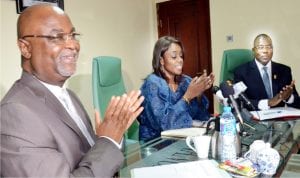
Permanent Secretary, Ministry of Defence, Amb. Danjuma Sheni, Minister of Finance, Mrs Kemi Adeosun and Head, Presidential Initiative on Continuous Audit (PICA), Mr Mohammed Dikwa, at the PICA meeting in Abuja, yesterday.
The Standard
Organisation of Nigeria (SON) has indicated interest to return to the country’s seaports to help control the influx of substandard products to the country.
SON’s Acting Director-General, Dr Paul Angya, indicated the interest at a stakeholders’ meeting on the enforcement of the ban on used tyres in Abuja.
“The reason they gave was to be able to fast track trade at the port to cut down the turnaround time.
“But with the consequences of SON leaving the ports, with the influx of substandard products which is almost over running Nigeria those reasons that they gave at that time, may have been germane at that time, but at this time they are no longer cogent.
“Because the consequences that we are suffering far outweighs any benefit from that decision and apart from that, as we speak, the present facility available to do the job are different and improved.
“And so there is no need for anybody to hold down any container at the port because things are largely digitised and computerised.
“So it’s time for the government to take SON back to the ports, so that it can do the job of policing the quality of products that are coming into Nigeria.
“So what we want the government to do is to reverse that decision of the last government and to call SON back to the ports so that SON can check the influx of substandard products into Nigeria.’’
Angya said that the most strategic place for SON to effectively prevent the inflow of substandard products was at the sea ports.
According to him, more than 90 per cent of products come through the ports.
According to him, the last administration through the Minister of Finance directed SON to leave the sea ports even though the law setting it up allows it to operate there.
Angya said there were quite a number of substandard products in almost everything being imported adding that more than 70 per cent of the products into the country did not meet SON’s specifications.
FRSC Corps Marshal Dr Boboye Oyeyemi, explained that the meeting was to fashion ways on the stakeholders decision reached at a meeting on the campaign on the use of tyres.
Oyeyemi said that the meeting agreed on a joint enforcement involving SON, FRSC, Customs Service, Department of State Service and the National Automobile Development Council.
He said that there would be training for all transport officers in Ministries, Departments and Agencies of government in June, on the detection of fake and substandard tyres.
“FRSC will sustain its enforcement on the highway and with the support received from NURTW, no vehicle with expired or substandard tyres would be allowed to load at motor parks.’’
“From next week top FRSC officers will be on the highway to check these things, immediately after that, I will lead a team to impound any vehicle with substandard tyres.’’
Oyeyemi said that impounded vehicles would be allowed to buy original tyres while the number of the vehicle would be engraved on the tyres before they are released.
He corroborated SON’s agitation to return to the ports and appealed to government to consider the appeal.
Director-General, National Automobile Design and Development CouncilMr Aminu Jamal, said that the council was working hard to ensure that there were standards for tyres.
Jamal said that training was ongoing to train vulcanizers nationwide on the use of tyres.


Nkpemenyie Mcdominic
Reports say that the training is designed to equip youths with practical technical skills for employment in the oil and gas and construction sectors, with emphasis on employability, safety, competence and self reliance.
In attendance at the flag-off ceremony this week, at the Petroleum Training Institute (PTI) Conference Hall, Effurun, were stakeholders, dignitaries, and political representatives, among others.
Dafinone, represented by his Chief of Staff, Adelabu Bodjor, said the initiative reflects a deliberate political investment in human capital development across Delta Central.
He explained that the training focuses on rigging and scaffolding, noting that “both are essential technical competencies required in industrial operations, construction projects, and oil and gas installations”.
Bodjor added, “The programme is intended to reduce dependency among youths by providing job-ready skills capable of supporting long-term economic opportunities and self-sufficiency. The initiative aligns with Senator Dafinone’s broader development agenda, which prioritises practical skill acquisition as a pathway to sustainable empowerment.”
Also addressing the participants, the NCDMB, Felix Omatsola Ogbe, represented by Mr. Teddy Bai, commended Dafinone for sponsoring the programme, describing it as “a timely response to critical manpower gaps in the industry”.
Bai explained that rigging and scaffolding remain safety-sensitive skills required across fabrication yards, offshore platforms, and construction sites, stressing that the programme bridges the gap between certification and practical competence.
He also charged the training consultant, OROH Contractors Limited, to maintain strict standards of professionalism, safety, and discipline, while urging participants to remain committed, focused, and disciplined throughout the exercise.
The Senate Liaison Officer for Sapele Local Government Area, Chief Patrick Akamuvba, , described the programme as a major step in strengthening human capital development in Delta Central.
Akamuvba said scaffolding and rigging skills are in high demand across residential, commercial, and industrial construction projects, noting that the training offers real employment opportunities for beneficiaries
He urged participants to prioritise knowledge and certification over short-term material expectations, stressing that discipline and seriousness would determine their long-term success.
He also cautioned youths against social vices and distractions, advising them to remain focused to maximise the opportunities provided by the programme.
-
News3 days ago
Obuah’s Victory Excites Former Lawmaker as APC Primaries Conclude in Rivers West
-

 Politics5 days ago
APC PRIMARIES: FUBARA’S WITHDRAWAL, HISTORIC SACRIFICE FOR NATIONAL STABILITY ……. GROUP
-

 News5 days ago
Court Sentences Seven To Death Over Murder Of Cleric In Rivers
-
News3 days ago
105 Nigerians Killed In S/Africa In Seven Years
-

 Sports5 days ago
PH Arsenal Community Set For Streets Procession, Saturday
-

 Niger Delta3 days ago
Royal Father Endorses PH Arsenal Community, Pledges To Support
-

 Politics5 days ago
IPAC Flays INEC Over Election Guidelines Judgement
-

 Politics5 days ago
NDC To Adopt Electronic Voting For Future Primaries