
Business
N220bn MSMEsFund: Bank MD Lauds FG

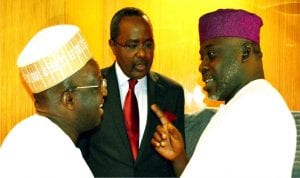
Chairman, House Committee on Capital Market, Rep. Yusuf Tajuddeen (right), discussing with representative of the Minister of Finance, Dr Mahmud Isa-Dutse (left) and Director-General, Security and Exchange Commission (SEC), Alhaji Munir Gwarzo, at the inauguration of the study team on Voice and Voting Power in the Nigerian Capital Market in Abuja on Monday.
Managing Director, Nige
ria Police Force (NPF) Microfinance Bank (MFB) Plc., Mr. Akin Lawal has commended the Federal Government for setting aside N220 billion to boost Micro Small and Medium Enterprise (MSME) development in the country.
Lawal told newsmen in an interview yesterday in Abuja that the decision was one of the best things the regulators had done for the sub-sector.
“Basically, I think it is one of the best things so far that the regulatory authorities have done in the subsector in the area of the N220 billion MSME fund.
“In terms of cost, they have been able to bring it down at a very considerable low rate of initially three but now two per cent; and you cannot get that anywhere
“But we need more of such funds to strengthen the system.’’
According to him, the fund has been very supportive and it will go a long way in reducing the cost of funds being that it is given at a single digit of nine per cent.
Recall that the Federal Government earmarked N220 billion MSME intervention fund to support the microfinance subsector.
“The fund has been helpful in provision of finance to address the core sector of the economy because, of course, it is restricted to the productive sectors of the economy
“You are only expected to do about ten per cent of that fund in commerce but mainly into the productive sector.
“And that is what actually is needed for us to create jobs and these are the things that will boost the economy of the country.
“Because, in anyway, if you are engaged in productive sector, there is no how you will not employ two or three people to join you and that is what we need at this point in time.’’
On bad loans, Lawal said it could be avoided with due diligence ‘’because with proper due diligence, one will be able to identify a bad loan before it is even granted’’.
According to him, most operators grant loans to beneficiaries who use the fund as ‘guinea pig’ for experiment on various business ventures which they are not certain about.
He said intervention funds were not meant for experimentation.
Lawal also urged the regulators to provide a common IT platform for all MFBs at an acceptable cost which would help improve their operations in the country.
“They should come up with more supportive initiatives that will be helpful to the subsector in general.
“The demand for credit is insatiable, the entire 1000 MFB or so we have in the system are not still enough to meet the demand sector
“ As you know, there are still huge numbers of the population that are unserved and how do you manage this, it is from the supply and that is in terms of the fund available.’’
Also, Mrs Nwanna Joel-Ezeugo , the Acting Managing Director, Accion MFB, urged the government to come up with a concrete economic blueprint.
“We are providers of fund, let’s know where we are going, the operators in the market, let them know where they are going to enable us strategies
“Because when there is no clear cut policy, the inconsistency will kill more and more people and throw a lot of people out of job.’’


Nkpemenyie Mcdominic
Reports say that the training is designed to equip youths with practical technical skills for employment in the oil and gas and construction sectors, with emphasis on employability, safety, competence and self reliance.
In attendance at the flag-off ceremony this week, at the Petroleum Training Institute (PTI) Conference Hall, Effurun, were stakeholders, dignitaries, and political representatives, among others.
Dafinone, represented by his Chief of Staff, Adelabu Bodjor, said the initiative reflects a deliberate political investment in human capital development across Delta Central.
He explained that the training focuses on rigging and scaffolding, noting that “both are essential technical competencies required in industrial operations, construction projects, and oil and gas installations”.
Bodjor added, “The programme is intended to reduce dependency among youths by providing job-ready skills capable of supporting long-term economic opportunities and self-sufficiency. The initiative aligns with Senator Dafinone’s broader development agenda, which prioritises practical skill acquisition as a pathway to sustainable empowerment.”
Also addressing the participants, the NCDMB, Felix Omatsola Ogbe, represented by Mr. Teddy Bai, commended Dafinone for sponsoring the programme, describing it as “a timely response to critical manpower gaps in the industry”.
Bai explained that rigging and scaffolding remain safety-sensitive skills required across fabrication yards, offshore platforms, and construction sites, stressing that the programme bridges the gap between certification and practical competence.
He also charged the training consultant, OROH Contractors Limited, to maintain strict standards of professionalism, safety, and discipline, while urging participants to remain committed, focused, and disciplined throughout the exercise.
The Senate Liaison Officer for Sapele Local Government Area, Chief Patrick Akamuvba, , described the programme as a major step in strengthening human capital development in Delta Central.
Akamuvba said scaffolding and rigging skills are in high demand across residential, commercial, and industrial construction projects, noting that the training offers real employment opportunities for beneficiaries
He urged participants to prioritise knowledge and certification over short-term material expectations, stressing that discipline and seriousness would determine their long-term success.
He also cautioned youths against social vices and distractions, advising them to remain focused to maximise the opportunities provided by the programme.
-
News15 hours ago
Obuah’s Victory Excites Former Lawmaker as APC Primaries Conclude in Rivers West
-

 Politics3 days ago
APC PRIMARIES: FUBARA’S WITHDRAWAL, HISTORIC SACRIFICE FOR NATIONAL STABILITY ……. GROUP
-

 News3 days ago
Court Sentences Seven To Death Over Murder Of Cleric In Rivers
-
News16 hours ago
105 Nigerians Killed In S/Africa In Seven Years
-

 Sports3 days ago
PH Arsenal Community Set For Streets Procession, Saturday
-

 Politics3 days ago
IPAC Flays INEC Over Election Guidelines Judgement
-

 Politics3 days ago
NDC To Adopt Electronic Voting For Future Primaries
-

 Politics3 days ago
Otu Vows To Recall Indolent, Arrogant Cross River Legislators