
Business
Re-engineering Tomato Processing For National Sufficiency

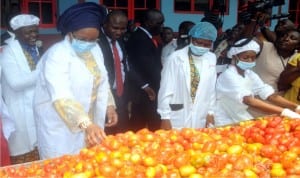
Wife of the President, Mrs Aisha Buhari (2nd left), inspecting fresh tomatoes at the inauguration of Erisco Foods Tomato Paste Revolution, in Lagos, recently. With her is President/Chief Executive of Erisco Foods Ltd., Chief Eric Umeofia (left).
In December 2015, Mrs
Sarah Smith, like most women agonised over the high cost of tomatoes in the market which marred her Christmas shopping due to paucity of funds arising from the economic downturn of the country.
However, upon her visit to the market in February 2016, she was dumbfounded by the reduced price of a basket of tomatoes occasioned by the alarming glut of the produce.
She said: “In December, I bought a basket of tomatoes from Mile 12 market at N21, 000, a produce I had bought between N6,500 and N8,000 in the previous months.
“Now, a basket of tomatoes goes for between N2,500 and N4,000 in the same market due to excess supply leading to huge waste of the produce because of its perishable nature.
“How I wish I could buy a lot and store in my freezer for the rainy season when tomatoes are usually pricey, but the epileptic power supply in the country will not allow that’’.
This situation is one of the many that tomato price fluctuations has caused, raising concerns to many homemakers for a pragmatic approach to reduce waste through preservation of the excess produce.
According to the Federal Ministry of Agriculture and Rural Development (FMARD), Nigeria is the 13th largest producer of tomato in the world and the second after Egypt in Africa.
Nigeria has a domestic demand for tomatoes put at 2.3 million tons, while it produces only 1.8 million tons annually.
However, due to the dysfunctional agricultural value chain system, about 50 per cent of the tomato produced is wasted due to lack of preservation, poor handling system, poor distribution channels and lack of easy access to markets.
The situation has resulted in tomato waste of over 750, 000 tonnes and an import bill of N16 billion annually to make up for the shortfall in local production.
According to experts, the panacea to reduce tomato waste is to preserve the excess supply through local processing into juice, paste, ketchup, puree and powder form.
The country’s Ministry of Agriculture puts the annual local demand for tomato paste at 900,000 tonnes.
Sadly, Nigeria is forced to rely on import of tomato puree, mostly from China because of lack of adequate processing plants.
Currently, most of the tomato processing plants in Nigeria are non- functional, ranging from Manto Tomato Processing Plant in Gombe State and Wanunne Tomato Processing Plant in Benue.
Others are Galf Tomato Factory in Jigawa State, Lau Tomato Processing Company in Taraba, Savannah Integrated in Borno and Perfect Integrated Foods Industry Ltd situated in Ondo State.
Data from FMARD reveals that the non-functional plants have processing and packaging capacities ranging from 7.0 to 1,050 metric tons of tomato paste per day.
Unarguably, lack of tomato import control, unstable power supply, inadequate assessment of market and supply chain channels are some identified factors that led to the absence of processing plants.
To mitigate these problems and ensure wastage is curtailed during glut, indigenous companies have risen to the challenge by reviving one of the moribund processing plants and investing in the industry.
Notably, the Ikara Food Processing Plant in Kaduna which had been moribund for over two decades was resuscitated in 2014 through a Public-Private Partnership between the state government and Springfield Agro Ltd.
The Ikara Tomato Company was established in 1981 by the Balarabe Musa administration. The company has an installed capacity for processing 16,950 tons of tomato and 700 hectares of land purposely for tomato farming.
As at today, the company’s tomato paste production from fresh tomatoes is put at 20 metric tons daily.
Following the trail of Ikara Food Company in tomato processing in Nigeria is Erisco Foods Ltd.
The Chief Executive Officer of Erisco Foods, Chief Eric Umeofia, said the plant has an installed production capacity of 450,000 metric tonnes per annum in its Lagos factory alone, making it the biggest in Africa and 4th largest in the world.
“The Erisco Foods revolution in tomato paste production will stop the annual wastages by over 75 per cent of fresh tomatoes across Nigeria.
“If we continue with the good policies of the present administration, there will be nothing like tomato glut anywhere in Nigeria in the next two years.
“We as off-taker will produce and process to meet our local demands and export to earn foreign exchange provided government continues to support manufacturing.
“Our backward integration programmes planned for Jigawa, Sokoto and Katsina states will generate employment and prosperity for 50,000 Nigerians within three years,’’ said Umeofia.
Also, Dangote Industries Ltd is not left out of the drive to boost the industrial sector of the economy with the establishment of Dangote Tomato Factory in Kadawa, Kano State.
The plant which will begin operation in March has a production capacity of 430,000 metric tonnes of paste per annum.
The factory requires 40 trailers of fresh tomatoes (1, 200 MT) each day to run at full capacity.
To strengthen the supply chain needed to improve tomato processing, the factory is collaborating with GEMS4 and the Tomato Growers Association in Kano.
Kano farmers supplying the factory means more sales, less waste and year-long demand for tomatoes even during the oversupply period.
Growth and Employment in States — Wholesale and Retail Sector (GEMS4) facilitates links between farmers and processing companies such as Dangote Factory and Ikara Food Company.
Its reach targets 100,000 farmers in Kaduna and Kano states.
GEMS4 is a 17 million pound market development project in Nigeria, funded by the World Bank and the U.K’s Department for International Development.
Its mandate is to facilitate market system changes to address identified constraints to encourage economic growth, resulting in the creation of 10,000 new jobs and increased incomes for 500,000 people, especially for the poor rural dwellers and women.
GEMS4 has been in implementation since 2012 and will be in operation until July 2017.
The project employs a “Making Markets Work for the Poor (M4P)’’ approach to implement initiatives that facilitates entry into markets.
It also provides technical support for the adoption of innovations, new business models and leverage investments for the development of key market facilities to support optimal business performance.
Mr Richard Ogundele, Intervention Manager for GEMS4, said that linking tomato farmers to processing plants initiative creates increased business choices for farmers by facilitating business linkages between small scale tomato farmers and tomato processing plants.
It enables them to serve each other on a commercial basis.
“The initiative also builds the capacity of farmers in good handling practices which ensures that incomes increase across the value chain.
“Proper handling, packaging and protection of their produce in a way that ensures quality, extends shelf-life and preserves sales value.
“Good quality produce attracts higher retail prices and financial losses from produce damage is prevented.’’
Similarly, an economist, Mr Adeoye Abiodun, decried Nigeria’s status as the largest importer of tomatoes as detrimental to economic growth and protection of local investments.
He said: “Available data reveals that the country has the wherewithal to meet local demands and even become a net exporter of the commodity.
“Importation of tomato paste to fill the local demand gap could be reversed with the right measures targeted at eliminating waste in the value chain’’.
Also, the Secretary to the Government of the Federation, Mr Babachir Lawal, said government would continue to support the growth of indigenous businesses, especially in this period of economic downturn.
He said that the current economic reality calls for a decisive policy thrust to address issues which must be realistic enough to leverage upon.
Ishola writes for the News Agency of Nigeria (NAN)
Oluwafunke Ishola


Nkpemenyie Mcdominic
Reports say that the training is designed to equip youths with practical technical skills for employment in the oil and gas and construction sectors, with emphasis on employability, safety, competence and self reliance.
In attendance at the flag-off ceremony this week, at the Petroleum Training Institute (PTI) Conference Hall, Effurun, were stakeholders, dignitaries, and political representatives, among others.
Dafinone, represented by his Chief of Staff, Adelabu Bodjor, said the initiative reflects a deliberate political investment in human capital development across Delta Central.
He explained that the training focuses on rigging and scaffolding, noting that “both are essential technical competencies required in industrial operations, construction projects, and oil and gas installations”.
Bodjor added, “The programme is intended to reduce dependency among youths by providing job-ready skills capable of supporting long-term economic opportunities and self-sufficiency. The initiative aligns with Senator Dafinone’s broader development agenda, which prioritises practical skill acquisition as a pathway to sustainable empowerment.”
Also addressing the participants, the NCDMB, Felix Omatsola Ogbe, represented by Mr. Teddy Bai, commended Dafinone for sponsoring the programme, describing it as “a timely response to critical manpower gaps in the industry”.
Bai explained that rigging and scaffolding remain safety-sensitive skills required across fabrication yards, offshore platforms, and construction sites, stressing that the programme bridges the gap between certification and practical competence.
He also charged the training consultant, OROH Contractors Limited, to maintain strict standards of professionalism, safety, and discipline, while urging participants to remain committed, focused, and disciplined throughout the exercise.
The Senate Liaison Officer for Sapele Local Government Area, Chief Patrick Akamuvba, , described the programme as a major step in strengthening human capital development in Delta Central.
Akamuvba said scaffolding and rigging skills are in high demand across residential, commercial, and industrial construction projects, noting that the training offers real employment opportunities for beneficiaries
He urged participants to prioritise knowledge and certification over short-term material expectations, stressing that discipline and seriousness would determine their long-term success.
He also cautioned youths against social vices and distractions, advising them to remain focused to maximise the opportunities provided by the programme.
-
News2 days ago
Obuah’s Victory Excites Former Lawmaker as APC Primaries Conclude in Rivers West
-

 Politics4 days ago
APC PRIMARIES: FUBARA’S WITHDRAWAL, HISTORIC SACRIFICE FOR NATIONAL STABILITY ……. GROUP
-

 News4 days ago
Court Sentences Seven To Death Over Murder Of Cleric In Rivers
-
News2 days ago
105 Nigerians Killed In S/Africa In Seven Years
-

 Sports4 days ago
PH Arsenal Community Set For Streets Procession, Saturday
-

 Niger Delta2 days ago
Royal Father Endorses PH Arsenal Community, Pledges To Support
-

 Politics4 days ago
IPAC Flays INEC Over Election Guidelines Judgement
-

 Politics4 days ago
NDC To Adopt Electronic Voting For Future Primaries