Connect with us

Business

Re-engineering Tomato Processing For National Sufficiency

Published

on

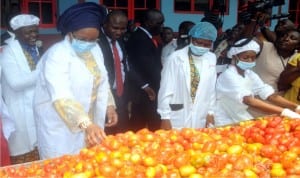
Wife of the President, Mrs Aisha Buhari (2nd left), inspecting fresh tomatoes at the inauguration of Erisco Foods Tomato Paste Revolution, in Lagos, recently. With her is President/Chief Executive of Erisco Foods Ltd., Chief Eric Umeofia (left).

Wife of the President, Mrs Aisha Buhari (2nd left), inspecting fresh tomatoes at the inauguration of Erisco Foods Tomato Paste Revolution, in Lagos, recently. With her is President/Chief Executive of Erisco Foods Ltd., Chief Eric Umeofia (left).

In December 2015, Mrs
Sarah Smith, like most women agonised over the high cost of tomatoes in the market which marred her Christmas shopping due to paucity of funds arising from the economic downturn of the country.
However, upon her visit to the market in February 2016, she was dumbfounded by the reduced price of a basket of tomatoes occasioned by the alarming glut of the produce.
She said: “In December, I bought a basket of tomatoes from Mile 12 market at N21, 000, a produce I had bought between N6,500 and N8,000 in the previous months.
“Now, a basket of tomatoes goes for between N2,500 and N4,000 in the same market due to excess supply leading to huge waste of the produce because of its perishable nature.
“How I wish I could buy a lot and store in my freezer for the rainy season when tomatoes are usually pricey, but the epileptic power supply in the country will not allow that’’.
This situation is one of the many that tomato price fluctuations has caused, raising concerns to many homemakers for a pragmatic approach to reduce waste through preservation of the excess produce.
According to the Federal Ministry of Agriculture and Rural Development (FMARD), Nigeria is the 13th largest producer of tomato in the world and the second after Egypt in Africa.
Nigeria has a domestic demand for tomatoes put at 2.3 million tons, while it produces only 1.8 million tons annually.
However, due to the dysfunctional agricultural value chain system, about 50 per cent of the tomato produced is wasted due to lack of preservation, poor handling system, poor distribution channels and lack of easy access to markets.
The situation has resulted in tomato waste of over 750, 000 tonnes and an import bill of N16 billion annually to make up for the shortfall in local production.
According to experts, the panacea to reduce tomato waste is to preserve the excess supply through local processing into juice, paste, ketchup, puree and powder form.
The country’s Ministry of Agriculture puts the annual local demand for tomato paste at 900,000 tonnes.
Sadly, Nigeria is forced to rely on import of tomato puree, mostly from China because of lack of adequate processing plants.
Currently, most of the tomato processing plants in Nigeria are non- functional, ranging from Manto Tomato Processing Plant in Gombe State and Wanunne Tomato Processing Plant in Benue.
Others are Galf Tomato Factory in Jigawa State, Lau Tomato Processing Company in Taraba, Savannah Integrated in Borno and Perfect Integrated Foods Industry Ltd situated in Ondo State.
Data from FMARD reveals that the non-functional plants have processing and packaging capacities ranging from 7.0 to 1,050 metric tons of tomato paste per day.
Unarguably, lack of tomato import control, unstable power supply, inadequate assessment of market and supply chain channels are some identified factors that led to the absence of processing plants.
To mitigate these problems and ensure wastage is curtailed during glut, indigenous companies have risen to the challenge by reviving one of the moribund processing plants and investing in the industry.
Notably, the Ikara Food Processing Plant in Kaduna which had been moribund for over two decades was resuscitated in 2014 through a Public-Private Partnership between the state government and Springfield Agro Ltd.
The Ikara Tomato Company was established in 1981 by the Balarabe Musa administration. The company has an installed capacity for processing 16,950 tons of tomato and 700 hectares of land purposely for tomato farming.
As at today, the company’s tomato paste production from fresh tomatoes is put at 20 metric tons daily.
Following the trail of Ikara Food Company in tomato processing in Nigeria is Erisco Foods Ltd.
The Chief Executive Officer of Erisco Foods, Chief Eric Umeofia, said the plant has an installed production capacity of 450,000 metric tonnes per annum in its Lagos factory alone, making it the biggest in Africa and 4th largest in the world.
“The Erisco Foods revolution in tomato paste production will stop the annual wastages by over 75 per cent of fresh tomatoes across Nigeria.
“If we continue with the good policies of the present administration, there will be nothing like tomato glut anywhere in Nigeria in the next two years.
“We as off-taker will produce and process to meet our local demands and export to earn foreign exchange provided government continues to support manufacturing.
“Our backward integration programmes planned for Jigawa, Sokoto and Katsina states will generate employment and prosperity for 50,000 Nigerians within three years,’’ said Umeofia.
Also, Dangote Industries Ltd is not left out of the drive to boost the industrial sector of the economy with the establishment of Dangote Tomato Factory in Kadawa, Kano State.
The plant which will begin operation in March has a production capacity of 430,000 metric tonnes of paste per annum.
The factory requires 40 trailers of fresh tomatoes (1, 200 MT) each day to run at full capacity.
To strengthen the supply chain needed to improve tomato processing, the factory is collaborating with GEMS4 and the Tomato Growers Association in Kano.
Kano farmers supplying the factory means more sales, less waste and year-long demand for tomatoes even during the oversupply period.
Growth and Employment in States — Wholesale and Retail Sector (GEMS4) facilitates links between farmers and processing companies such as Dangote Factory and Ikara Food Company.
Its reach targets 100,000 farmers in Kaduna and Kano states.
GEMS4 is a 17 million pound market development project in Nigeria, funded by the World Bank and the U.K’s Department for International Development.
Its mandate is to facilitate market system changes to address identified constraints to encourage economic growth, resulting in the creation of 10,000 new jobs and increased incomes for 500,000 people, especially for the poor rural dwellers and women.
GEMS4 has been in implementation since 2012 and will be in operation until July 2017.
The project employs a “Making Markets Work for the Poor (M4P)’’ approach to implement initiatives that facilitates entry into markets.
It also provides technical support for the adoption of innovations, new business models and leverage investments for the development of key market facilities to support optimal business performance.
Mr Richard Ogundele, Intervention Manager for GEMS4, said that linking tomato farmers to processing plants initiative creates increased business choices for farmers by facilitating business linkages between small scale tomato farmers and tomato processing plants.
It enables them to serve each other on a commercial basis.
“The initiative also builds the capacity of farmers in good handling practices which ensures that incomes increase across the value chain.
“Proper handling, packaging and protection of their produce in a way that ensures quality, extends shelf-life and preserves sales value.
“Good quality produce attracts higher retail prices and financial losses from produce damage is prevented.’’
Similarly, an economist, Mr Adeoye Abiodun, decried Nigeria’s status as the largest importer of tomatoes as detrimental to economic growth and protection of local investments.
He said: “Available data reveals that the country has the wherewithal to meet local demands and even become a net exporter of the commodity.
“Importation of tomato paste to fill the local demand gap could be reversed with the right measures targeted at eliminating waste in the value chain’’.
Also, the Secretary to the Government of the Federation, Mr Babachir Lawal, said government would continue to support the growth of indigenous businesses, especially in this period of economic downturn.
He said that the current economic reality calls for a decisive policy thrust to address issues which must be realistic enough to leverage upon.
Ishola writes for the News Agency of Nigeria (NAN)

 
Oluwafunke Ishola

Continue Reading

Business

KALCCIMA PROMISES KALABARI ECONOMIC GROWTH, INAUGURATES NEW EXECUTIVES

Published

on

The Kalabari Chamber of Commerce, Industry, Mines and Agriculture (KALCCIMA) has formally inaugurated its new executive council at a ceremony marked by optimism, strong institutional backing, and renewed commitment to economic development in Kalabari land.
The inauguration was performed by the National Deputy President of the National Association of Chambers of Commerce,Industry, Mines and Agriculture (NACCIMA), Dr. Emi Membere-Otaji, who charged the new leadership to position KALCCIMA as a catalyst for inclusive growth, enterprise development, and strategic engagement with government and the private sector.
The newly inaugurated officers of KALCCIMA are:
Elder Monima Daminabo (President); Amb. Clement Akanibo (First Deputy President); Boma Kaladokubo (Second Deputy President); Harry Awolayeofori Macmorrison (Executive Secretary/Director-General); Faaye Franklin (Treasurer); Engr. Robinson Success (Financial Secretary); Ibiba Don-Pedro (Public Relations Officer); Princess Nancy Boma Princewill (Organising Secretary); Barr. Idaoyibo Fortune Igbikikuno (Legal Adviser); Abiye George (Welfare Officer).
In his keynote address, Dr. Membere-Otaji congratulated the Exco and emphasized the strategic importance of a vibrant local chamber to regional and national economic growth.
He urged the leadership to align KALCCIMA’s programmes with NACCIMA’s national vision, stressing professionalism, transparency, and innovation in advancing commerce, mining, agriculture, and small and medium-scale enterprises in Kalabari.
“The Chamber must become a rallying point for entrepreneurs, investors, and policymakers. Kalabari has immense economic potential, and KALCCIMA must provide the structure and leadership to unlock it,” he said.
Also speaking, the Chairman of the Board of Trustees, Prince Billy Harry, charged the Exco to lead with integrity, unity, and purpose.
He encouraged them to move beyond ceremonial roles and focus on tangible outcomes that would uplift Kalabari communities, empower youth and women, and attract sustainable investments.
In his acceptance remarks, Elder Daminabo expressed gratitude to NACCIMA, the Board of Trustees, and stakeholders for their confidence in the new leadership.
He assured members that the Exco would prioritize stakeholder engagement, capacity building, and partnerships aimed at stimulating trade, supporting local industries, and promoting agricultural and maritime opportunities unique to the Kalabari axis.
Goodwill messages poured in from notable professionals and stakeholders, including Arc. Eniye Braide, Arc. Danny Sokari George and Ebianga Bestmann, all of whom commended the inauguration and expressed confidence in the capacity of the new Exco to reposition KALCCIMA as a strong voice for economic advocacy and development.
They urged the Chamber to leverage Kalabari’s strategic location, cultural heritage, and human capital to foster entrepreneurship, attract investments, and contribute meaningfully to the economic prosperity of Rivers State and Nigeria at large.
The inauguration ceremony ended on a note of collective resolve, with stakeholders expressing hope that the new leadership would usher in a new era of relevance, impact, and sustainable development for KALCCIMA and the entire Kalabari nation.
By: Opaka Dokubo
Continue Reading

Business

NCDMB Begins Nigerian Content Research, Innovation and Technology Challenge

Published

on

The Nigerian Content Development and Monitoring Board (NCDMB), in December 2025 commenced the Nigerian Content Research, Innovation and Technology Challenge 2025/2026 edition.
The Board called on interested individuals, research institutions, academia, oil and gas industry suppliers, and members of the public with research innovations, to submit proposals for evaluation and admission into the NCDMB Technology Innovation and Incubation Centre (TIIC), Yenagoa, Bayelsa State.
The Tide learnt that the competition, which seeks to identify and develop new technologies to address specific challenges in the oil and gas industry and its linkage sectors, requires that proposals be in line with approved thematic areas and priority industry challenge, namely, Geological and Geophysical Studies, Local Materials Substitution Studies, Technology Development Studies, Health, Safety and Environmental Studies, Engineering Studies, and Renewable Energy.
For Geological and Geophysical Studies, proposals have to focus on developing solutions related to exploration, big data, and real time logging data processing, while those for Local Materials Substitution Studies have to concentrate on sustainable materials for environmental remediation, materials for development of cryogenic technology for liquefied natural gas (LNG), refinery, and other applications, as well as local materials for ultra-high temperature pressure cementing.
For Technology Development Studies, the NCDMB requires innovation on denationalization technology, application of Internet of Things to exploration and production, and condensate refining technology, while proposals for HSE Studies are expected to deal with carbon capture utilisation and storage technology to reduce greenhouse emission, depollution and produced water management system, and hydrogen production techniques to enhance carbon dioxide capture.
In respect of Engineering Studies, proposals are expected for developing technology solutions for enhanced oil recovery, refinery units technology to improve efficiency, laboratory analytical equipment for experiment and materials testing, and drilling technology, instrumentation, and control systems.
For Renewable Energy, the Board said proposals are expected from solar energy technologies, wind energy solutions, and energy storage systems, such as battery technologies, hydrogen storage, thermal storage, and molten salts.
The NCDMB noted that the proposals, which should not be more than 1,500 words were to be submitted via email address (info@tiic.com.ng) not later than a month from the date of publication were also required to be in the following format: Company/institution name, Thematic area, Title of innovation, Description of innovation, and Objective, vision and mission.
Others are, Team structure, Funding model and budget estimate, Marketing plan, and Risk analysis.
In a statement from the Directorate of Corporate Communications of the NCDMB quoted the management of the Board as saying that at the first stage of the competition, the top 30 proposals will be selected and the teams assigned mentors to guide them towards developing a compelling demo and presentation, while proposals will be reduced to 10 at the second stage, and further reduced to five on the final day of the competition where the winners will be determined.
“The innovators will present their business pitches/demos to corporate venture capitalists to invest, drive innovation, and expand market reach, while helping emerging businesses to grow.
“Prizes will be awarded to the top five winners of the competition in the form of cash, mentorship opportunities, and media coverage, while the top 10 participants will be onboarded into the TIIC at the Nigerian Content Tower for guidance and further development of their innovation to commercialisation”, the NCDMB said.
By Ariwera Ibibo-Howells, Yenagoa
Continue Reading

Business

Ikuru Town Issues Start-Up Grants, Packs To Skill Acquisition Graduands 

Published

on

As parts of efforts to enhance the livelihood of the people in the season of celebration, the Ikuru Town Host Community Development Trust (HCDT), has distributed christmas packages worth about N50m to the people of the trust.
The condiments, including 10kg of rice, vegetable oil, tin tomato, and maggi cubes were distributed to over 2,500 households in Ikuru Town community.
The HCDT also issued start-up grants of N200,000 alongside starter-packs to each of the 13 graduands of its Skill Acquisition Programme.
Speaking to journalists at the Ikuru Town HCDT Community Town Hall meeting and Sharing of Livelihood Support Items programme, in Ikuru Town, Andoni, Rivers State, Monday, the Chairman, Ikuru Town HCDT, Prof. Lysias D Gilbert, said the gesture was the birth of the 3% derivative of the Petroleum Industry Act (PIA) of Its settlors, the  Green Energy International Limited and Lekoil (GEIL/LEKOIL JV).
Gilbert who noted with dismay the high rate of poverty in the country opined that some households may be unable to afford the condiments of the season, insisting that the gesture was to fill the gap for such households and individuals.
According to him, the Ikuru Town HCDT is aimed at developing the community and boosting the livelihood of its people.
“Remember, the rate of poverty in Nigeria is high. A lot of people cannot even afford a cup of rice in December like this. We have come to share these condiments to well about 2,500 households. To those who are living on their own in the community including single mothers and widows. This is to put smiles on their faces, giving them hope that the community has not forgotten them”.
Gilbert said that the HCDT, as part of its empowerment programme for the youths of the community, trained 13 youths comprising of males and females in different skills of pipefitting, hairstyling, photography/video editing, fashion designing, mobile phone repair, welding and fabrication and hair cutting.
In his words “we empowered 13 persons. We picked 15 of our youths, took them to PortHarcourt for a period of 12 months.
We rented an apartment for them, one for the boys and another for the ladies, paid them stipends to enable them feed and transport themselves, and trained them in these different skills”.
Out of the 15, 13 of them successfully graduated and some of them have secured jobs with reputable companies based on their acquired skills. We took them from the community, so, today, we have brought them back to the community, to present them as parts of our achievements in 2025″.
While noting that the HCDT had been consistent in the gestures for the past three years, Gilbert urged the beneficiaries to maximise the opportunity for their individual growth and community development.
He further outlined the HCDT’s achievements to include the community legacy water project which he said would be commissioned before the end of the first quarter, renovation and refurbishment of the community’s secondary school and public toilets, employment of six auxiliary teachers to support the teaching staff in the primary and secondary schools, award of bursary to 801 beneficiaries across all educational levels amongst others.
Beneficiaries of the livelihood support and skill acquisition programme lauded the Ikuru Town HCDT for the gestures and called for continuity.
A graduand in fashion designing, Julia Raymond, said “on behalf of the trainees, I say a very big thank you to the Ikuru Town HCDT. They were there for us at every level of our training. We have acquired a lifetime skill that can sustain us with our parents and siblings and it has been beneficial to us especially in this festive period. I can assure the HCDT that we will make good use of the opportunity “.
Earlier, the Okan-Ama of Ikuru Town, HRM King Miller Aaron Ikuru, expressed gratitude for the peace that has prevailed in the community insisting that it has paved the way for the event of the day.
Represented by the Deputy Okan-Ama, Ikuru Town, Sir Chief Micheal Williams Omayi, King Ikuru said “for today, to God be the glory because peace has finally returned to Ikuru Town. I call on everyone for cooperation and understanding so that we can forge ahead to achieve the developmental process in Ikuru Town.
“The HCDT has done very well to boost the skills of the youths. I encourage the graduands to take the skills seriously for their betterment “.
More Vibrant Businesses In 2016- MD
Chidi Enyie
A Por Harcourt based businessman, Chinonye Okoha Esq has said that businesses in Nigeria are likely to prosper in 2026 following the Federal Government’s policy reforms.
Mr. Okoha who stated that while speaking with journalist in Port Harcourt on New Year day, remarked that despite initial hiccups at the beginning of the present administration, the economy had gradually bounced back.
He said he was optimistic that the Renewed Hope Agenda would fix the economy in a short time.
He said that the spiral inflation had ebbed drastically giving way for a economic growth.
Mr. Okoha noted the prices of commodities that soared as a result of fuel subsidy had become more stable in recent times.
He encouraged Nigerians to support the present administration so it could deliver the necessary dividends of democracy.
According to him, it is likely that if President Ahmed Bola Tinunu’s administration is encouraged to achieve its vision for the country, the Nigerian economy will bounce back and the country will be a desired business destination.
He condemned the restiveness in the North and noted that such things were setting the country back.
He pointed out that Nigeria would be a better business destination if the activities of the bandits were halted.
He lauded the present administration for its plan to fix the Nigerian economy.
By: Lady Godknows Ogbulu
Continue Reading

Trending