
Nation
THE STATES

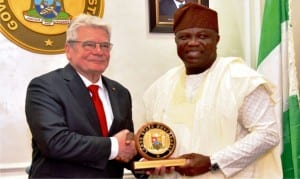
Governor Akinwunmi Ambodi of Lagos State (right), presenting a souvenir to the German President, Mr Joachim Gauck, during his visit to Lagos State, recently.
Adamawa
An Abuja based Non- Governmental Organisation (NGO),
Adventist-Development and Relief Agency (ADRA), is rendering support to 514 households of Internally Displaced Persons (IDPs) in Adamawa State.
The Emergency Management Coordinator of the group, Mr Peter Odiahi, disclosed this at the presentation of relief materials to some households in Michika Local Government Area of the state.
Odiahi said that the gesture was part of efforts by the organisation to assist returning IDPs to integrate them to the society.
He explained that the organisation with the support of the UN Foods and Agriculture organisation (FAO), had provided the IDPs with various agro food processing machines to improve their livelihoods.
According to him, ADRA as an International NGO, has been working in partnership with the FAO, and the United Nations Development Programme (UNDP) in providing humanitarian services to displaced persons in seven local government areas worst affected by activities of Boko Haram in Adamawa.
Bauchi
Nigerien citizens living in Bauchi State have expressed
optimism that Sunday’s general elections in their country would reflect the wishes of the electorate.
Some of them, who spoke to newsmen in Bauchi, said they were satisfied with the arrangement made by their country’s electoral body.
They were particularly pleased with the opportunity given to Nigeriens in diaspora, to exercise their franchise.
They however said the number of vehicles provided to enable them travel to designated states to cast their votes, were inadequate.
One of them, Abubakar Mohammed, said six vehicles were provided in Bauchi for them to travel to Kano, the nearest voting centre, as such only few of them could make it.
Borno
Some Internally Displaced Persons (IDPs) at the Dalori Camp
II along Bama Road, Maiduguri, Borno State, have called for improved living conditions in the camp.
The IDPs made the appeal while speaking to newsmen during a visit to the camp by the UNHRC.
According to them, some of the challenges they face included inconsistent and poor feeding, poor sanitary conditions, lack of proper medical attention, deplorable sanitary condition and poor security.
The IDPs said although the government was trying, they needed improved welfare, urging the government and NGOs to take their welfare as a priority because they are Nigerian citizens who are just victims of circumstance.
Malam Abatcha Ali, the Men’s Leader of the camp, said in spite of the best efforts of government, displaced persons continue to suffer hunger and other deprivations in the camps.
Gombe
Citizens of Niger Republic residing in Gombe State, have
called on whoever emerge president of the country, to sustain the collaborative effort in the fight against insurgents.
Speaking with newsmen in Gombe, they said that the progress of Niger Republic, Nigeria and other neighboring countries depended on restoration of peace to the region.
They also admonished losers in Sunday’s general elections in the country, to exhibit spirit of good sportsmanship in defeat, while urging winners to be magnanimous in victory.
A Nigerien, Bala Buzu, said whoever would be elected president, should join hands with Nigeria and other countries in the fight against insurgents.
According to him, a lot of people in Niger, Nigeria and other countries are suffering as a result of the activities of insurgents.
Kaduna
Kaduna State Government on Sunday, tasked religious
leaders to assist monitor projects that are being executed within their areas, by ensuring that contractors give the communities value for their money.
The Director- General of Interfaith Matters, Engr. Namadi Musa gave this advice in a press statement made available to newsmen.
According to the statement in sensitisation meeting with Muslim and Christian religious leaders in the three senatorial zones, Musa urged them to report any project that is being shoddily executed to relevant authorities.
It stated that Governor Nasir El Rufa’i had started fulfilling his campaign promises with the ongoing school feeding programme, roads, hospitals and schools rehabilitation across the state.
Katsina
The Katsina State Government has set aside the sum of
N2.5 billion for the rehabilitation and upgrading of Ajiwa Water Treatment Plant to solve the perennial water scarcity faced in Katsina metropolis.
Governor Aminu Masari gave the figure while inaugurating the Association of Retired Civil Servants of the state Water Board in Katsina.
Masari said that the water treatment plant, which was constructed and commissioned in the 1970’s, was neglected by the previous administrations despite serving the Katsina State capital and its environs.
He said that the plant would not be able to provide enough water for the citizens of the metropolitan area due to obsolete facilities that had been overstretched.
The governor revealed that the rehabilitation work at the plant would include replacement of outdated equipment as well as laying of new pipes to provide additional 40 million litres of water daily to the metropolis.
Lagos
Lagos State Police command said it had begun
investigation into the death of one Afape Fatai, who allegedly committed suicide in his kitchen.
The command’s spokesperson, Superintendent of Police (SP) Oladapo Badmos, in a statement said the incident happened on Saturday at about 6 am at No. 28, Orioji Olarenwaju Close, Ijaiye in Lagos.
It stated that the deceased, whose age, marital status and occupation were not mentioned, allegedly hung himself with a rope in his kitchen.
“Police detectives from Meiran Division visited the scene, photographed and examined the corpse.
“The police later visited the scene of the crime, removed and deposited the body at Ijaiye General Hospital morgue.
Nasarawa
The National Council of Muslim Youth Organisations
(NACOMYO) has urged residents of Nasarawa State to avoid rats in order to prevent Lassa fever.
The National President of NACOMYO, Alhaji Kamal’ddin Akintunde, made the call at a one-day awareness campaign on Lassa fever organised by the Nasarawa State chapter of the organisation in Karu.
He said that the call had become imperative due to the effects of Lassa fever on human health and the socio-economic development of the country.
“First and foremost, I want to commend the state chapter of NACOMYO in organising this awareness campaign in Kube, Beti, Kare and Kugwaru, among other communities of Karu.
Ondo
The Ondo State Government says it will sanction any
household that has no registered waste bin and prosecute anyone caught dumping refuse indiscriminately in the state.
The Chairman, Ondo State Waste Management Board, Mr Shina Fadamitan, told newsmen in Akure that the move would ensure cleanliness in the state.
“It is an offence for any household not to have a registered waste bin in Ondo State and anybody caught dumping refuse will be prosecuted according to the laws of the land.
“We have made this decision because we have noticed that there is an increase in the number of illegal dumping sites across the state.
Oyo
Dean, College of Medicine, University of Ibadan, Prof.
Juwon Arotiba, has called for the introduction of Bio-Medical Engineering courses in more tertiary institutions in the country.
Arotiba made the call in an interview with newsmen in Ibadan.
He said if more tertiary institutions would introduce such courses, the problems of inadequate and ineffective medical equipment in Nigerian hospitals would be resolved.
Arotiba defined Bio-Medical Engineering as biological or medical application of engineering equipment.
“It is the application of biological techniques (as genetic recombination) to create modified versions of organisms (as crops), especially.
Plateau
The Catholic Bishop of Pankshin Diocese, Most Rev. Michael
Gokum, has urged Christians to support the Internally Displaced Persons (IDPs) in the North-Eastern part of the country.
The Bishop said this during the launch of the 2016 Lenten Campaign of the diocese in Pankshin, Plateau State.
He said that this year’s campaign was to raise funds to support IDPs, less privileged and the destitute in the society.
The theme of the campaign is: “the Right to Security and Sustainable Development Goals.’’
‘’We are all God’s creation brought into existence by one living God, so there is the need to extend support to the have-nots.
“In our world today, there are many who can’t afford a single meal in a day, others don’t have where to lay their heads, while very many don’t have what to wear.
“A lot of people in our society, especially those in the north-eastern part of our country have fled their places of abode because of the incessant attacks by Boko Haram; these people need support.
Yobe
Chairman, Inter Party Advisory Council (IPAC) in Yobe, Alhaji
Umar Kukuri, has urged the state government to conduct elections into the 17 local government councils as required by law.
Umar made the call in an interview with newsmen in Damaturu while reacting to the inauguration of local council caretaker chairmen appointed by Gov. Ibrahim Gaidam.
“IPAC was expecting the state government to conduct election into the local councils after the expiration of the former councils in December last year,” the IPC chairman said
He said political parties in the state had commenced preparations for a new election before the appointment and inauguration of the new caretaker chairmen.
“The council wishes to remind the state government of the constitutional provision which recognises elected officials for local government councils.
“As a state under the national ruling party, we hope the provisions and sanctity of the constitution will be respected and protected,” he said.



The Hydrocarbon Pollution Remediation Project (HYPREP) has announced that the mangrove wetlands in Ogoniland have been officially designated a Ramsar Site of International Importance by the Secretariat of the Ramsar Convention on Wetlands.
The designation, according to HYPREP, underscores the global ecological significance of Ogoniland’s mangrove wetlands and highlights ongoing restoration efforts aimed at addressing environmental degradation in the area.
In a press statement issued by the Project Coordinator of HYPREP, Prof Nenibarini Zabbey, the recognition was described as a major milestone for the agency, the people of Ogoni and other stakeholders working towards environmental restoration in the region.
Zabbey explained that the mangrove wetlands, which cover more than 31,700 hectares, consist of islands, tidal creeks, mudflats and mangrove forests that support a wide range of biodiversity. The ecosystem provides habitat for several species including fin fish, shellfish, crustaceans, crocodiles, turtles and the endangered grey parrot.
He noted that beyond biodiversity conservation, the wetland also provides essential ecosystem services such as fisheries production, flood control, water purification and carbon storage. According to him, the international recognition will further support local livelihoods, promote ecotourism and bring global attention to the region.
The HYPREP coordinator disclosed that the designation followed a meticulous process that began in 2024 when the project submitted a memorandum to the National Council on Environment seeking support for the recognition of the Ogoni wetlands as a Ramsar site.
Following the council’s review and approval, the Honourable Minister of Environment and Chairman of HYPREP’s Governing Council, Balarabe Abbas Lawal, formally wrote to the Ramsar Convention Secretariat requesting international recognition of the wetlands.
After a comprehensive ecological assessment, the Ramsar Secretariat granted the designation, officially recognising the Ogoniland wetlands as one of the world’s sites of international importance.
Zabbey said the recognition would strengthen ongoing environmental restoration efforts in the area and encourage stronger conservation measures and sustainable management of the wetlands for the benefit of present and future generations.
He added that the designation also fulfils a key recommendation of the United Nations Environment Programme (UNEP) Environmental Assessment Report on Ogoniland, marking another significant step in the implementation of the report’s recommendations.
The HYPREP project coordinator reaffirmed the agency’s commitment to restoring the Ogoni environment through the remediation of oil-polluted land, shorelines and mangrove ecosystems.
He also called for collective responsibility and stakeholder support to sustain the progress of the Ogoni cleanup programme and facilitate the development of a comprehensive and sustainable management plan for the Ogoni mangrove wetlands.

The Permanent Secretary, Rivers State Ministry of Social Welfare and Rehabilitation, Mrs Lauretta Davies-Dimkpa, has attributed the successes of the 12-day programme organised for adolescent girls aimed at eliminating Female Genital Mutilation(FGM) in some parts of the State to the ability of the respective stakeholders to take ownership of the programme.
Mrs Davies-Dimkpa, who dropped the hint in an interview at the end of the programme in Elele-Alimini Community in Emohua Local Government Area on Saturday, said the event had a buy-in component, an ownership mentality, whereby facilitators, staff, and everyone involved took ownership of the project.
She explained that the Rivers State Ministry of Social Welfare and Rehabilitation, in collaboration with the United Nations Children’s Fund (UNICEF) and the United Nations Population Fund (UNFPA) had packaged a series of training sessions for adolescent girls aimed at ending the practice of Female Genital Mutilation (FGM) in some communities across the State.
According to her, the initiative was designed to educate young girls on the harmful effects of the practice and empower them to become advocates against it within their communities.
She noted that the programme, which lasted for several weeks, targeted adolescent girls from different local government areas where the practice is still prevalent, stressing that
data collected by UNICEF and the Ministry revealed that Female Genital Mutilation is still practised in some parts of the State, prompting the need for intensified sensitisation and community engagement.
Mrs Davies-Dimkpa explained that the programme adopted a “train-the-trainer” approach where adolescent girls were educated on the dangers of the practice and encouraged to share the knowledge with their peers, families and communities.
“This is a programme by the Rivers State Ministry of Social Welfare and Rehabilitation with support from UNICEF and UNFPA to train adolescent girls towards ending Female Genital Mutilation, which is still practised in some local government areas,” she said.
She further explained that each participating local government area had a three-day training session, with the exercise running for a total of 12 days.
The local government areas, where the programme took place, she noted, included Ahoada West, Abua-Odual, and Emohua, adding that the initiative is part of broader efforts by the state government and development partners to eliminate harmful traditional practices and protect the rights and wellbeing of girls.
She revealed that prior to the training of the adolescent girls, the Ministry and its partners had also engaged community facilitators, including older women and men, to sensitise them on the dangers associated with Female Genital Mutilation.
According to her, the involvement of community leaders and adults is essential in addressing the cultural and social factors that sustain the practice.
Speaking on the response of the participants, the permanent secretary expressed satisfaction with the level of engagement and enthusiasm shown by the girls throughout the training sessions.
She noted that many of the participants said they were learning about the harmful effects of Female Genital Mutilation for the first time.
“The girls are between the ages of 12 and 17 and from the interactions we had with them, they were very excited. Some of them are hearing these things for the first time and never knew that the practice is harmful,” she said.
She expressed optimism that the knowledge gained from the training would enable the girls to serve as advocates for change within their communities.
She added that the Rivers State Government, alongside its partners, would continue to intensify efforts and expand community-based interventions aimed at ending the practice across the State.
Meanwhile, the participants for Emohua Local Government Area were drawn from Elele-Alimini, Egbeda, Rumuji, Ibaa, Rumuekpe, Rumuakunde, Eligbarada, and Ogbakiri Communities.
The participants,who spoke in separate interviews described the training as eye-opening, noting that it helped them better understand issues surrounding adolescent health, personal hygiene, reproductive health, and the harmful consequences of Female Genital Mutilation.
Favour Azukwu from Rumuekpe community, said the programme provided a deeper understanding of the dangers associated with the practice, particularly its impact on the health and wellbeing of girls and women.
She explained that the training sessions exposed participants to the medical, social and psychological effects of Female Genital Mutilation, including severe bleeding, infections and complications during childbirth.
She revealed that she personally experienced the practice at the age of 12 and suffered heavy bleeding afterwards, an experience that has strengthened her determination to advocate for its eradication.
According to her, many communities still practise Female Genital Mutilation because it is perceived as a cultural tradition, despite the dangers associated with it.
“I do not support Female Genital Mutilation because there are many dangers involved. I experienced severe bleeding when it was done to me as a child.
Another participant, Glory Ken, a 16-year-old secondary school student from Rumuji community, said the programme broadened her understanding of several important topics affecting adolescents.
She explained that beyond the discussion on Female Genital Mutilation, the training also focused on issues such as personal hygiene, reproductive health, peer education, and self-care.
According to her, the sessions helped participants understand the importance of making informed health decisions and supporting one another as peer educators.
“I learned about many things that affect young people in society and how to take care of myself. I also learned that Female Genital Mutilation is harmful to our health. The message I am taking back to my community is that this practice should stop,” she said.
Also speaking, Goodness Kenjika Nyeche described the programme as very impactful.
She noted that the training equipped participants with the skills and confidence to educate others about the harmful effects of Female Genital Mutilation.
She said she plans to organise sensitisation among adolescents in her community, particularly girls between the ages of 10 and 19, to ensure they understand the dangers associated with the practice.
“I learned many things from this programme and I feel very good about it. I will educate other young girls in my community and help them understand why Female Genital Mutilation should not continue,” she said.
For Queen Dike from Ibaa community, the programme helped clarify misconceptions surrounding the practice.
She explained that in some communities, the practice is still referred to as circumcision and is viewed as part of cultural identity.
She said the training helped participants understand that Female Genital Mutilation involves the cutting or removal of parts of the female genital organs and that it has serious health consequences.
She stressed that awareness and education are key to ending the practice, especially among communities that continue to uphold it as tradition.
“I think the programme is very helpful because many people still believe it is part of culture. More awareness is needed so people can understand why it should stop,” she said.
Another participant, MyJoy Echika Amadi, said the programme provided critical information about adolescent health and the dangers associated with Female Genital Mutilation.
She described the initiative as enlightening and said it encouraged young people to become advocates for change in their communities.
According to her, participants were encouraged to use various platforms such as churches, peer groups, schools and community gatherings to spread awareness about the harmful effects of the practice.
“This programme has enlightened us about the dangers of Female Genital Mutilation. I will do my best to create awareness in my community and encourage people to stop the practice,” she said.
Many of the participants emphasised that the knowledge gained during the programme has empowered them to challenge harmful traditions and promote healthier practices among young people.
They also called on the Rivers State Government, development partners and civil society organisations to sustain the sensitisation campaigns and extend the training to more communities across the State.
According to them, empowering young people with the right information will play a critical role in eliminating Female Genital Mutilation and protecting the rights, health and dignity of girls in Rivers State.
The participants expressed appreciation to the Rivers State Ministry of Social Welfare and Rehabilitation, UNICEF and UNFPA for organising the programme and for investing in the wellbeing and future of adolescent girls in the State.

-

 News1 day ago
Police Arrest Nigerian, Two Others For Kidnapping In Edo
-

 Business20 hours ago
NERC Amends Order on Meter Tampering, Power Bypass For Discos
-

 Business20 hours ago
Nigeria, AFC sign $1.3 billion deal to build alumina refinery
-

 Rivers19 hours ago
KENPOLY Rector Promises To Prioritise Students’ Welfare
-

 News1 day ago
NDLEA Arrests Ex-Councillor With 40kg Skunk, Recovers Drugs In Diapers
-

 Nation1 day ago
Perm Sec Explains Success Of FGM Elimination Programme In Rivers
-

 Business20 hours ago
NCDMB Signs Mgt Deal With Radisson, Edison…As Board’s 204 Rooms Hotel Open December 2026
-

 Rivers19 hours ago
Don, Stakeholders Urge Environmental Laws In N’Delta