
Nation
THE STATES

Benue
Makurdi Magistrates’ Court has remanded five accused
persons, including two brothers, in prison custody for allegedly killing a herdsman, Dahiru Idris.
Those remanded were Adah Effeche, Gabriel Ejeh, Daniel Ugwueke, Sunday Ugwueke and Boniface Onoja of various addresses in Edumoga, Okpokwu Local Government Area of Benue.
They were arraigned on a two count-charge of criminal conspiracy and culpable homicide.
They were charged with punishable under Sections 97 and 222 of the Penal Code of Benue, 2004.
Prosecutor Terzungwe Kajo told the court that the case was transferred from the Divisional Police Headquarters, Okpokwu to State CID on December 28, 2015 via a letter for investigation.
Ekiti
Ekiti State Government said that it had recorded one case
of the dreaded Lassa Fever.
The state Commissioner for Health, Dr. Olurotimi Ojo, made this known at a Stakeholders Forum on Lassa Fever in Ado-Ekiti.
Ojo said that the patient was discovered at the Federal Teaching Hospital, Ido Ekiti at the weekend.
“The state has confirmed a Lassa Fever case that is being managed at the Federal Teaching Hospital, Ido Ekiti.
“The patient is stable and has commenced treatment,” he said.
Meanwhile, the government has said that no fewer than 500,000 children will be immunised against measles in all parts of the state between January 28 and February 1, 2016.
FCT
Tourists and guests have called on hotel owners in Abuja
to provide better security and improve their facilities to justify the high charges on services.
The respondents made the call in separate interviews with newsmen.
Mr Franklin Andrew, a tourist from Canada said that he was visiting Africa for the first time and decided to start with Nigeria, adding his experience in terms of security was not too pleasant.
“I have been to other countries where people use encoded keys to protect their rooms; it was only at the Protea and Transcorp Hilton hotels that I used a card to open my room doors.
“When I wanted to experience a close-to-nature-touch, I went to another hotel; here in Abuja, where the experience was nothing to write home about.
Jigawa
The Sole Aministrator of Malammadori Local Government
in Jigawa State, Alhaji Ali Alkali, said the council had adopted measures to control soil erosion in the area.
Alkali stated this in an interview with newsmen recently in Malammadori.
He said that the council had implemented steps to control erosion at Maudachi burrow pit which he said, was threatening road and adjourning farmlands.
He said that the council had sought for the intervention of the state’s Ministry of Land for boundary definition of the pit site.
“We called for clear demarcation of boundary between Malammadori and Hadejia local government areas on the eroded land, this will facilitate effective management of the pit,” he said.
Kaduna
The National Commission for Mass Literacy, Adult and
Non-Formal Education (NMEC) says it is targeting a literacy-target of five million people in 2016.
Its Executive Secretary, Alhaji Jibrin Paiko, said this in Kaduna at the opening of a two-day workshop on coordination and management of non-formal education in Nigeria.
Our correspont reports that the workshop was jointly organised by NMEC and the Universal Basic Education Commission (UBEC).
It was for executive directors of agencies for mass education from the 36 states of the federation and the FCT.
According to Paiko, the workshop is designed to provide the managers with skills and schemes that will serve as a guide in achieving the set target.
Katsina
Sheikh Dayyib Haruna-Rasheed, National Leader, Madinatul
Ahbab Waltalmiz Islamic Schools, has called on parents and community leaders to support teachers on inculcating moral training in children.
Haruna-Rasheed made the call at the graduation of 23 students who mastered the reading of the Holy Qur’an from the Fayamasa Malumfashi branch of the Madinatul Ahbab Waltalamiz Islamic Schools.
He said the school was set up to provide moral training and education on Islam, including inculcation of the right ideologies and knowledge on interpretations of the Holy Qur’an.
He, therefore, urged parents to support the schools in promoting religious ideals and morality in their children.
The cleric disclosed that the organisation had established 474 schools in 450 communities located in Nigeria and Niger Republic.
Kwara
An Indian philanthropist, Mr Naranbai Patel, has pledged
a donation of N25 million to support researchers at the University of Ilorin.
This is contained in the university’s bulletin, according to the bulletin, Patel, who was impressed by the collaboration between the University of Ilorin and Uka Tarsaida University (UTU), Bardoli, India, sent a letter to the University of Ilorin’s Vice Chancellor.
The bulletin said that in the letter, Patel, promised to redeem his pledge in five equal installments of N5 million over a period of five years.
It said the philanthropist expressed confidence in the ability and visionary skills of the university administration under the leadership of Prof. Ambali.
Lagos
A 70 -year-old man, Mutairu Afolabi, has sought the
dissolution of his 36 years marriage to Monsurat, 60, over alleged bleaching and conversion of his wife to Christianity.
Afolabi told the court that as an Imam his wife’s conversion from Islam to Christianity had brought him shame.
He said that the marriage was consummated in 1980 and produced four children, from age 20 to 33.
“The smell of her body since she started bleaching is not good for my health, why should she be bleaching at her age, she now a grandmother.
“Her name is Monsurat before I married her, my wife is now known in the whole Celestial Churches in Lagos; I’m an Imam how do I explain that.
“She goes out at will, without my permission, she curses a lot and I can see that her curse is coming to pass in the lives of my children.
“I told my wife that I have diabetes the next day she started singing that God should add honey and sugar to her life.
Nasarawa
The police have arraigned a 29-year-old trader, Agbo
Michael, in a Mararaba Grade 1 Area Court, Aso Pada, over the alleged theft of his neighbour’s generator.
The accused, who resides behind the Catholic Church, Aso, Mararaba, is standing trial on a two-count charge of house breaking and theft.
According to the Prosecutor, Cpl. Friday Adaji, one Itodo Leonard of same address with the accused reported the matter at the Aso Pada Police station on January 18.
Adaji said on the same date at about 2 p.m., the accused broke into the complainant’s house and stole the generator, valued at N31, 000.
“The accused also stole the sum of N10, 000 which the complainant left at home, when he went to work.
Ogun
A 39-year old man, Emeka Uboh, has appeared before an
Ota Chief Magistrates’ Court, Ogun, for allegedly damaging a gate and other items worth N100,000 belonging to one Boniface Ibeh.
Uboh, who resides at No. 11 Banjo St., Ishaha, Ota, Ogun, is facing a two-count charge of malicious damages and threat to life.
The Prosecutor, Sgt. Itaita Ebibomini, told the court that the accused committed the offences on October 11, 2015 at about 12:00pm at No. 3, Agbala Itura, Ishaha in Ota.
Ebibomino said that the accused damaged a building gate and other items worth N100, 000, property of Ibeh.
He said that the accused also threatened the complainant with a broken bottle.
Osun
The Osun State House of Assembly has directed the state
Ministry of Health to suspend the proposed increment in tuition fees of state-owned schools of nursing, health technology and midwifery.
Mr Kamil Oyedele, the Chairman, House Committee on Finance and Appropriation, gave the directive in Osogbo when the management of the ministry appeared before the committee for the defence of its 2016 appropriation bill.
The Permanent Secretary in the ministry, Dr Temitope Oladele, in her defence had told the committee that one of the ways the ministry could boost its revenue generation for the year was by increasing its tuition fees.
Plateau
An elder statesman, Ambassador Yahaya Kwande, has
commended the success so far recorded in the fight against corruption and challenged the judiciary and the police to “play their roles effectively”.
“The Federal Government’s fight against corruption is gaining the right momentum and is in line with the cardinal goal for which President Muhammadu Buhari was voted into office.
“What remains is for the judges and police to play their own roles, so that the suspects would be convicted if culpable, to serve as a deterrent and also rid the nation of this canker-worm,” Kwande told newsmen in Jos.
According to him, the constitution is clear on how to tackle the menace.
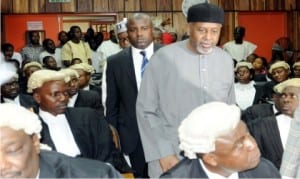
Former National Security Adviser (NSA), Retired Col. Sambo Dasuki, arriving the High Court of the Federal Capital Territory where he is standing trial over alleged misappropriation of N32billion arms fund in Abuja on Friday. The case was adjourned till February 4 for the hearing of the Ex-NSA’s application for stay of proceedings.


The Movement for the Survival of the Izon Ethnic Nationality in the Niger Delta (MOSIEND) has decried the neglect of communities in Obolo Nation and others in the Niger Delta Region
MOSIEND also called on the stakeholders to empower the youths in skill acquisition and other meaningful ventures to better their lives
This call was on Rhythm 93.7 FM Port Harcourt, Radio program, Talk of the Town, by MOSIEND Eastern Zonal Coordinator of MOSIEND Half Hour Comrade Tammy Bruce Longjohn, alongside Asarama Clan Chairman, Comrade Amos Zebedee Udu, and Unyeada Clan Chairman Comrade Owen Wilson Ngere monitored by our correspondent
The spokepersons underscores the urgent need for government agencies and development partners to respond decisively to the dire state of basic amenities in the area.
MOSIEND leaders in Obolo Nation lamented the absence of potable water, electricity, access roads, and other functional public infrastructures in the clans
“What is troubling is that these complaints continue to echo without corresponding action from the Rivers State Government, the Niger Delta Development Commission, and the oil companies operating in and around the area”.
According to the MOSIEND leaders, the situation has reached a point where community members, particularly youths and women, require deliberate intervention to rebuild livelihoods and restore hope.
They also emphasised the need for empowerment programmes, vocational training, and investments in local economies that depend heavily on fishing and trade.
The Clan leaders call for provision of small engine boats for fishermen and the construction of proper market spaces for the communities
Asarama Clan Chairman, Comrade Udu noted that the community participates fully in electoral processes yet continues to live without clean water or electricity.
He insisted that the clan is not benefiting as they ought to from any MoU with oil companies nor from NDDC projects, raises concerns about the fairness and inclusiveness of development planning in the state.
Equally troubling is the account from Unyeada Clan Chairman, Comrade Owen Wilson Ngere, who highlighted the alarming state of Unyeada Primary School, where children are forced to learn on bare floors without desks, chairs, or basic sanitation facilities.
” For a region that hosts oil and gas activities, such conditions are unacceptable and should concern all stakeholders”.
The Unyeada Clan Commended NDDC for the installation of solar lights in the communities, noting that the project is not enough for the entire community as they
appeal for more of the solar project in the area
While the leaders expressed appreciation to Governor Siminalayi Fubara for the ongoing construction of roads in the area, and to the local council Chairman for the provision of potable water in some communities, .
“Obolo Nation has shown remarkable restraint and continues to maintain peace, as noted by the MOSIEND Coordinator”.
“The issues highlighted are not demands for luxury,but are basic necessities that every community in the Niger Delta deserves.
“The time for promises has passed; what Obolo communities need now is visible, sustained, and inclusive development.
Chinedu Wosu
Prominent academics and industry players have called on government at all levels to partner with the Rivers State International Film Festival (RIFF) to unlock the hidden potentials of the film industry and market the State to the international community.
The appeal was made at the opening ceremony of the 3rd edition of the festival, held recently at Ezewali Event Centre in Port Harcourt.
The festival, which featured film screenings, workshops, and discussions, aimed to promote Nigerian culture and provide a platform for filmmakers to showcase their work.
A lecturer at the University of Port Harcourt, Prof Femi Shaka; Mr Tobechukwu Daniel: and the Chief Executive Officer of Down Town Cinema, Mrs Nneka Clareth commended the Chief Executive Officer of RIFF, Kate Ezeigbo for her efforts in promoting the culture of the Niger Delta and Nigeria through film.
According to Prof Shaka, “They are telling our stories the way nobody else will tell it. It gives them the opportunity to show the world what we have.”
He urged the Rivers State Government, under the leadership of Sir Siminalayi Fubara, and other Governors from the Niger Delta States to support RIFF, describing it as a marketplace where upcoming stars can showcase their talents.
Mr Tobechukwu Daniel, one of the founding fathers of RIFF, expressed satisfaction with the four-day programme, which was jam-packed with activities that had a direct impact on the participants and the industry.
He emphasised the need for government partnership, stating that funding from governments, multinationals, and captains of industries is crucial for the growth of the film industry.
“The international participation in RIFF programmes will boost our economy, as they will watch our cinema, buy our films, and give our youths opportunities to showcase their talent,” Daniel said, advising actors and actresses to focus on professionalism rather than godfatherism.
Mrs Nneka Clareth, who has been in the business for 12 years, noted that lack of funding is a setback to the nation.
“I want the government to support Nollywood in totality, because Nollywood covers visibility, sustainability, culture, tourism, storytelling, and a whole lot,” she said.
The festival, which featured free medical treatment, film production, scriptwriting, and discussions on various topics by professionals, drew participants from different parts of the world.
The organisers commended Kate Ezeigbo and her team for putting together a wonderful event, urging participants to make proper use of the opportunity.
The Chairman of Hausa Butchers Association in Ahoada East Local Government Area of Rivers State, Alhaji Hamisu Jika, has commended the Chairman of the local government council, Hon Solomon Abuba Ochoma for organising a successful free medical outreach programme that benefited thousands of people in the area.
The outreach, which was organised by the local government council provided free medical services to thousands of people, including the elderly, women, and children, healing many with different ailments.
Alhaji Jika described Hon Abuba as a visionary leader, who has the welfare of his people at heart, noting that he is a de-tribalised Nigerian citizen who is determined to run an all-inclusive government.
He pledged the total support of the Hausa community to the administration of the council chairman in all its programmes and policies.
According to Alhaji Jika, the Hausa community in Ahoada East is law-abiding and will continue to maintain the existing peace in the area.
“Honestly, I want to tell you that we are peace-loving people and we are solidly behind the administration of the Executive Chairman of Ahoada East in all his programmes and policies in the local government,” he said.
The chairman revealed that the Hausas and their hosts, the Ahoada people, have been enjoying a cordial relationship since they started settling in the area, stressing that the council chairman has been a good leader who does not condone evil.
He expressed optimism that Hon Abuba will improve the comfort and wellbeing of the people and transform the council area, noting that the chairman has his people at heart.
He, therefore, called on both indigenes and non-indigenes of the local government to rally round the chairman, as he needs their support to take the local government to another level.
He appealed to the chairman to look into the welfare of Hausa people and help them with soft loans to boost their businesses, noting that some of the Hausas were born and brought up in Ahoada and have married there, and there is understanding and cordiality amongst them in the area.
Alhaji Jika also called on the youths to be law-abiding and stay away from trouble, stressing that where there is no peace, there will not be any meaningful development.
It was gathered that the Chairman of Ahoada East Local Government Council, Hon Solomon Abuba Ochoma has indeed started well and is working hard to fulfill his electioneering promises, making him a charismatic leader and the man of the people.
-

 Niger Delta4 days ago
Bayelsa’s Aircraft Makes Inaugural Flight…As Lawmakers, Oil Minister, NDDC’S MD Hail Diri
-
 Nation17 hours ago
Ogoni Power Project: HYPREP Moves To Boost Capacity Of Personnel
-
Nation17 hours ago
Hausa Community Lauds Council Boss Over Free Medical Outreach
-
Nation17 hours ago
Association Hails Rivers LG Chairmen, Urges Expansion Of Dev Projects
-
Nation17 hours ago
Film Festival: Don, Others Urge Govt To Partner RIFF
-
Rivers17 hours ago
UNIPORT Moves To Tackle Insecurity … Inducts Security Experts
-
Nation17 hours ago
Traditional Rulers Advise Khana Youths To Shun Politics Of Bitterness
-
News17 hours ago
HYPREP Tightens Security At Project Sites