
Politics
2015 And Electoral Violence In Nigeria

There is no agreeable
‘definition of electoral violence. This is because of the contentious issue of “violence begets violence” developed by Frantz Fanon in the era of anti-colonial struggles. The Fanonian argument is predicated on the fact that ‘violence provokes violence’. So those who retaliate to the first violence of political opponent do not agree that they are perpetrating violence. They sirnply argue that they are countering violence.
From the array of definitions available, one can glean an operational definition. Operationally, electoral violence connotes all forms of violence (physical, psychological, administrative, legal and structural) at different stages engaged in by particiipants, their supporters and sympathizers (including security and election management body staff) in the electoral process. These forms of violence take place before elections, during elections and after or post-election, and could also be intra- or inter-party.
Since Nigeria became independent on October 1st 1960, the history of election has been written in violence. The Human Rights Watch (2007) in its follow up of post-independence events in Nigeria describes the nation’s post-independence history as being overshadowed by the depredations of a series of corrupt, abusive, and unaccountable governments. This description is apt because it appears that Nigerians seem to have acquired a culture of electoral violence as seven of the eight general elections conducted since independence in 1960 have been violence-ridden -1964/1965,1979,1983,1999,2003, 2007 and 2011.
For example, at independence, the country adopted a parliamentary system of government akin to the British type. The first post-independence election organized by that government led by Prime Minister Tafawa Balewa\President Nnamdi Azikiwe in 1964 and 1965 were characterized by widespread complaints of fraud, violence and intimidation. Protests in the wake of the regional elections, which in some areas degenerated into a violent exercise in competitive rigging, led to widespread violence and inter-communal rioting that claimed more than 200 lives.
Later in January 1966, the military struck and the fledging Nigerian democracy was thwarted by the action of its very own practitioners. From 1966, the military held sway until 1979 when they handed over to another civilian government headed by Alhaji Shehu Shagari of the National Party of Nigeria (NPN). The Shagari-Ied government organized a civilian to civilian transition election but again like its First Republic counterparts, repeated history and massively rigged the 1983 general elections through very violent means in connivance with the election management body, Federal Election Commission (FEDECO) and security forces. That again set the stage for the second wave of military intervention in the nation’s politics on December 31, 1983. The military from then remained in power until May 29, 1999 after, several attempts to democratize.
Suffice it to say that between independence in 1960 and 1999 when civilian rule was restored, Nigeria produced only two elected governments and both were overthrown in military coup de’tats before completing a second term in office. In all, Nigeria’s military ruled the country for nearly 30 of its first 40 years of independence, excluding the three months of short-lived Interim National Government (ING)
Since the restoration of civil rule, attempts have not been made by politicians to deepen and strengthen democracy. Instead, Nigeria has only added to its history fraudulent and violent elections. The 1999, 2003 and 2007 general elections that brought President Olusegun Obasanjo and later late President Umaru Yar’ Adua to power were marred by such widespread violence and fraud.
For example, the US-based Jimmy Carter Centre for Democracy which monitored the 1999 election as an international observer concluded its report on the outcome of the presidential election like the others before it thus: “It is not possible for us to make an accurate judgment about the outcome of the presidential election”. In the same vein, the 2003 elections were more pervasively and openly rigged than the flawed 1999 polls, and far more bloody.
These events set the stage for the 2007 elections which both domestic and foreign observers succinctly described as the worst in Nigeria’s history ranking among the worst conducted anywhere in the world in recent times. For instance, the US-based National Democratic Institute (NDI) stated in its post-election statement that the electoral process “failed the Nigerian people”.
The Human Rights Watch (2007) which monitored the election in its report said the Nigeria’s failed April 2007 polls cast a harsh and very public light on patterns of violence, corruption and outright criminality that have come to characterize Nigeria’s political system-and on the extent to which officials and institutions at all levels of government accept, encourage and participate in those abuses. The 2007 and 2011 general elections had come and gone with some cases still in courts, Nigerians .are afraid of future elections especially the 2015 elections that is a stone throw away.
There are plethora of reasons that account for the causes of electoral violence.
These include rigging, ineffectiveness of security forces and culture of impunity, partisan disposition of the security forces detailed to monitor elections, weak penalties against defaulters and poor handling of election petitions, among others.
It is true that electoral violence has characterized our political elections since independence. This trend can be reversed only if we can change our mindsets on what politics and governance is all about. Politics should not be conceived as the most lucrative industry in Nigeria. It is this mindset that makes aspirant or political office seekers to exhaust “all means” in capturing the position. It should be seen as a service to humanity and protecting the lives and the welfare of our prosperity.
Governance should be transparent at all levels. Electoral rules should be enforced. Political positions should be made unattractive by downward review of their take-home salary/allowances. Within our constituencies, we should be our brothers’ keeper. Electoral officials should devoid themselves of corrupt practices, while law enforcement agents should remain neutral. Politicians found parading thugs should be disqualified from the race. Violence free election is achievable in 2015
Being an excerpt of a public lecture delivered at the sensitisation/awareness campaign by the Rundele Peoples Assembly in Port Harcourt, recently.
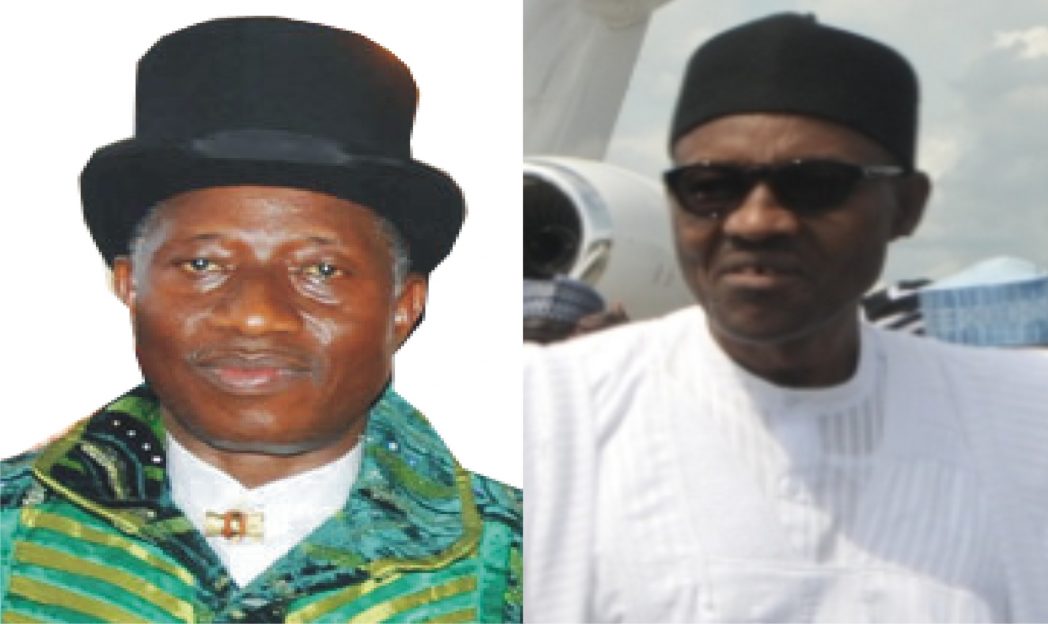
President Goodluck Jonathan and Buhari
Ben Thom-Otuya



The Independent National Electoral Commission (INEC) has extended the deadline for political parties to submit the list of candidates for the 2027 governorship and state Houses of Assembly elections from Saturday, August 8, to Tuesday, August 11, 2026.
The commission announced the extension in a statement issued on Saturday and signed by the National Commissioner and Chairman of its Information and Voter Education Committee, Mohammed Haruna.
According to INEC, the decision followed appeals by political parties for additional time to complete the submission process through the dedicated online portal.
“The submission window, which according to the revised Timetable and Schedule of Activities for the General Election was originally scheduled to close on Saturday, 8th August, 2026, has been extended to Tuesday, 11th August, 2026,” the commission said.
In a a related development, INEC announced the suspension of PVC collection in Osun State ahead of the August 15 governorship election.
The commission said voters who applied for replacement of lost, damaged or defaced Permanent Voter Cards would have until midnight on Sunday, August 9, to print downloadable copies of their cards.
The electoral body explained that the deadline was necessary to enable it compile data on downloaded PVCs and produce final statistics on the total number of cards collected ahead of the election.
INEC said PVC collection in Osun commenced at the Registration Area level from July 22 to 28, 2026, but was extended to July 31 following complaints about large crowds and difficulties experienced by voters at collection centres.
The exercise subsequently moved to the local government level and ran from August 1 to 7.
The commission also disclosed that replacement downloadable PVCs had been made available to voters in Odo-Otin and Ife Central Local Government Areas following the theft of cards during attacks on the two collection centres.
It stressed that the stolen cards could not be used to vote.
INEC reassured Osun residents of its preparedness for the August 15 governorship election.
“The commission reiterates that the stolen cards cannot be used to vote.
“INEC reassures the people of Osun State of its readiness to conduct a free, fair, credible and inclusive governorship election on 15th August, 2026,” the statement said.
The commission said the deadline, initially set for Saturday, 8 August, has been extended to Tuesday, 11 August 2026, following appeals from political parties for more time.
INEC also announced that the window for voters who applied to replace lost, damaged or defaced PVCs to download their replacement cards will close at midnight on Sunday, 9 August.
The move is to enable the commission compile final PVC collection figures ahead of the 15 August Osun governorship election.
INEC said replacement downloadable PVCs have also been provided to affected voters in Odo-Otin and Ife Central Local Government Areas after hoodlums carted away cards from two collection centres, stressing that the stolen cards cannot be used to vote.
The commission reaffirmed its readiness to conduct a free, fair, credible and inclusive election in Osun State.
Gov. Kefas made the remarks over the weekend at the Federal Medical Centre (FMC), Jalingo, during the flag-off of the second phase of the Renewed Hope Medical Outreach in Taraba State, organised as part of activities marking Prof. Yilwatda’s 58th birthday.
The governor commended Prof. Yilwatda for choosing to mark his birthday by providing medical care to people in need.
“What Professor Nentawe did is a powerful demonstration of what leadership should be,” Gov. Kefas said.
He assured that his administration would continue to support initiatives that complement government efforts to improve healthcare delivery and the wellbeing of residents.
Speaking at the event, Prof. Yilwatda called on Nigerian leaders to embrace the culture of giving and use their positions to touch the lives of the less privileged.
He said his decision to celebrate his 58th birthday in Taraba State was deliberate and informed by the needs of underserved communities, particularly people who face difficulties accessing healthcare because of distance and financial constraints.
According to him, the intervention followed a needs assessment and was extended across the three senatorial districts of the state.
He said the exercise commenced on August 3 at Takum General Hospital and covered the Federal University Teaching Hospital, Wukari; First Referral Hospital, Sunkani, Ardo-Kola Local Government Area; General Hospital, Bali; General Hospital, Gembu; and FMC Jalingo.
Prof. Yilwatda said the intervention provided medical services to thousands of beneficiaries, including people who required surgical procedures.
He said sustainable national development could only be achieved when strong institutions placed Nigerians at the centre of development.
“Leadership is about service,” he said, urging political and public leaders to make giving back to society an important part of their responsibilities.
He reaffirmed his commitment to serving Nigeria and its people, saying his personal vision was to make every day of his life useful to humanity.
“Every day that I live, the vision is: let it be useful to humanity,” he said.
The Taraba State Commissioner for Health, Dr. Bordiya Buma, commended the initiative, saying it was consistent with the Renewed Hope agenda and efforts to strengthen healthcare delivery in the state.
Dr Buma said the second phase followed the successful completion of the first phase, which was conducted simultaneously in six local government areas, with two LGAs selected from each of the three senatorial districts.
According to him, more than 10,000 patients were attended to during the first phase, including people with medical and surgical conditions.
He disclosed that 327 general surgeries, 71 eye surgeries and 575 dental procedures were carried out during the exercise.
The commissioner expressed appreciation to President Bola Tinubu for the Renewed Hope Medical Outreach and thanked Prof. Yilwatda for supporting the initiative and choosing Taraba State as a beneficiary.
The Minister of Health and Social Welfare, Prof. Muhammad Ali Pate, also commended Prof. Yilwatda for choosing Taraba State to mark his 58th birthday through a medical outreach.
Prof. Pate said making healthcare the centrepiece of the birthday celebration was significant because health affects everyone.
-

 News3 days ago
RSG Targets Nine Million Residents in Mosquito Net Distribution Campaign
-

 Oil & Energy3 days ago
Aiyedatiwa Signs New Electricity Bill
-

 Oil & Energy3 days ago
NLNG Commissions Research And Innovation Centre In RSU
-

 Maritime3 days ago
Marine Minister Commends President Tinubu On NPERA Bill Assent
-

 News3 days ago
KenPoly Holds Eight Convocations, August 29
-

 News3 days ago
RSG Begins Another Phase of Projects Commissioning Today
-

 News3 days ago
RMAFC Completes Revenue Sharing Review, Proposes New Pay
-

 Maritime3 days ago
NAGAFF Petitions IGP Over Alleged Maritime Police Harassment