
Nation
THE STATES

Bauchi
The Bauchi State Universal Basic Education Board
(SUBEB), Bauchi, has distributed items worth N26 million to physically-challenged pupils spread across various schools in the state.
The Executive Chairman of the Board, Alhaji Abdullahi Dabo, said in Bauchi while distributing the items, that the effort would assist the pupils pursue education with little difficulties.
Dabo said 150 wheel chairs, 100 crouches, 20 sewing machines, 20 knitting machines, 20 Perkins brail machines, three brail computers, four desktop computers and sewing materials were distributed.
He said the intervention would help the pupils to learn together with other students in the same environment under the board’s inclusive education programme.
Benue
Wood carvers in Makurdi, Benue State, have decried
incessant attacks on villages in some local government areas of the state by suspected herdsmen.
A cross section of these professionals told newsmen that they no longer felt safe to go into the hinterland to fell trees for their trade.
A 70-year-old wood carver, Mr Solomon Nyamkyor, expressed concern that the herdsmen had occupied the hinterland with their cattle .
Nyamkyor added that the activities of the herdsmen had adversely affected their business as they could no longer access the big trees suitable for their business.
FCT
The Deputy Director, National Identity Management
Commission (NIMC), Mrs Mifor Udoh, says the national identity card scheme is critical to national development drive.
Udoh said this in an interview with newsmen in Abuja.
According to her, the identity card scheme can be used to collect valuable electronic data, protect them from theft, and facilitate financial payment while it remains a universally acceptable resource for confirming identity.
The deputy director added that the current national exercise would help to actualise the transformation agenda of President Goodluck Jonathan.
Gombe
Two policemen are feared dead following a clash be
tween them and some youths in Difa village of Yamaltu/Deba Local Government Area of Gombe State.
A reliable source in the area told our correspondent in Gombe that the incident occurred in the night of February 16.
According to the source, some policemen on routine night patrol from Kwadon division arrested some youths in the village for allegedly being in possession of illegal drugs.
The source said that the arrest did not go down well with other youths whose protest led to violent clashes that resulted in the death and burning of the bodies of the two policemen.
Kano
Youths from the Northwest zone of the country have
agreed to table the challenges of employment, poverty and violence confronting them at the upcoming National Conference.
The Vice-Chairman, National Youth Council of Nigeria (NYCN), Alhaji Jamilu Karama, made the disclosure in Kano while addressing journalists on the outcome of the council’s meeting on February 15 in Kano.
“For a long time, youths have been left at the back stage of political development in Nigeria. We appreciate the interventions of various government policies on youths, but we feel more is needed,’’ he said.
Karama, who was nominated to the conference by youths in the zone, attributed failures of the youth to their large population without corresponding resources and facilities to cater for them.
Kebbi
The Federal Roads Maintenance Agency (FERMA) in
Kebbi State has said it would spend N88.5 million to maintain damaged roads linking Jega-Koko-Yauri and the border with Niger Republic.
Mr Ali Mohammed, the Maintenance Officer of the agency, said this in an interview with newsmen in Birnin Kebbi.
He said that N44.2 million would be spent to rehabilitate the Jega-Maiyama and Maiyama-Yauri-Koko road, representing sections two and three of the federal highway in the state.
He explained that the 400km Kontagora-Sokoto road would be rehabilitated.
Lagos
The Lagos State Government has sealed a firm along
Adeniji Jones, Ikeja, for allegedly assaulting an official of the state’s Internal Revenue Service (LIRS).
The Head, Distrain Unit of LIRS, Mrs Folasade Coker-Afolayan, was said to have been attacked and wounded when she served a notice of tax default on the firm.
It was learnt that the incident occurred when an official of the firm ordered Coker-Afolayan and others out of the company’s premises.
The firm, it was said, allegedly owed the state government N11.5 million in unremitted personal income taxes of its workers in 2012.
Managing Director of the company, Mr Sam Osunde, however, told reporters that the company’s officials resisted the attempt to seal the company because it also served as his residence.
Nasarawa
A Grade 1 Area Court, Aso Pada, in Mararaba,
Nasarawa State, has ordered former lovers, Rhoda Ndukwe, 34, and Michael Agbor, 39, to steer clear of each other.
The presiding judge, Mr Albert Maga, gave the order at the resumed hearing of the case when Ndukwe told the court that she had agreed to withdraw charges against her former fiancée.
The court was told that Ndukwe, 34, of Kabayi village and Agbor, 39, of same address in Abuja, lived together.
Ndukwe said she decided to withdraw the charges on the ground that the accused had agreed never to intimidate her again.
Maga also ordered the accused to write an undertaking never to intimidate Ndukwe again and that both should steer clear of each other.
Osun
The Osun State House of Assembly has directed the
State Independent Electoral Commission (OSIEC) to conduct a referendum on the proposed creation of additional 27 Local Council Development Areas.
The Speaker of the Assembly, Mr Najeem Salaam, gave the directive during plenary in Osogbo.
It would be recalled that Gov. Rauf Aregbesola had on Dec. 16, 2013, presented a bill to the House for the creation of the councils.
The bill, which had scaled through second reading, would increase the number of local governments and local council development areas to 57 if passed into law.
Oyo
A housewife, Mrs Rachael Adekanmi, has urged an
Oyo State High Court to dissolve her 10-year-old marriage to her husband, John, alleging abandonment.
The complainant said that her husband had abandoned her and their two children in the last five years.
She said that the family had resided at No. 2, Ade Festus Way, Gbodofu area of Osogbo before her husband left.
The complainant, who told the court that she got married to her husband on Feb. 20, 2004, added that her husband had already married another wife.
Plateau
The Commissioner of Police in Plateau, Mr Chris Olakpe,
has set up a joint Police/ Traditional Rulers Security Committee, to curtail violence in the state.
Olakpe announced the formation of the committee during a one-day interactive session with traditional and religious leaders in Jos.
“The committee will be holding security meetings every end of the month, to trash out grey areas, through intelligence information sharing.
Taraba
The Coordinator, Examination Ethics International,
Alhaji Ahmed Muhammed, has described the lingering examination malpractice in the country as “poisonous and a threat to the future of Nigeria”.
Muhammed told newsmen in Jalingo that some parents, teachers and students had “almost legalised the illegal practice” of examination malpractice.
“They say money is the root of all evils, but examination malpractice is the greatest evil we have in Nigeria.
“We have cases of building collapse, bad governance, corruption and other negative acts. These are being perpetrated by products of examination malpractice,” he said.
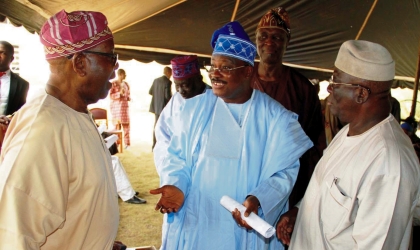
L-R: Afenifere chieftain, Sir Olaniwun Ajayi, Governor Abiola Ajimobi of Oyo State and Chief Ayo Adebanjo, during the preliminary meeting of the Yoruba Committee on National Conference in Ijebu last Monday. Photo: NAN.



The Hydrocarbon Pollution Remediation Project (HYPREP) has announced that the mangrove wetlands in Ogoniland have been officially designated a Ramsar Site of International Importance by the Secretariat of the Ramsar Convention on Wetlands.
The designation, according to HYPREP, underscores the global ecological significance of Ogoniland’s mangrove wetlands and highlights ongoing restoration efforts aimed at addressing environmental degradation in the area.
In a press statement issued by the Project Coordinator of HYPREP, Prof Nenibarini Zabbey, the recognition was described as a major milestone for the agency, the people of Ogoni and other stakeholders working towards environmental restoration in the region.
Zabbey explained that the mangrove wetlands, which cover more than 31,700 hectares, consist of islands, tidal creeks, mudflats and mangrove forests that support a wide range of biodiversity. The ecosystem provides habitat for several species including fin fish, shellfish, crustaceans, crocodiles, turtles and the endangered grey parrot.
He noted that beyond biodiversity conservation, the wetland also provides essential ecosystem services such as fisheries production, flood control, water purification and carbon storage. According to him, the international recognition will further support local livelihoods, promote ecotourism and bring global attention to the region.
The HYPREP coordinator disclosed that the designation followed a meticulous process that began in 2024 when the project submitted a memorandum to the National Council on Environment seeking support for the recognition of the Ogoni wetlands as a Ramsar site.
Following the council’s review and approval, the Honourable Minister of Environment and Chairman of HYPREP’s Governing Council, Balarabe Abbas Lawal, formally wrote to the Ramsar Convention Secretariat requesting international recognition of the wetlands.
After a comprehensive ecological assessment, the Ramsar Secretariat granted the designation, officially recognising the Ogoniland wetlands as one of the world’s sites of international importance.
Zabbey said the recognition would strengthen ongoing environmental restoration efforts in the area and encourage stronger conservation measures and sustainable management of the wetlands for the benefit of present and future generations.
He added that the designation also fulfils a key recommendation of the United Nations Environment Programme (UNEP) Environmental Assessment Report on Ogoniland, marking another significant step in the implementation of the report’s recommendations.
The HYPREP project coordinator reaffirmed the agency’s commitment to restoring the Ogoni environment through the remediation of oil-polluted land, shorelines and mangrove ecosystems.
He also called for collective responsibility and stakeholder support to sustain the progress of the Ogoni cleanup programme and facilitate the development of a comprehensive and sustainable management plan for the Ogoni mangrove wetlands.

The Permanent Secretary, Rivers State Ministry of Social Welfare and Rehabilitation, Mrs Lauretta Davies-Dimkpa, has attributed the successes of the 12-day programme organised for adolescent girls aimed at eliminating Female Genital Mutilation(FGM) in some parts of the State to the ability of the respective stakeholders to take ownership of the programme.
Mrs Davies-Dimkpa, who dropped the hint in an interview at the end of the programme in Elele-Alimini Community in Emohua Local Government Area on Saturday, said the event had a buy-in component, an ownership mentality, whereby facilitators, staff, and everyone involved took ownership of the project.
She explained that the Rivers State Ministry of Social Welfare and Rehabilitation, in collaboration with the United Nations Children’s Fund (UNICEF) and the United Nations Population Fund (UNFPA) had packaged a series of training sessions for adolescent girls aimed at ending the practice of Female Genital Mutilation (FGM) in some communities across the State.
According to her, the initiative was designed to educate young girls on the harmful effects of the practice and empower them to become advocates against it within their communities.
She noted that the programme, which lasted for several weeks, targeted adolescent girls from different local government areas where the practice is still prevalent, stressing that
data collected by UNICEF and the Ministry revealed that Female Genital Mutilation is still practised in some parts of the State, prompting the need for intensified sensitisation and community engagement.
Mrs Davies-Dimkpa explained that the programme adopted a “train-the-trainer” approach where adolescent girls were educated on the dangers of the practice and encouraged to share the knowledge with their peers, families and communities.
“This is a programme by the Rivers State Ministry of Social Welfare and Rehabilitation with support from UNICEF and UNFPA to train adolescent girls towards ending Female Genital Mutilation, which is still practised in some local government areas,” she said.
She further explained that each participating local government area had a three-day training session, with the exercise running for a total of 12 days.
The local government areas, where the programme took place, she noted, included Ahoada West, Abua-Odual, and Emohua, adding that the initiative is part of broader efforts by the state government and development partners to eliminate harmful traditional practices and protect the rights and wellbeing of girls.
She revealed that prior to the training of the adolescent girls, the Ministry and its partners had also engaged community facilitators, including older women and men, to sensitise them on the dangers associated with Female Genital Mutilation.
According to her, the involvement of community leaders and adults is essential in addressing the cultural and social factors that sustain the practice.
Speaking on the response of the participants, the permanent secretary expressed satisfaction with the level of engagement and enthusiasm shown by the girls throughout the training sessions.
She noted that many of the participants said they were learning about the harmful effects of Female Genital Mutilation for the first time.
“The girls are between the ages of 12 and 17 and from the interactions we had with them, they were very excited. Some of them are hearing these things for the first time and never knew that the practice is harmful,” she said.
She expressed optimism that the knowledge gained from the training would enable the girls to serve as advocates for change within their communities.
She added that the Rivers State Government, alongside its partners, would continue to intensify efforts and expand community-based interventions aimed at ending the practice across the State.
Meanwhile, the participants for Emohua Local Government Area were drawn from Elele-Alimini, Egbeda, Rumuji, Ibaa, Rumuekpe, Rumuakunde, Eligbarada, and Ogbakiri Communities.
The participants,who spoke in separate interviews described the training as eye-opening, noting that it helped them better understand issues surrounding adolescent health, personal hygiene, reproductive health, and the harmful consequences of Female Genital Mutilation.
Favour Azukwu from Rumuekpe community, said the programme provided a deeper understanding of the dangers associated with the practice, particularly its impact on the health and wellbeing of girls and women.
She explained that the training sessions exposed participants to the medical, social and psychological effects of Female Genital Mutilation, including severe bleeding, infections and complications during childbirth.
She revealed that she personally experienced the practice at the age of 12 and suffered heavy bleeding afterwards, an experience that has strengthened her determination to advocate for its eradication.
According to her, many communities still practise Female Genital Mutilation because it is perceived as a cultural tradition, despite the dangers associated with it.
“I do not support Female Genital Mutilation because there are many dangers involved. I experienced severe bleeding when it was done to me as a child.
Another participant, Glory Ken, a 16-year-old secondary school student from Rumuji community, said the programme broadened her understanding of several important topics affecting adolescents.
She explained that beyond the discussion on Female Genital Mutilation, the training also focused on issues such as personal hygiene, reproductive health, peer education, and self-care.
According to her, the sessions helped participants understand the importance of making informed health decisions and supporting one another as peer educators.
“I learned about many things that affect young people in society and how to take care of myself. I also learned that Female Genital Mutilation is harmful to our health. The message I am taking back to my community is that this practice should stop,” she said.
Also speaking, Goodness Kenjika Nyeche described the programme as very impactful.
She noted that the training equipped participants with the skills and confidence to educate others about the harmful effects of Female Genital Mutilation.
She said she plans to organise sensitisation among adolescents in her community, particularly girls between the ages of 10 and 19, to ensure they understand the dangers associated with the practice.
“I learned many things from this programme and I feel very good about it. I will educate other young girls in my community and help them understand why Female Genital Mutilation should not continue,” she said.
For Queen Dike from Ibaa community, the programme helped clarify misconceptions surrounding the practice.
She explained that in some communities, the practice is still referred to as circumcision and is viewed as part of cultural identity.
She said the training helped participants understand that Female Genital Mutilation involves the cutting or removal of parts of the female genital organs and that it has serious health consequences.
She stressed that awareness and education are key to ending the practice, especially among communities that continue to uphold it as tradition.
“I think the programme is very helpful because many people still believe it is part of culture. More awareness is needed so people can understand why it should stop,” she said.
Another participant, MyJoy Echika Amadi, said the programme provided critical information about adolescent health and the dangers associated with Female Genital Mutilation.
She described the initiative as enlightening and said it encouraged young people to become advocates for change in their communities.
According to her, participants were encouraged to use various platforms such as churches, peer groups, schools and community gatherings to spread awareness about the harmful effects of the practice.
“This programme has enlightened us about the dangers of Female Genital Mutilation. I will do my best to create awareness in my community and encourage people to stop the practice,” she said.
Many of the participants emphasised that the knowledge gained during the programme has empowered them to challenge harmful traditions and promote healthier practices among young people.
They also called on the Rivers State Government, development partners and civil society organisations to sustain the sensitisation campaigns and extend the training to more communities across the State.
According to them, empowering young people with the right information will play a critical role in eliminating Female Genital Mutilation and protecting the rights, health and dignity of girls in Rivers State.
The participants expressed appreciation to the Rivers State Ministry of Social Welfare and Rehabilitation, UNICEF and UNFPA for organising the programme and for investing in the wellbeing and future of adolescent girls in the State.

-

 Business3 days ago
NERC Amends Order on Meter Tampering, Power Bypass For Discos
-

 Business3 days ago
NCDMB Signs Mgt Deal With Radisson, Edison…As Board’s 204 Rooms Hotel Open December 2026
-

 Rivers3 days ago
KENPOLY Rector Promises To Prioritise Students’ Welfare
-

 Business3 days ago
Nigeria, AFC sign $1.3 billion deal to build alumina refinery
-

 News4 days ago
Police Arrest Nigerian, Two Others For Kidnapping In Edo
-

 Rivers3 days ago
Don, Stakeholders Urge Environmental Laws In N’Delta
-

 Rivers3 days ago
ADIAFRICA Flags-off Free Eye Screening Outreach In PH
-

 Environment3 days ago
IWD: NGO promotes clean energy access for women in Kaduna