
Nation
THE STATES

Benue
Katsina-Ala Local Government Council says it has started
the construction of rural roads to boost the transportation of farm produce from the council to urban markets .
The Chairman of the council, Mr Martins Agir, made this known during the ongoing accountability briefing for local government councils in the state.
Agir said his administration considered the construction of rural roads a priority, owing to the agrarian nature of the council, and disclosed that an ultra-modern yam market had also been constructed to boost its production in the area.
Agir, who expressed concern over the weak revenue profile of the council, said he dissolved the existing market committees and reconstituted new ones for the purpose of enhancing revenue collection.
Borno
The Borno State Government last Thursday said it planned
to recruit 100 fresh graduates to beef up the state civil service. Governor Kashim Shettima made this known when he received a delegation of past labour leaders in the state at the Government House, Maiduguri.
Shettima explained that the objective was to fill the existing vacancies at the middle cadre level in the service due mainly to retirements and death of civil servants.
A onetime president of the Nigeria Labour Congress (NLC), Comrade Ali Chiroma, who led the delegation, commended the governor for his developmental projects in spite of the prevailing security challenges facing the state.
Ekiti
The Ekiti State House of Assembly last Thursday passed
three bills aimed at strengthening the judicial process in the state. The bills were the “Ekiti State Administration of Criminal Justice Bill 2014’, “Ekiti State Arbitration Bill 2014’ and “Ekiti State Law Reform Commission Bill 2014.
The Chairman, Committee on Judiciary and Legal Matters, Mr Segun Erinle, presented the three reports of his committee on the bills before they were considered and passed.
Welcoming the lawmakers to the new year, the Speaker, Adewale Omirin, thanked them for their patriotism which he noted translated to making laws that brought dividends of democracy to Ekiti citizens.
FCT
Senate President, David Mark, has called for the adoption
of a global approach to tackle terrorism in order to end the menace threatening world peace.
Mark said in Abuja when he played host to the British Parliamentary under- Secretary for Justice, Mr Jeremy Wright said that world leaders must come together to work out a blueprint to fight terrorism.
He noted the growing trend and spread of terrorists across the globe and canvassed for collaborative efforts to end the menace.
Gombe
The National Population Commission (NPC) last Thurs
day said it had registered 102,140 births in Gombe State in 2013.
The NPC Commissioner in charge of the state, Alhaji Bala Magaji, said the enlightenment programme of the commission had helped in eliciting positive response as more now registered their newly born babies.
He said the commission was also issuing attestation certificates to support the declaration of age and birth certificates of people above 17 years.
“Attestation certificate is equally universally accepted and it attracts only N2, 000. It is important for everybody to obtain it,” he advised.
Kano
The Harmattan season has brought some measures of ru
ral life to the metropolitan Kano city as many residents now converge at fire hearth to fight cold.
Residents now use firewood and charcoal to make fire to warm themselves and boil water for bath.
In the early morning and evening at Sabongari, Nasarawa and Fagge areas of the Kano State metropolis, people squat in groups around fire at tea shops and courtyards as “Majalisa” and chat heartily.
Commenting on the development, Mohammed Bello, a Nigerien who sells tea at Fagge, Kofar Mata, said that business had improved because some people drink tea (shayi) while warming themselves.
Kaduna
The Kaduna State House of Assembly last Thursday sus
pended its member, Dr Shehu Adamu, for six months over allegation of N180 million bribe levelled against other members.
The decision followed a motion by Alhaji Muhammad Ali, (Kawo – PDP), who drew the attention of members to an interview granted by Adamu, (Maigana-APC), where he made the allegation.
Adamu had in an interview on September 23, 2013 in the electronic media and national dailies, accused members of collecting bribe of N10 million each to remove the former speaker, Usman Gangara and other principal officers.
On November 6, 2013 when the motion was moved by Ali, the assembly mandated its Committee on Ethics and Privileges to investigate.gation.
Kwara
Governor AbdulFatah Ahmed of Kwara State has consti
tuted a committee on job creation.
Inaugurating the committee last Thursday in Ilorin, the governor said his administration had put ‘necessary machinery in motion’ to create jobs for youths in 2014, and said the committee would work out modalities for the establishment of job intervention initiative tagged “QuickWin’’ programme.
Ahmed said his administration was determined to get more young people into employment this year, noting that government would also facilitate the training of some youths and offer credit facilities to others who might wish to start their own business.
Lagos
Lagos State President of the Environmental Health Offic
ers Association of Nigeria (EHOAN), Mr Akin Akingbehin, has advised operators of eatery houses to ensure that their staff are medically fit.
Akingbehin said last Thursday in Lagos that it was important to get the potential workers examined, to ascertain their health status before being employed by fast foods operators.
According to him, the potential workers must also meet certain requirements necessary to prevent the transmission of communicable diseases.
He advised eateries’ operators to adhere strictly to the stipulated laws guiding the operation and standard of eatery business and told them to be mindful of the impact of their waste generation on their immediate environment.
Niger
Niger State Government said it spent over N477.6 million
on the settlement of WASCE and NABTEB registration fees for the final year students in public schools in the state last academic session.
The state’s Commissioner for Education, Alhaji Danladi Abdulhameed who, stated this in Minna last Thursday during an interactive session with newsmen said that under the state’s free education policy, the government pays one public examination fees for students in the state, while the parents pay for the other.
He said most parents preferred paying the National Examination Council (NECO) fees while the state government settled WASCE fees and other examinations.
Osun
The Director of the Centre for Distance Learning, Obafemi
Awolowo University, Ile-Ife, Prof. Bode Asubiojo, has described distance learning education as a viable alternative.
Asubiojo said in an interview last Thursday in Osogbo that distance learning education was the only way to curb the desperation for admission into universities among school leavers.
The don cited the example of some prominent Nigerians who did not have university education through the conventional classrooms but became educated through distance learning.
He, however, stressed the need for operators of distance learning initiatives to adhere to international best practices in the delivery of programmes.
Oyo
Wife of Oyo State Governor, Mrs Florence Ajimobi, has
received books worth N5 million from Heinemann publishers to complement her ‘Educate a Rural Child’ (ERC) project.
Senior Special Assistant on Social Welfare, Mrs Sandra Kolade, who received the books on her behalf, said that the books would be distributed to ERC intervention primary schools, as library resource materials.
She reiterated Ajimobi’s commitment to taking qualitative education to children in the rural areas and promised that all the books would get to the right places.
Chairman, Heinemann, Mr Ayo Ojeniyi, noted that books were indispensable tools to education, stating that primary education should be accorded priority as the foundation on which other phases of education rested.
Plateau
The Chairman of Plateau State Independent Electoral Com
mission (PLASIEC), Mr Peter Dalyop, last Thursday announced that six political parties had been cleared to contest the January 30 council elections.
Dalyop hinted the political parties as; All Peoples Grand Alliance (APGA), Democratic Peoples Party (DPP), Peoples Democratic Party (PDP), Labour Party (LP), Peoples Democratic Movement (PDM) and All Progressives Congress (APC).
He told newsmen in Jos that he was satisfied with the screening and clearing of candidates of the political parties, adding that the candidates list would be released on Monday.
Taraba
The National Emergency Management Agency (NEMA)
lastThursday donated relief materials to victims of state of emergency in neighbouring Borno, Yobe and Adamawa, taking refuge in Taraba.
The Agency’s Director-General, Alhaji Muhammed Sidi, donated the materials in Jalingo, on behalf of the Federal Government.
Represented by the head of Gombe State Operations Office of the Agency, Mr Appolos Jediel, Sidi said the gesture was aimed at alleviating the sufferings of the victims, adding that the donation was in response to the request for assistance by the Taraba State acting Governor, Alhaji Garba Umar.
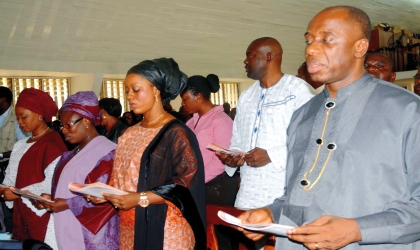
L-R: Wife of Ogun State Governor, Mrs Funso Ibikunle Amosun,Wife of Ogun State Commissioner for Local Government, Mrs Funke Oladipo,Wife of Special Adviser to the Governor on Special Duties, Mrs Funmi Adeyemi, Governor Rotimi Amaechi of Rivers State, at the funeral service of Prof. Wole Soyinka’s Daughter, Iyetade, last Friday. Photo: NAN



The Hydrocarbon Pollution Remediation Project (HYPREP) has announced that the mangrove wetlands in Ogoniland have been officially designated a Ramsar Site of International Importance by the Secretariat of the Ramsar Convention on Wetlands.
The designation, according to HYPREP, underscores the global ecological significance of Ogoniland’s mangrove wetlands and highlights ongoing restoration efforts aimed at addressing environmental degradation in the area.
In a press statement issued by the Project Coordinator of HYPREP, Prof Nenibarini Zabbey, the recognition was described as a major milestone for the agency, the people of Ogoni and other stakeholders working towards environmental restoration in the region.
Zabbey explained that the mangrove wetlands, which cover more than 31,700 hectares, consist of islands, tidal creeks, mudflats and mangrove forests that support a wide range of biodiversity. The ecosystem provides habitat for several species including fin fish, shellfish, crustaceans, crocodiles, turtles and the endangered grey parrot.
He noted that beyond biodiversity conservation, the wetland also provides essential ecosystem services such as fisheries production, flood control, water purification and carbon storage. According to him, the international recognition will further support local livelihoods, promote ecotourism and bring global attention to the region.
The HYPREP coordinator disclosed that the designation followed a meticulous process that began in 2024 when the project submitted a memorandum to the National Council on Environment seeking support for the recognition of the Ogoni wetlands as a Ramsar site.
Following the council’s review and approval, the Honourable Minister of Environment and Chairman of HYPREP’s Governing Council, Balarabe Abbas Lawal, formally wrote to the Ramsar Convention Secretariat requesting international recognition of the wetlands.
After a comprehensive ecological assessment, the Ramsar Secretariat granted the designation, officially recognising the Ogoniland wetlands as one of the world’s sites of international importance.
Zabbey said the recognition would strengthen ongoing environmental restoration efforts in the area and encourage stronger conservation measures and sustainable management of the wetlands for the benefit of present and future generations.
He added that the designation also fulfils a key recommendation of the United Nations Environment Programme (UNEP) Environmental Assessment Report on Ogoniland, marking another significant step in the implementation of the report’s recommendations.
The HYPREP project coordinator reaffirmed the agency’s commitment to restoring the Ogoni environment through the remediation of oil-polluted land, shorelines and mangrove ecosystems.
He also called for collective responsibility and stakeholder support to sustain the progress of the Ogoni cleanup programme and facilitate the development of a comprehensive and sustainable management plan for the Ogoni mangrove wetlands.

The Permanent Secretary, Rivers State Ministry of Social Welfare and Rehabilitation, Mrs Lauretta Davies-Dimkpa, has attributed the successes of the 12-day programme organised for adolescent girls aimed at eliminating Female Genital Mutilation(FGM) in some parts of the State to the ability of the respective stakeholders to take ownership of the programme.
Mrs Davies-Dimkpa, who dropped the hint in an interview at the end of the programme in Elele-Alimini Community in Emohua Local Government Area on Saturday, said the event had a buy-in component, an ownership mentality, whereby facilitators, staff, and everyone involved took ownership of the project.
She explained that the Rivers State Ministry of Social Welfare and Rehabilitation, in collaboration with the United Nations Children’s Fund (UNICEF) and the United Nations Population Fund (UNFPA) had packaged a series of training sessions for adolescent girls aimed at ending the practice of Female Genital Mutilation (FGM) in some communities across the State.
According to her, the initiative was designed to educate young girls on the harmful effects of the practice and empower them to become advocates against it within their communities.
She noted that the programme, which lasted for several weeks, targeted adolescent girls from different local government areas where the practice is still prevalent, stressing that
data collected by UNICEF and the Ministry revealed that Female Genital Mutilation is still practised in some parts of the State, prompting the need for intensified sensitisation and community engagement.
Mrs Davies-Dimkpa explained that the programme adopted a “train-the-trainer” approach where adolescent girls were educated on the dangers of the practice and encouraged to share the knowledge with their peers, families and communities.
“This is a programme by the Rivers State Ministry of Social Welfare and Rehabilitation with support from UNICEF and UNFPA to train adolescent girls towards ending Female Genital Mutilation, which is still practised in some local government areas,” she said.
She further explained that each participating local government area had a three-day training session, with the exercise running for a total of 12 days.
The local government areas, where the programme took place, she noted, included Ahoada West, Abua-Odual, and Emohua, adding that the initiative is part of broader efforts by the state government and development partners to eliminate harmful traditional practices and protect the rights and wellbeing of girls.
She revealed that prior to the training of the adolescent girls, the Ministry and its partners had also engaged community facilitators, including older women and men, to sensitise them on the dangers associated with Female Genital Mutilation.
According to her, the involvement of community leaders and adults is essential in addressing the cultural and social factors that sustain the practice.
Speaking on the response of the participants, the permanent secretary expressed satisfaction with the level of engagement and enthusiasm shown by the girls throughout the training sessions.
She noted that many of the participants said they were learning about the harmful effects of Female Genital Mutilation for the first time.
“The girls are between the ages of 12 and 17 and from the interactions we had with them, they were very excited. Some of them are hearing these things for the first time and never knew that the practice is harmful,” she said.
She expressed optimism that the knowledge gained from the training would enable the girls to serve as advocates for change within their communities.
She added that the Rivers State Government, alongside its partners, would continue to intensify efforts and expand community-based interventions aimed at ending the practice across the State.
Meanwhile, the participants for Emohua Local Government Area were drawn from Elele-Alimini, Egbeda, Rumuji, Ibaa, Rumuekpe, Rumuakunde, Eligbarada, and Ogbakiri Communities.
The participants,who spoke in separate interviews described the training as eye-opening, noting that it helped them better understand issues surrounding adolescent health, personal hygiene, reproductive health, and the harmful consequences of Female Genital Mutilation.
Favour Azukwu from Rumuekpe community, said the programme provided a deeper understanding of the dangers associated with the practice, particularly its impact on the health and wellbeing of girls and women.
She explained that the training sessions exposed participants to the medical, social and psychological effects of Female Genital Mutilation, including severe bleeding, infections and complications during childbirth.
She revealed that she personally experienced the practice at the age of 12 and suffered heavy bleeding afterwards, an experience that has strengthened her determination to advocate for its eradication.
According to her, many communities still practise Female Genital Mutilation because it is perceived as a cultural tradition, despite the dangers associated with it.
“I do not support Female Genital Mutilation because there are many dangers involved. I experienced severe bleeding when it was done to me as a child.
Another participant, Glory Ken, a 16-year-old secondary school student from Rumuji community, said the programme broadened her understanding of several important topics affecting adolescents.
She explained that beyond the discussion on Female Genital Mutilation, the training also focused on issues such as personal hygiene, reproductive health, peer education, and self-care.
According to her, the sessions helped participants understand the importance of making informed health decisions and supporting one another as peer educators.
“I learned about many things that affect young people in society and how to take care of myself. I also learned that Female Genital Mutilation is harmful to our health. The message I am taking back to my community is that this practice should stop,” she said.
Also speaking, Goodness Kenjika Nyeche described the programme as very impactful.
She noted that the training equipped participants with the skills and confidence to educate others about the harmful effects of Female Genital Mutilation.
She said she plans to organise sensitisation among adolescents in her community, particularly girls between the ages of 10 and 19, to ensure they understand the dangers associated with the practice.
“I learned many things from this programme and I feel very good about it. I will educate other young girls in my community and help them understand why Female Genital Mutilation should not continue,” she said.
For Queen Dike from Ibaa community, the programme helped clarify misconceptions surrounding the practice.
She explained that in some communities, the practice is still referred to as circumcision and is viewed as part of cultural identity.
She said the training helped participants understand that Female Genital Mutilation involves the cutting or removal of parts of the female genital organs and that it has serious health consequences.
She stressed that awareness and education are key to ending the practice, especially among communities that continue to uphold it as tradition.
“I think the programme is very helpful because many people still believe it is part of culture. More awareness is needed so people can understand why it should stop,” she said.
Another participant, MyJoy Echika Amadi, said the programme provided critical information about adolescent health and the dangers associated with Female Genital Mutilation.
She described the initiative as enlightening and said it encouraged young people to become advocates for change in their communities.
According to her, participants were encouraged to use various platforms such as churches, peer groups, schools and community gatherings to spread awareness about the harmful effects of the practice.
“This programme has enlightened us about the dangers of Female Genital Mutilation. I will do my best to create awareness in my community and encourage people to stop the practice,” she said.
Many of the participants emphasised that the knowledge gained during the programme has empowered them to challenge harmful traditions and promote healthier practices among young people.
They also called on the Rivers State Government, development partners and civil society organisations to sustain the sensitisation campaigns and extend the training to more communities across the State.
According to them, empowering young people with the right information will play a critical role in eliminating Female Genital Mutilation and protecting the rights, health and dignity of girls in Rivers State.
The participants expressed appreciation to the Rivers State Ministry of Social Welfare and Rehabilitation, UNICEF and UNFPA for organising the programme and for investing in the wellbeing and future of adolescent girls in the State.

-

 News5 days ago
Don Savours Inaugural Lecture Presentation, Commends VC
-

 News13 hours ago
Police Arrest Nigerian, Two Others For Kidnapping In Edo
-

 Nation15 hours ago
Perm Sec Explains Success Of FGM Elimination Programme In Rivers
-

 News13 hours ago
NDLEA Arrests Ex-Councillor With 40kg Skunk, Recovers Drugs In Diapers
-

 Nation15 hours ago
Ogoni Mangrove Wetlands Gain International Recognition As Ramsar Site
-

 News13 hours ago
Army Foils Cattle Rustling, Kills Terrorists In Benue …Rescues Two Kidnapped Bank Staff
-

 Business3 hours ago
Nigeria, AFC sign $1.3 billion deal to build alumina refinery
-

 Sports12 hours ago
Beyond Limits Intensify NPFL Return