
Sports
Commissioner Lauds Obuah Over Support For Rivers United

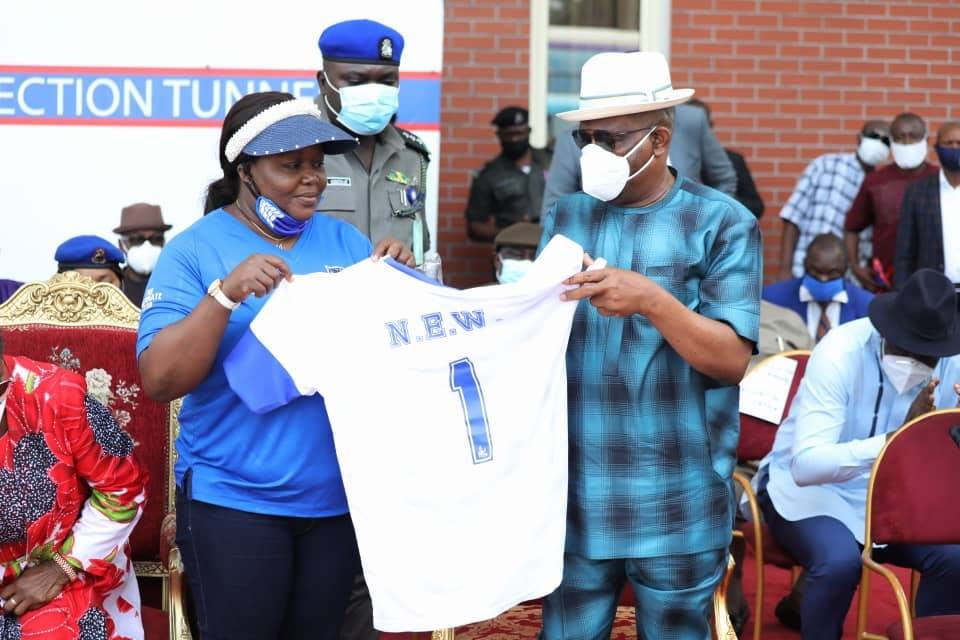
Rivers Sports Commissioner, Boma Iyaye, has showered encomiums on the founder of Go-Round Football Club and sports philanthropist, Bro Felix Obuah, over his continued support to Rivers United.
According to him, Bro Obuah’s actions are testimonies of genuine love for sports development and particularly, for the State government-owned Rivers United.
Rivers United has benefitted from Obuah’s financial promises after he tasked the team to win matches in the ongoing CAF Confederation Cup and get rewarded.
Iyaye gave the commendation at Omoku, Rivers State, when he led a team that included the Permanent Secretary, Sir Honour Sirawoo; officials and players of Rivers United, supporters club, amongst others, on a thank you visit to Obuah.
The commissioner described Obuah’s gesture as unparalleled in the history of the state, stressing that outside the Rivers State Government, no other individual has done that much for the team.
He seized the opportunity to laud Governor Wike, whom he said recently donated a 54-seater luxurious bus to Rivers United in line with his undiluted support for the club; emphasising that with such a support-base, the team have no other choice but to make Rivers people proud.
Also speaking, the Permanent Secretary in the Ministry of Sports, Sir Honour Sirawoo, commended Bro Obuah for his exemplary commitment to the cause of Rivers people, pointing out that his efforts for the team would not be in vain.
Sir Sirawoo stressed that though, the Rivers State government was providing all necessary support for the club, encouragement from well-spirited Rivers people will serve as a further tonic.
The General Manager of Rivers United, Okey Kpalukwu, Technical Manager, Stanley Eguma, team Captain, Festus Austin, and chairman, Rivers United Supporters Club, Franklin Owhor, all praised the uncommon love for the team by Obuah.
Responding, Bro Obuah commended the Rivers State Governor and Power of Sports (POS) Africa, Barr Nyesom Wike, for giving the team all required support to excel so far in the continent and local league.
While downplaying his gesture to the team, he stressed that he was just doing it out of his love for good football, stressing that the team is a reflection of the unity that the State should continue to enjoy and therefore needed to be encouraged.
He tasked the team to do all within its powers to win the CAF Confederation Cup for the State and country, with the belief that the government will reward them, knowing the antecedents of Governor Wike.
He announced the sum of N2 million should the team defeat Enyimba in Aba, as well as N200,000 for each goal scored.


Pics 1: Fencing in action.
President of the Nigeria Fencing Federation, Adeyinka Samuel, has said the country will host a unique 2026 Commonwealth Fencing Championships as the first sub-Saharan nation to stage the tournament, Tidesports source reports.
The championship will be held in Lagos from August 9 to 14, with the federation announcing that Rugby School Nigeria will host the event.
The Commonwealth Fencing Federation formally awarded the hosting rights for the 2026 championships to Nigeria in March 2025.
“It is the third international tournament the country will host, having also become the first to stage a junior épée World Cup, which was held in Lagos in December 2024. Nigeria also hosted the 23rd African Fencing Championships last year.
Nigeria’s hosting will be unique in several ways. First, it will be the inaugural edition on African soil, giving it historic significance. Second, we are integrating development initiatives such as an international training camp to foster technical exchange. Finally, the event will showcase African hospitality, culture, and energy, offering athletes a rich experience beyond the competition,” Samuel said on Wednesday.
“Preparations have advanced steadily across competition planning, venue readiness, logistics, athlete services, and partnerships.”
He also noted that over 24 Commonwealth nations have already registered.
“We are organising a pre-championship international training camp in Lagos to unite athletes ahead of the competition. Everything is moving in the right direction, and our focus is on delivering a world-class event that reflects Nigeria’s ability to host major international tournaments.”
The last two tournaments hosted by Nigeria were held at Charterhouse Lagos, and Samuel explained the choice of Rugby School Nigeria for this championship.
“The venue was selected for its modern, state-of-the-art facilities and its proximity to hospitality, tourism, and entertainment hubs. This ensures athletes and officials will enjoy excellent accommodation, transport, and leisure options during their stay.”
While thanking the private sector for its support in organising the championship, the president also called for greater government intervention in the fast-growing sport.
“The private sector has shown encouraging support, with institutions like Rugby School Nigeria and companies such as Flour Mills of Nigeria backing the championships. However, stronger government involvement is needed. Hosting the 2026 Commonwealth Fencing Championships is a milestone achievement, and we believe institutional support will help Nigeria maximise the opportunity and deliver a truly memorable event.”
The final draw was concluded at CAF Headquarters in Cairo, Egypt, on Wednesday and posted on the body’s website.
Notably, hosts Morocco will face a North African showdown in Group A, drawn alongside Tunisia, Egypt, and Ethiopia.
Only the top two teams from each group will advance to the quarter-finals, making Group A particularly competitive.
Group B features former champions Côte d’Ivoire and Cameroon, alongside Uganda and debutants DR Congo.
In Group C, 2015 and 2017 champions and last year’s runners-up, Mali, will meet Angola, Mozambique, and Tanzania.
Group D is led by 2023 champions Senegal, who will face South Africa (2015 runners-up),
The eight quarter-finalists from the tournament will automatically qualify for the 2026 FIFA U-17 World Cup in Qatar.
The teams finishing third in each group will contest two play-off matches to determine the final two qualifiers, bringing the total number of African representatives at the global finals to ten nations.
2026 CAF U-17 Africa Cup of Nations – Groups:
- Group A: Morocco, Tunisia, Egypt, Ethiopia
- Group B: Côte d’Ivoire, Cameroon, Uganda, DR Congo
- Group C: Mali, Angola, Tanzania, Mozambique
- Group D: Senegal, South Africa, Algeria, Ghana
Tidesports source reports that Nigeria will not feature at the tournament for the second consecutive edition.
The Golden Eaglets suffered a 2-0 defeat to rivals Ghana in the semi-finals of the WAFU Zone B qualifiers in September 2025, dashing their hopes of advancing to the finals.
The Super Eagles of Nigeria will begin their title defence at the 2026 Unity Cup with a semi-final clash against Zimbabwe on May 26 at The Valley in South London, Tidesports source reports.
The four-nation tournament, which also features Jamaica and India, returns to its historic venue after the success of the 2025 edition in Brentford, where Nigeria emerged champions.
The competition, scheduled to run from May 26 to 30, blends elite football with cultural celebration, bringing together Afrocentric and global diaspora communities.
Nigeria’s opening fixture against Zimbabwe serves as a rematch of their recent encounters in the 2026 FIFA World Cup qualifiers, setting the stage for a highly competitive contest.
The winner will progress to the final on May 30, while the second semi-final between Jamaica and India will be played a day later.
President of the Nigeria Football Federation, Ibrahim Gusau, expressed confidence in the Super Eagles’ chances while acknowledging the quality of the opposition.
“The Nigeria Football Federation is pleased with another opportunity to see the Super Eagles compete at the highly exciting and entertaining Unity Cup Tournament,” Gusau said.
“As perennial champions, the Super Eagles will look to retain their title again this summer, even as they will not underrate the other participating teams viz India, Jamaica and Zimbabwe. The tournament promises to be explosive and that is the setting in which the Super Eagles thrive best.”
The Unity Cup will culminate in a finals day featuring both the third-place play-off and the final, alongside a festival atmosphere that includes cultural showcases, food exhibitions, and live performances.
Zimbabwe Football Association president Nqobile Magwizi described his nation’s participation as a landmark moment, highlighting the opportunity to compete on an international stage in England for the first time.
“The Unity Cup represents far more than a celebration of football and culture, it is a powerful platform that reflects Zimbabwe football’s growing ambition to compete, perform, and excel on the global stage,” Magwizi said.
With Nigeria seeking to retain their crown and rivals eager to make their mark, the opening clash against Zimbabwe is expected to set the tone for what promises to be a fiercely contested and culturally vibrant tournament.
-
 Editorial3 days ago
Domesticate FG’s Exit Benefit Scheme
-

 News3 days ago
RSU Unveils Five-Year Strategic Dev Plan …Calls For Collective Commitment To Institutional Excellence
-
 News3 days ago
DHQ Confirms Deaths Of Terrorists, Soldiers In Borno Attack
-

 News3 days ago
Tinubu Commissions Bayelsa Gas Turbine, Other Projects Today
-
Business3 days ago
Niger Delta Investment Summit Targets $5bn Inflows, 500,000 Jobs
-
Nation3 days ago
Rumuji Youth Leader Condemns Protest, Disowns Alleged Government Empowerment Claim
-
Rivers3 days ago
Dep Gov Seeks Collaboration, Transparency Between RIVCHPP, PHCMB
-
Sports3 days ago
Full Draw For 2026 U-17 AFCON