Connect with us

Nation

THE STATES

Published

on

FCT
The U.S. Government has been urged to urgently supply
arms to the Nigerian military to effectively fight Boko Haram terrorists.
The Chairman, House of Representatives Committee on Civil Society and Donor Agencies, Prof Ini Udoka, made the appeal in Abuja on Monday.
He spoke during the signing of 9.2 million dollars grant to 15 Civil Society Organisations (CSOs) in Nigeria by the U.S. Government.
His remarks came against the backdrop of Monday’s attack on a school in Potiskum, Yobe by the Boko Haram sect, in which several students were killed.

Kaduna

President Goodluck Jonathan, on Monday, advised
Nigerians to emulate the legacies of the Premier of Northern Region, late Sir Ahmadu Bello, the Sardauna of Sokoto.
Jonathan made the call during the inauguration of the new secretariat of Ahmadu Bello Memorial Foundation in Kaduna.
He said the late premier lived a life of sacrifice and dedicated his life to the development of the region and the country.
Represented by the Minister of Special Duties, Alhaji Kabiru Turaki, Jonathan said that the Sardauna was a visionary leader who helped to industralise the region during his tenure as premier.
Katsina

Senator Ibrahim Ida, a Katsina State PDP governorship
aspirant, said on Monday in Abuja that the party would lose the state in 2015 if an unpopular candidate was imposed on the people.
He stated this on Monday in Abuja when he led a group of five PDP gubernatorial aspirants from the state on a protest to the party‘s National Working Committee (NWC).
Ida was a former Deputy Governor of Katsina State.
The other aspirants include Alhaji Tukur Jikamshi, Alhaji Gide Yar’Adua, Alhaji Ahmed Yar’Adua, Alhaji Kabiru Barkiye and Alhaji Mohammed Khalil.
He added that though Katsina was a stronghold of the PDP in the North West zone, it was also the home state of leading members of the opposition.
“Therefore, for the party to succeed in the 2015 general elections, it must field a popular and acceptable candidate,’’ he said.

Kwara

Alhaji Hakeem Lawal, son of former Kwara State Governor,
late Admiral Mohammed Lawal, has promised to make life more abundant for the people of the state if elected as governor in 2015.
Lawal, who is contesting the governorship ticket under the umbrella of the Peoples Democratic Party (PDP), made the promise on Monday during an interview with newsmen in Ilorin.
He said though he was from a well grounded political family, the need to have things done differently for the progress and rapid development of Kwara informed his bid to contest for the governorship ticket.
“I am in politics to contribute my quota to the development of Kwara and make things done differently,” Hakeem said.

Lagos

An Ikeja High Court on Tuesday remanded a Togolese,
Benjamin Sunday, in prison for allegedly stabbing one Gbenga Adigun to death with a broken bottle.
Justice Oluwatoyin Ipaye remanded the 18-year-old accused at the Kirikiri Medium Prisons, Apapa, after his arraignment by the Lagos State Directorate of Public Prosecutions (DPP).
Our correspondent reports that Sunday, who lives at No. 4, Haruna St., Ifako-Ijaiye, Lagos, is facing a one-count charge of murder.
The state prosecutor, Mr Akin George, said Sunday committed the offence on June 2, 2013 at Harmony Estate, Ifako-Ijaiye, Lagos.
George said that a dispute between the accused and Adigun degenerated into a fight and the former thereafter stabbed his opponent with a broken bottle, which led to his death.

Niger

The Peoples Democratic Party (PDP) in Niger said that 15
female aspirants shown interest to contest for various political offices in 2015 in the state.
Alhaji Hassan Shaba, Publicity Secretary of the chapter, announced this on Monday in an interview with newsmen in Minna.
He said that the aspirants would be given equal opportunity like their male counterparts, adding that the party was ready to support and guide them.
‘’As part of the party’s philosophy, female aspirants will be supported to contest with their male counterparts. We will not allow anything to hinder their vision of positive contribution.

Ondo
The Fourth Alteration to the 1999 Constitution has
gone through the second reading at the Ondo State House of Assembly.
The house, which was presided over by the Speaker, Jumoke Akindele, said a letter was sent to the house by the Clerk of the National Assembly, Salisu Maikasuwa, to the state parliament to deliberate.
The two arms of National Assembly, comprising the Senate and House of Representatives, had earlier discussed critical areas of the constitution and made some amendments.
They include autonomy for local governments, separation of office of minister of justice and attorney general of the federation, establishment of House of Assembly Service Commission and independent candidacy.
Plateau

Sen Gyang Pwajok last Monday expressed “deep
disappointment’’ over the  disappearance of voters’ records in 161 polling units in Jos North Local Government Area and advised INEC to revert to manual registration.
Our correspondent reports that voters, who went to the affected polling units to collect their Permanent Voters’ Cards (PVCs), returned home disappointed as there were no INEC officials at the units.
The commission’s officials later explained that the records had been completely wiped out.
“It is inconceivable that such an important data can be completely wiped out without appropriate back-up after it had been relied upon for several elections,’’ Pwajok said
He made the statement when he visited the INEC office of the local government area to lodge his constituents’ complaints.
He suggested that the manual register be kept as a handy back-up so as not to disenfranchise the “more than 110,000 voters’’ whose records had been wiped out.

Taraba
Alhaji Babaji Buba, the Chairman, Local Miners Association, Nguroge, Taraba State, last Tuesday appealed to the state government to provide amenities in the mining village in the area.
Buba told newsmen at Sardauna, that the miners were in dire need of a health centre, potable water and telecommunications network.
He said that the provision of these amenities in the “Blue Village” would boost the morale of the miners to be more productive.
The chairman noted that the discovery of the mine in December 2013 had provided a source of employment to the teeming youths, thereby increasing their income and reducing crime rate in the area.

Yobe
Former Vice-President Atiku Abubakar has expressed
outrage over the bombing of the Government Technical Science College, Potiskum, Yobe, by a suicide bomber dressed as a student of the school.
Atiku, in a statement by his Media Officer, Malam Garba Shehu, on Monday, said that the latest bombing was needless.
According to the statement, the deaths of young and promising Nigerian school children underscored the need for the government at all levels, elders and opinion leaders to find a permanent solution to the problem of insurgency.
It noted that the tragic incident was not the first time that innocent young people were subjected to violence and untimely death in their quest to get an education.
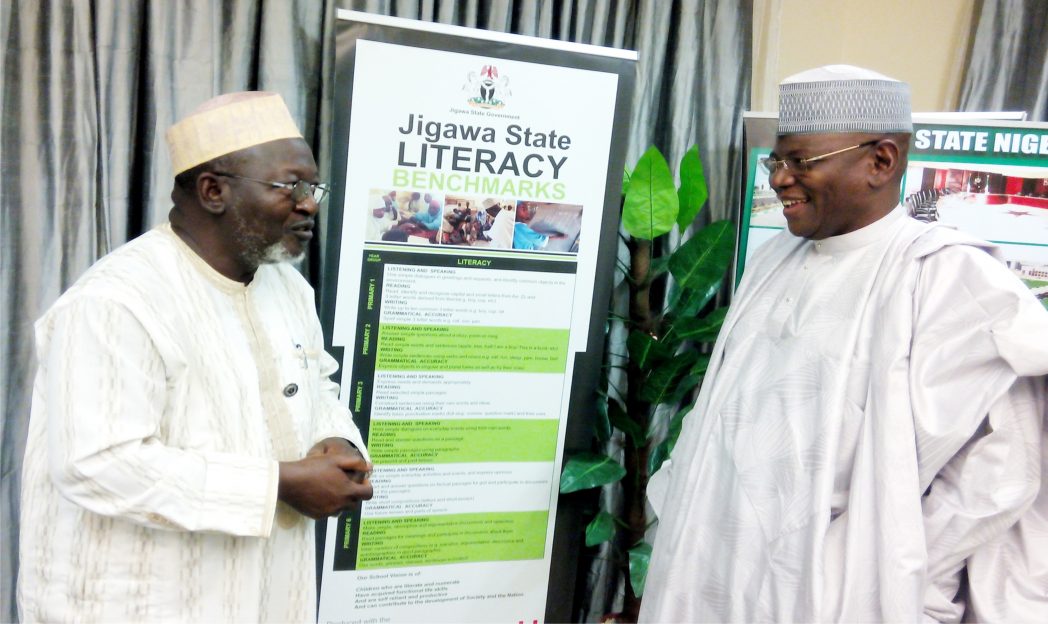
Governor  Sule Lamido of Jigawa State (right), receiving the chairman, Governing Council of  Nursing and Midwifery Council of Nigeria, Alhaji Mustapha Jumare in Dutse, recently.

Governor Sule Lamido of Jigawa State (right), receiving the chairman, Governing Council of Nursing and Midwifery Council of Nigeria, Alhaji Mustapha Jumare in Dutse, recently.


Continue Reading

Nation

Ogoni Mangrove Wetlands Gain International Recognition As Ramsar Site

Published

on

The Hydrocarbon Pollution Remediation Project (HYPREP) has announced that the mangrove wetlands in Ogoniland have been officially designated a Ramsar Site of International Importance by the Secretariat of the Ramsar Convention on Wetlands.

The designation, according to HYPREP, underscores the global ecological significance of Ogoniland’s mangrove wetlands and highlights ongoing restoration efforts aimed at addressing environmental degradation in the area.

In a press statement issued by the Project Coordinator of HYPREP, Prof Nenibarini Zabbey, the recognition was described as a major milestone for the agency, the people of Ogoni and other stakeholders working towards environmental restoration in the region.

Zabbey explained that the mangrove wetlands, which cover more than 31,700 hectares, consist of islands, tidal creeks, mudflats and mangrove forests that support a wide range of biodiversity. The ecosystem provides habitat for several species including fin fish, shellfish, crustaceans, crocodiles, turtles and the endangered grey parrot.

He noted that beyond biodiversity conservation, the wetland also provides essential ecosystem services such as fisheries production, flood control, water purification and carbon storage. According to him, the international recognition will further support local livelihoods, promote ecotourism and bring global attention to the region.

The HYPREP coordinator disclosed that the designation followed a meticulous process that began in 2024 when the project submitted a memorandum to the National Council on Environment seeking support for the recognition of the Ogoni wetlands as a Ramsar site.

Following the council’s review and approval, the Honourable Minister of Environment and Chairman of HYPREP’s Governing Council, Balarabe Abbas Lawal, formally wrote to the Ramsar Convention Secretariat requesting international recognition of the wetlands.

After a comprehensive ecological assessment, the Ramsar Secretariat granted the designation, officially recognising the Ogoniland wetlands as one of the world’s sites of international importance.

Zabbey said the recognition would strengthen ongoing environmental restoration efforts in the area and encourage stronger conservation measures and sustainable management of the wetlands for the benefit of present and future generations.

He added that the designation also fulfils a key recommendation of the United Nations Environment Programme (UNEP) Environmental Assessment Report on Ogoniland, marking another significant step in the implementation of the report’s recommendations.

The HYPREP project coordinator reaffirmed the agency’s commitment to restoring the Ogoni environment through the remediation of oil-polluted land, shorelines and mangrove ecosystems.

He also called for collective responsibility and stakeholder support to sustain the progress of the Ogoni cleanup programme and facilitate the development of a comprehensive and sustainable management plan for the Ogoni mangrove wetlands.

Continue Reading

Nation

Perm Sec Explains Success Of FGM Elimination Programme In Rivers

Published

on

The Permanent Secretary, Rivers State Ministry of Social Welfare and Rehabilitation, Mrs Lauretta Davies-Dimkpa, has attributed the successes of the 12-day programme organised for adolescent girls aimed at eliminating Female Genital Mutilation(FGM) in some parts of the State to the ability of the respective stakeholders to take ownership of the programme.

Mrs Davies-Dimkpa, who dropped the hint in an interview at the end of the programme in Elele-Alimini Community in Emohua Local Government Area on Saturday, said the event had a buy-in component, an ownership mentality, whereby facilitators, staff, and everyone involved took ownership of the project.

She explained that the Rivers State Ministry of Social Welfare and Rehabilitation, in collaboration with the United Nations Children’s Fund (UNICEF) and the United Nations Population Fund (UNFPA) had packaged a series of training sessions for adolescent girls aimed at ending the practice of Female Genital Mutilation (FGM) in some communities across the State.

According to her, the initiative was designed to educate young girls on the harmful effects of the practice and empower them to become advocates against it within their communities.

She noted that the programme, which lasted for several weeks, targeted adolescent girls from different local government areas where the practice is still prevalent, stressing that
data collected by UNICEF and the Ministry revealed that Female Genital Mutilation is still practised in some parts of the State, prompting the need for intensified sensitisation and community engagement.

Mrs Davies-Dimkpa explained that the programme adopted a “train-the-trainer” approach where adolescent girls were educated on the dangers of the practice and encouraged to share the knowledge with their peers, families and communities.

“This is a programme by the Rivers State Ministry of Social Welfare and Rehabilitation with support from UNICEF and UNFPA to train adolescent girls towards ending Female Genital Mutilation, which is still practised in some local government areas,” she said.

She further explained that each participating local government area had a three-day training session, with the exercise running for a total of 12 days.

The local government areas, where the programme took place, she noted, included Ahoada West, Abua-Odual, and Emohua, adding that the initiative is part of broader efforts by the state government and development partners to eliminate harmful traditional practices and protect the rights and wellbeing of girls.

She revealed that prior to the training of the adolescent girls, the Ministry and its partners had also engaged community facilitators, including older women and men, to sensitise them on the dangers associated with Female Genital Mutilation.

According to her, the involvement of community leaders and adults is essential in addressing the cultural and social factors that sustain the practice.

Speaking on the response of the participants, the permanent secretary expressed satisfaction with the level of engagement and enthusiasm shown by the girls throughout the training sessions.

She noted that many of the participants said they were learning about the harmful effects of Female Genital Mutilation for the first time.

“The girls are between the ages of 12 and 17 and from the interactions we had with them, they were very excited. Some of them are hearing these things for the first time and never knew that the practice is harmful,” she said.

She expressed optimism that the knowledge gained from the training would enable the girls to serve as advocates for change within their communities.

She added that the Rivers State Government, alongside its partners, would continue to intensify efforts and expand community-based interventions aimed at ending the practice across the State.

Meanwhile, the participants for Emohua Local Government Area were drawn from Elele-Alimini, Egbeda, Rumuji, Ibaa, Rumuekpe, Rumuakunde, Eligbarada, and Ogbakiri Communities.

The participants,who spoke in separate interviews described the training as eye-opening, noting that it helped them better understand issues surrounding adolescent health, personal hygiene, reproductive health, and the harmful consequences of Female Genital Mutilation.

Favour Azukwu from Rumuekpe community, said the programme provided a deeper understanding of the dangers associated with the practice, particularly its impact on the health and wellbeing of girls and women.

She explained that the training sessions exposed participants to the medical, social and psychological effects of Female Genital Mutilation, including severe bleeding, infections and complications during childbirth.

She revealed that she personally experienced the practice at the age of 12 and suffered heavy bleeding afterwards, an experience that has strengthened her determination to advocate for its eradication.

According to her, many communities still practise Female Genital Mutilation because it is perceived as a cultural tradition, despite the dangers associated with it.

“I do not support Female Genital Mutilation because there are many dangers involved. I experienced severe bleeding when it was done to me as a child.

Another participant, Glory Ken, a 16-year-old secondary school student from Rumuji community, said the programme broadened her understanding of several important topics affecting adolescents.

She explained that beyond the discussion on Female Genital Mutilation, the training also focused on issues such as personal hygiene, reproductive health, peer education, and self-care.

According to her, the sessions helped participants understand the importance of making informed health decisions and supporting one another as peer educators.

“I learned about many things that affect young people in society and how to take care of myself. I also learned that Female Genital Mutilation is harmful to our health. The message I am taking back to my community is that this practice should stop,” she said.

Also speaking, Goodness Kenjika Nyeche described the programme as very impactful.

She noted that the training equipped participants with the skills and confidence to educate others about the harmful effects of Female Genital Mutilation.

She said she plans to organise sensitisation among adolescents in her community, particularly girls between the ages of 10 and 19, to ensure they understand the dangers associated with the practice.

“I learned many things from this programme and I feel very good about it. I will educate other young girls in my community and help them understand why Female Genital Mutilation should not continue,” she said.

For Queen Dike from Ibaa community, the programme helped clarify misconceptions surrounding the practice.

She explained that in some communities, the practice is still referred to as circumcision and is viewed as part of cultural identity.

She said the training helped participants understand that Female Genital Mutilation involves the cutting or removal of parts of the female genital organs and that it has serious health consequences.

She stressed that awareness and education are key to ending the practice, especially among communities that continue to uphold it as tradition.

“I think the programme is very helpful because many people still believe it is part of culture. More awareness is needed so people can understand why it should stop,” she said.

Another participant, MyJoy Echika Amadi, said the programme provided critical information about adolescent health and the dangers associated with Female Genital Mutilation.

She described the initiative as enlightening and said it encouraged young people to become advocates for change in their communities.

According to her, participants were encouraged to use various platforms such as churches, peer groups, schools and community gatherings to spread awareness about the harmful effects of the practice.

“This programme has enlightened us about the dangers of Female Genital Mutilation. I will do my best to create awareness in my community and encourage people to stop the practice,” she said.

Many of the participants emphasised that the knowledge gained during the programme has empowered them to challenge harmful traditions and promote healthier practices among young people.

They also called on the Rivers State Government, development partners and civil society organisations to sustain the sensitisation campaigns and extend the training to more communities across the State.

According to them, empowering young people with the right information will play a critical role in eliminating Female Genital Mutilation and protecting the rights, health and dignity of girls in Rivers State.

The participants expressed appreciation to the Rivers State Ministry of Social Welfare and Rehabilitation, UNICEF and UNFPA for organising the programme and for investing in the wellbeing and future of adolescent girls in the State.

Continue Reading

Nation

UNIZIK Honours Business Mogul, Ezekwe, For Philanthropism

Published

on

The Nnamdi Azikiwe University (UNIZIK) has conferred the Award of Digital Academic Promoter on the Managing Director and Chief Executive Officer of Arrowconn Group, High Chief (Dr.) Emeka Ezekwe, for his philanthropic gestures.
Chief Ezekwe received the philanthropist award during a landmark technical workshop organised by the Department of Business Education, Faculty of Technology and Vocational Education, Nnamdi Azikiwe University (UNIZIK), Awka, recently.
Making the presentation, the Vice Chancellor of the university, Prof. Ugochukwu Stanley Anyaehie, said the award was in recognition of Ezekwe’s philanthropic contributions, academic support, and dedication to human capital development, hailing his commitment to bridging industry and academia.
Ezekwe who is also the Chairman of Port Harcourt Chamber of Commerce Professional Services and Consultancy Trade Group, delivered a keynote address at the event with a theme: “Technicalities and Application of Artificial Intelligence (AI) in Business and Education.”
In his address, Ezekwe described the current AI surge as a civilizational shift rather than a mere technological upgrade.
He compared AI’s rapid trajectory to past innovations like electricity, computers, the Internet, and mobile phones, which he said, progressed from luxuries to necessities.
“AI is reshaping value creation, knowledge sharing, and decision-making at unprecedented speed. It has moved from experimentation to execution, powering business forecasting, academic research, digital learning, and strategic decisions,” he said.
The business mogul, however, warned that in business, delays lead to losses, while in education, irrelevance spells failure.
“AI is no longer optional, it is a necessity,” he declared.
Ezekwe highlighted the critical AI skill gap, driven by curriculum lags, limited training, and fear of the unknown, but stressed the bigger danger which is exclusion.
“Those who master AI will shape markets, education, and policy; those who lag will be shaped by others,” he said.
The Arrowconn Group boss also outlined AI’s practical advantages for businesses —including data-driven strategies, smarter investments, scalable customer insights, and competitive edges for SMEs.
In education, he clarified that AI empowers rather than replaces teachers, enabling personalized learning, efficient lesson planning, assessment support, and accelerated research.
He advocated a shift from rote memorization to critical thinking, creativity, and problem-solving, while preserving human strengths in engagement, judgment, and collaboration.
Ezekwe urged ethical AI development, warning that “technology without values is dangerous,” and called on institutions like UNIZIK to update curricula, train educators, promote interdisciplinary work, forge industry partnerships, and produce graduates who are solution providers in an AI-driven world.
The workshop also marked the unveiling of the maiden edition of the UNIZIK Journal of Business Education and Entrepreneurship, reinforcing the department’s push for scholarly innovation in AI applications.
Continue Reading

Trending