Business
Hotels Protest Multiple Taxation In Rivers
The Rivers State Chapter of Nigeria Hotels Association has protested what it considers as double taxation on its members in Rivers State by related agencies.
The position of the Association, which is the frontiers of the hospitality industry, was declared by the Rivers State Chapter Chairman, Comrade Eugene Nwauzi during a courtesy call on the General Manager of the Rivers State Newspaper Corporation, publishers of The Tide Newspapers, Mr. Celestine Ogolo.
The Chairman observed duplicity of duties in tax assessment on the members by the Ministry of Environment, Ministry of Water Resources and the State Water Board. He called on the Rivers State Internal Revenue Services (RIRS) to harmonise the tax process to ensure a synergy and avoid the tendency of multiple taxation presently faced by its members.
He commended the authorities of the Obio/Akpor Local Government Area for setting up a committee to oversee Hotel revenues with a view of checking touting.
He also assured the commitment to the association for offer quality service delivery and also boost the revenue base of the state.
Responding the General Manager of The Tide, Mr. Celestine Ogolo, thanked the association for the visit and tasked them on the promotion of tourism in Rivers State. The General Manager also assured that the corporation would partner with the association on efficient service delivery in the tourism sector.
Taneh Beemene
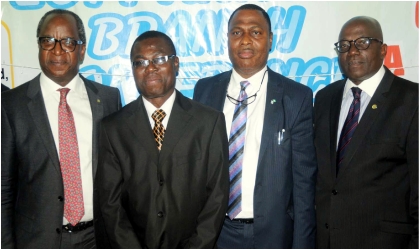
L-R: Guest Speaker, Mr Abiola Popoola, Chairman, Chartered Institute of Personnel Management (CIPN), Oyo State Branch, Mr Kolawole Oyerinde, chairman of the occasion, Mr Olujinmi Olukoya
and Registrar of the Institute, Mr Sunday Adeyemi, during the 12th Annual Conference by the Oyo State Branch, in Ibadan, yesterday.

Business
33 Banks Raise N4.65tn As Recapitalisation Ends
The Central Bank of Nigeria (CBN) yesterday said 33 banks have met new minimum capital requirements under its recapitalisation programme, raising a combined N4.65 trillion to strengthen the financial system.
The apex bank disclosed this in a statement marking the end of the exercise, which commenced in March 2024 and drew participation from domestic and foreign investors.
The statement was jointly signed by the Director of Banking Supervision, Olubukola Akinwunmi, and the Acting Director of Corporate Communications, Hakama Sidi-Ali.
The statement said “Over the 24-month period, Nigerian banks raised a total of N4.65tn in new capital, strengthening the resilience of the financial system and enhancing its capacity to support the economy.”
The regulator said local investors accounted for 72.55 per cent of the funds, while international investors contributed 27.45 per cent, reflecting continued confidence in the sector.
Commenting on the outcome, the CBN Governor, Olayemi Cardoso, said in the statement, “The recapitalisation programme has strengthened the capital base of Nigerian banks, reinforcing the resilience of the financial system and ensuring it is well-positioned to support economic growth and withstand domestic and external shocks.”
It added that while 33 banks have complied with the new thresholds, a few others are still undergoing regulatory and legal processes.
The statement noted, “The CBN confirms that 33 banks have met the revised minimum capital requirements established under the programme.
“A limited number of institutions remain subject to ongoing regulatory and judicial processes, which are being addressed through established supervisory and legal frameworks.
“All banks remain fully operational, ensuring continued access to banking services for customers.”
The apex bank stressed that the exercise was executed without disrupting banking operations, ensuring uninterrupted access to services nationwide.
It further stated that key prudential indicators have improved, particularly capital adequacy ratios, which remain above global Basel benchmarks.
The minimum ratios were set at 10 per cent for regional and national banks and 15 per cent for banks with international licences.
The bank also said the recapitalisation coincided with a gradual exit from regulatory forbearance, a move it said improved asset quality, strengthened balance sheet transparency, and enhanced overall stability.
To preserve these gains, the CBN said it has reinforced its risk-based supervision framework, mandating periodic stress tests and adequate capital buffers for banks.
It added that supervisory and prudential guidelines would be reviewed regularly to strengthen governance, risk management, and resilience across the sector.
“The successful completion of the programme establishes a stronger and more resilient banking system, better positioned to support lending, mobilise savings, and withstand domestic and global shocks,” the statement said.
The Tide learnt that foreign capital inflows into Nigeria’s banking sector rose by 93.25 per cent year-on-year to $13.53bn in 2025, up from $7.00bn recorded in 2024, amid the ongoing recapitalisation drive by the Central Bank of Nigeria.
Data from the National Bureau of Statistics capital importation report showed that the banking sector remained the dominant destination for foreign capital, accounting for $13.53bn of the total $23.22bn recorded in 2025, representing 58.26 per cent of total inflows, up from 56.81 per cent in 2024.
The surge reflects heightened investor interest in Nigerian banks as they raised fresh capital to meet new regulatory thresholds introduced by the apex bank, with industry-wide recapitalisation activities driving large-scale inflows across all quarters of the year.
However, the Centre for the Promotion of Private Enterprise (CPPE) recently raised concerns over weak credit flows to small businesses despite recent banking sector reforms.
The CPPE, led by a renowned economist, Dr Muda Yusuf, acknowledged that the ongoing bank recapitalisation exercise by the CBN has strengthened the financial system, but warned that the benefits have yet to translate into meaningful support for the real economy.
Business
SMEs Dev: Firms Launch N100m Loan Scheme
The facility will be disbursed through participating Microfinance Institutions (MFIs), which will in turn extend the loans to their customers, particularly SMEs, as they directly interface with businesses at the grassroots level.
The Executive Director of COMCIN, Mr. Micheal Ogbaa who represented the Chairman, Dr. Iredele Oyedele (FCA, FCCA), said the initiative is designed to strengthen micro-lending institutions and expand access to finance for grassroots entrepreneurs, particularly women and youths in the informal sector.
Ogbaa explained that COMCIN does not lend directly to individuals but works through its network of microfinance and cooperative institutions, which in turn provide loans to end users.
“We came together to advocate for the microfinance ecosystem. Commercial banks often exclude people at the grassroots, but our members are positioned to reach them. This facility will empower them to do more,” he said.
He noted that the loan scheme offers low interest rates and flexible repayment plans, making it more accessible to small business owners.
According to him, about 90 percent of beneficiaries are expected to be women, who play a key role in sustaining families and driving economic activities at the local level.
“Our focus is on traders, service providers, and players in the informal sector. These are the real movers of the economy. By supporting them, we are strengthening families and contributing to national development,” he added.
Ogbaa disclosed that eligible SMEs with proven integrity and business track records could access up to N5 million each through participating micro-lending institutions. The rollout has commenced in Lagos and will extend to Abuja, Enugu, and other regions, including the South-West, South-East, and North-East.
He said 12 micro-lending institutions have already benefited from the scheme, while 85 applications are currently being processed under the pilot phase.
“Our target is to reach at least 100,000 SMEs nationwide. We are building a platform that connects funding partners with credible micro-lending institutions, creating a reliable channel for financial inclusion,” Ogbaa said.
He added that COMCIN is also working to attract larger funding pools from development finance institutions and private investors, noting that successful implementation of the pilot phase would boost confidence and unlock more capital for SMEs.
“We have seen encouraging testimonies from early beneficiaries. As we demonstrate transparency and efficiency, more institutions will be willing to channel funds through us,” he said.
Business
Yenagoa’s Radisson Hotel Ready December — NCDMB, Other
-
News4 days ago
Decentralizing Pipeline Surveillance Poses Greater Dangers To Niger Delta …. Group Warns
-
Politics5 days agoAPC Resumes Electronic Membership Registration Nationwide
-
Rivers5 days agoCourt Rules Out Interim Administration In Jumbo House, Bonny
-
Business4 days ago33 Banks Raise N4.65tn As Recapitalisation Ends
-
Politics4 days agoAlleged Coup: Protests Rock N’Assembly As Detained Officers’ Children, Wives Demand Justice
-
Nation5 days agoNile University Hosts ICA Nigeria First National Confab On Global Communication
-
Sports4 days ago
Lewandowski Leads Top Stars Missing From W/Cup Roll Call
-
Sports5 days agoPara Games: Team Rivers Wins 53 Medals On Day 5 … Director Praise Athletes