
Nation
THE STATES

Adamawa
The Nigerian Society of Engineers (NSE) last Saturday
said decisive measures were being taken to stop the cases of building collapse in the country.
The National President of the society, Mr Ademola Olurunfemi, made the pledge at the ground breaking and foundation laying of NSE branch office in Yola.
The president, who was in Yola for a two day visit, was represented by the National Vice President of the society, Mr Kunle Mokolo
Olurunfemi said the society was disturbed by the cases of building collapse in the country, adding “the society is taking decisive measures.”
He said among the measures being taken was effort to bring out the intellectual capacity of Nigerian engineers to eradicate the syndrome.
Bauchi
Darazo Local Government in Bauchi State and the state
Basic Universal Education Board (SUBEB) have donated 21 bicycles to disabled primary school pupils to ease their transportation to schools.
The Chairman of the council, Alhaji Kabiru Sade presented the items to the beneficiaries on Sunday in Darazo, headquarters of the area.
Sade, represented by the Head of Administration of the council, Alhaji Yusuf Ningi, said it would reduce the transportation problems being faced by the pupils and he commended SUBEB for its initiative and commitments by alleviating the plight of the beneficiaries.
The Secretary, Local Government Education Authority, Alhaji Adamu Disina, explained that SUBEB procured 11 of the bicycles while the council had the rest and called on the beneficiaries to ensure that the items were properly maintained.
Borno
The National Directorate of Employment (NDE) in Borno
State last Saturday said it would train 25 graduates on industrial attachment to enable them to acquire skills to be self-employed.
State Coordinator, NDE, Alhaji Wakil Kalanga, said in Maiduguri that the graduates would be trained under the Industrial Attachment Programme of the Agency.
Kalanga said that the selected beneficiaries were state indigenes who graduated last year and had not yet secured job adding that said the programme was designed to train them to showcase their potentials, so that they could be gainfully employed and also be employer of labours.
The coordinator said the gesture was in line with the President Goodluck Jonathan’s Transformation Agenda to create job opportunities and reduce unemployment.
Kalanga said last year, NDE trained 50 graduates, saying that most of them were now gainfully employed or self-employed.
Jigawa
The Chairman of Gwaram Local Government in Jigawa
State, Alhaji Hanafi Yakubu, has advised new councillors in the area to protect the interest of the people that voted them into office.
Yakubu who gave the advice during the swearing-in of the councillors on Saturday in Gwaram, urged them to make laws that would bring about development and positive impact on the lives of the people.
The chairman emphasised the need for the councillors to take the oath they took seriously and not to do anything contrary to their oath of office.
Yakubu enjoined the people to be loyal to their leaders and support them to facilitate rapid development of the area.
Kaduna
The Director, Public Affairs, Kaduna State Muslim Pil
grims Welfare Board, Alhaji Adamu Muhammad, said government had established a committee for practical demonstration of Hajj operations to enhance success of 2014 Hajj.
Speaking shortly after the flag-off of the practical demonstration of the exercise in Zaria last Saturday. Muhammad lauded Governor Muktar Yero of Kaduna State for establishing the committee, assuring that it wiIl go a long way in keeping the state intending pilgrims well informed for successful Hajj.
The director said the committee would visit all the 23 local government areas of the state to practically educate them for enhanced and better result.
In an interview, Alhaji Adda’u Muhammad, Pilgrims Officer, Zaria Local Government, appealed to intending pilgrims to cooperate with the tutors for the good of all.
Muhammad said the practical demonstration would not interfere with the normal weekly Hajj training.
Lagos
An educationist, Mrs Rose Omonubi, last Saturday
called on Nigerian universities to adopt new courses that would make their graduates employable and entrepreneurs.
Omonubi, Executive Director, Nubi Educational Counselling Ltd.,who spoke on the sideline of the 2014 Nubi Education Fair in Lagos, advised universities to restructure their courses to meet the needs of the nation’s industry.
She said that courses like accounting, marketing, banking, engineering and pharmacy were no longer competitive in the labour market.
“If you go to the University of London Library, the best theses there were written by Nigerians”, she said.
Niger
President Goodluck Jonathan last Saturday said the Fed
eral Government would comprehensively tackle challenges facing all sectors of the country’s education.
Jonathan said this at the combined 21st, 22nd and 23rd convocation of Federal University of Technology (FUT), Minna.
He stressed the need for reorientation of our value system with increased emphasis on conduct, character and competence.
The president who was represented by Dr John Mack, the Permanent Secretary, Federal Ministry of Education enjoined educated elite in the society not to see people who did not have university degree as second class citizens.
Ogun
The Federal University of Agriculture Abeokuta
(FUNAAB), last Saturday graduated 81first class students at its 2011/2012 and 2012/2013 convocation.
The institution’s Vice-Chancellor, Prof. Olusola Oyewole, said in Abeokuta that of the 3,859 graduating students, 3,555 were for first degrees, while 304 were post-graduate students.
Oyewole said the Colleges of Animal Sciences, Livestock Production and Natural Sciences had 20 first class graduates each.
He said the institution was committed to the provision of visionary leadership, sustainable management of resources and committed to providing world-class future leaders.
Oyo
The Sultan of Sokoto State, Alhaji Sa’ad Abubakar, has
appealed to Oyo State government to immortalise the late Alhaji AbdulAzeez Arisekola-Alao.
Abubakar, who was in Ibadan Saturday to commiserate with the family and the state government, said though Arisekola-Alao was dead his legacies should not be forgotten.
The Sultan, who is the President-General of Nigerian Supreme Council for Islamic Affairs (NSCIA), said Nigeria had lost a prominent son but not lost his spirit. He said the deceased would be difficult to replace in Nigeria because he dedicated his life in the service of his creator and mankind.
Plateau
Governor Jonah Jang of Plateau State has urged Nige
rians to observe regular exercise to enable them to stay fit, healthy and live longer.
Jang, who gave the advice last Saturday at the 25th edition of Olympic Day Run in Jos, said exercise was crucial for the body.
Represented by Mr Agwom Sani-Zandi, Commissioner for Solid Minerals Development, Jang advised people to know their health conditions before embarking on strenuous exercise, stating that his administration embarked on massive projects in the sports sector in recognition of its importance.
Zamfara
Top government officials in the Gov. Abdulaziz Yari-led
All Progressives Congress (APC) administration in Zamfara are gradually resigning their appointments and leaving the party.
The Commissioner for Agriculture, Alhaji Malami Yandoto and three directors-general had resigned their appointments in the last one month.
The DGs included that of Governor’s Office, Alhaji Mustapha Bukkuyum; Alhaji Shehu Yanware of the Directorate of Inter-Party Relations and Alhaji Haruna Jangebe of the Directorate of Non-Governmental Organisations.
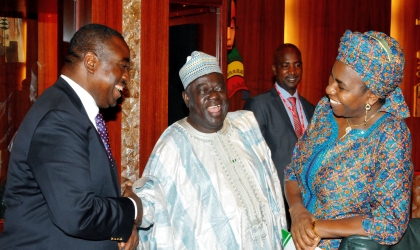
Governor Gabriel Suswam of Benue State, Governor Babangida Aliyu of Niger State and Minister of Water Resources, Mrs Sarah Ochekpe,at the National Economic Council Meeting in Abuja yesterday Photo: NAN



As the world marked the 2026 International Day of the Girl Child on Sunday, October 11, 2026, a non-governmental organisation, Stand Up for Women Society (SWS) has intensified its campaign against child marriage, urging schoolgirls to prioritise education, protect their rights and develop skills for a better future.
The organisation joined the global observance of the day under the theme, “International Day of the Girl Child: End Child Marriage and Invest in Girls’ Rights,” with a sensitisation programme at Government Girls Secondary School, Oromenike, D-Line, Port Harcourt, Rivers State.
Led by its Vice Chairperson, Daba Benebo, the group engaged the students in discussions on the dangers of early marriage, teenage pregnancy, sexual abuse and other challenges that threaten the education, safety and development of the girl child.
Speaking during the programme, Benebo urged the students to reject early marriage and remain focused on their studies, stressing that education would empower them to make informed decisions about their lives and future.
She cautioned the girls against allowing anyone to deprive them of their right to education and dignity, advising them to report cases of harassment, abuse and other violations of their rights to the appropriate authorities.
Benebo assured the students that SWS remained available to support them whenever they encountered violations of their rights.
She also encouraged them to maintain discipline and responsible conduct while avoiding behaviours that could expose them to negative influences and jeopardise their future.
Beyond formal education, the SWS vice chairperson urged the students to acquire vocational skills that could provide additional opportunities for economic independence and help them navigate future challenges.
The sensitisation programme, enlivened by singing, dancing and to share their views and experiences on issues affecting the girl child interactive sessions, provided an opportunity for the students to share their views and experiences on issues affecting the girl child.
One of the major issues raised during the discussion was the appropriate age for marriage. While some participants maintained that 18 years was the constitutionally approved age, the discussion highlighted the need to consider not only age but also the maturity, preparedness and responsibilities associated with marriage.
The speaker stressed that marriage required adequate mental and emotional preparation, as well as the capacity to shoulder its responsibilities.
She therefore advised the students to concentrate on acquiring a sound education before considering marriage, noting that education would equip them with the knowledge and skills needed to make responsible decisions and manage family life.
The issue of teenage pregnancy also featured prominently during the question-and-answer session.
In addressing the subject, the speaker explained that pregnancy could occur even at the age of 12, using the example to underscore the vulnerability of young girls to the consequences of early sexual activity.
She advised the students to avoid sexual intercourse and prioritise their education, personal safety and future aspirations.
The discussion also examined the difficulties some girls encounter when living with hostile spouses, relatives or guardians.
Benebo encouraged the students to cultivate patience, humility and diligence, noting that these qualities could help them navigate difficult situations and build a brighter future.
However, she warned that patience and humility should never be interpreted as an obligation to endure violence, abuse or degrading treatment.
She urged girls experiencing hostile or abusive living conditions to seek help from their parents, trusted adults or appropriate support services rather than remain in environments that could expose them to physical or emotional trauma.
“When such happens, please return to your parents and engage in petty trade or learn a skill to support your education rather than stay in a hostile environment,” Benebo stressed.
The programme also underscored the importance of protecting girls from early marriage and other harmful practices that can disrupt their education, compromise their well-being and limit their opportunities in life.
It also reinforced the need for families, schools, communities and relevant organisations to work together to ensure that girls have access to education, vocational training, protection and the support they need to realise their potential.
For SWS, the message was clear: empowering the girl child begins with protecting her rights, investing in her education and equipping her with the confidence and skills to make informed choices about her future.
Stories by Kevin Nengia
The Egberipapa Foundation has unveiled a mass transit scheme aimed at easing transportation difficulties and improving connectivity among communities in the three Kalabari local government areas of Asari-Toru, Degema and Akuku-Toru in Rivers State.
The initiative, established by former Caretaker Committee Chairman of Akuku-Toru Local Government Council, High Chief Sobomabo Jackrich, popularly known as Egberipapa, is designed to make transportation more accessible and affordable for residents across the Kalabari area.
The scheme was launched on Monday, October 12, 2026, and is expected to address longstanding transportation challenges confronting residents, particularly those in riverine and hard-to-reach communities.
Communities expected to benefit from the initiative include Krakrama, Minama, Angulama, Sangama, Omekwe-Tariama and Omekwe-Ama.
The project is expected to ease movement within and beyond the Central Group area, while providing residents with a more convenient means of transportation for their daily activities.
For decades, transportation difficulties have posed significant challenges to several Kalabari communities, making movement between settlements both cumbersome and expensive. These challenges have also affected commercial activities, social interactions and access to essential services.
The introduction of the mass transit scheme is therefore expected to provide relief to residents, strengthen inter-community connections and stimulate economic activities across the benefiting communities.
Beyond improving mobility, the initiative could contribute to community development by facilitating the movement of people and goods, supporting local businesses and enhancing social and economic interactions within the Kalabari area.
As the scheme gets underway, attention will be focused on its implementation, accessibility and sustainability, as well as its capacity to deliver lasting transportation benefits to the target communities.
The initiative represents a potentially significant step towards addressing transportation challenges and promoting grassroots development across the Kalabari Kingdom.

The Amaewhule family of mbodo Aluu in Ikwerre Local Government Area of Rivers State has cautioned members of the public against entering into any land transaction involving a disputed property known as “Ada Oro Fam Land,” located behind the OPM Church along Airport Road.
The family, through its legal counsel, Barrister Ndubuisi Agumagu, issued the warning amid an ongoing legal dispute over the ownership and control of the property, which is said to comprise more than 900 plots of land.
The matter is currently before the Isiokpo High Court of Rivers State in a suit numbered IHC/246/CS/2026, presided over by Justice Sobere Biambo.
The claimants in the suit include Chief Green Amaewhule and others, while Fabulous Amaewhule and Odibola Properties are listed among the respondents.
Counsel to the Amaewhule family, Barr Ndubuisi Agumagu, advised prospective land buyers and members of the public to exercise caution and refrain from purchasing any portion of the disputed property pending the determination of the case by the court.
According to the legal counsel, the property is a family estate belonging collectively to the Amaewhule family, and no individual member of the family has the authority to unilaterally dispose of portions of the land.
The counsel specifically maintained that Fabulous Amaewhule, one of the respondents in the suit, does not have the legitimate authority, according to the family’s position before the court, to sell portions of the disputed property.
The family further warned that anyone who proceeds to purchase land from the respondents while the matter remains before the court would be doing so at their own risk.
It stressed that such buyers could potentially lose their investments should the court eventually deliver judgment against the validity of the transactions.
The legal team said the warning became necessary to prevent unsuspecting members of the public from committing their resources to a property whose ownership and right of disposition are currently the subject of judicial determination.
The family also urged prospective investors, developers and land buyers to conduct proper legal inquiries and obtain independent verification of the status of the property before committing funds to any transaction relating to it.
The Amaewhule family said its position was intended to protect members of the public from possible financial losses and further legal complications while the case remains sub judice, stressing that interested parties should await the final determination of the court.
Akujobi Amadi
-

 Education1 day ago
FCE Yola Graduates 3,555 Teachers , Seeks Upgrade to University
-

 Sports1 day ago
Nigerian Trio Target Titles At PFL Africa Finals
-

 Niger Delta1 day ago
Diri Restates Stance On Lagos-Calabar Coastal Highway
-

 Niger Delta1 day ago
C’River, NUJ Pay Tribute To Late Guardian Editor
-

 News1 day ago
NDLEA Recovers Tons Of Illicit Drug Consignments In Nine States
-

 Opinion1 day ago
Checking Voter Apathy In Nigeria’s Electoral Process
-

 Politics1 day ago
2027: DICKSON’S EX-ALLY VOWS TO WORK AGAINST NDC INTEREST IN BAYELSA
-

 Politics1 day ago
2027: GROUP PLEDGES 40,000 SUPPORTERS FOR COALITION CANDIDATES IN RIVERS