
Business
N’Delta Youth Get Another Chance To Own Businesses

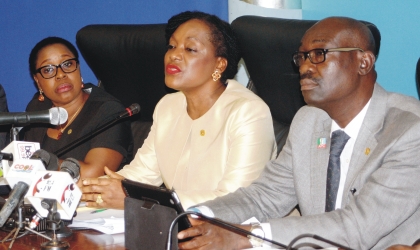
Director of Administration and Finance, Lagos Central Business District (CBD), Mrs Bolanle Owolabi, Special Adviser to Lagos State Governor on CBD, Mrs Derin Disu and her counterpart on Information and Strategy, Mr Lateef Raji, at a news conference on activities of CBD in the last one year in Lagos, last Wednesday.
Niger Delta youth are being given yet another chance to start their own businesses through the 2014 edition of the LiveWIRE programme, for which the Shell Petroleum Development Company of Nigeria Limited (SPDC), has invited entries from eligible candidates.
In a statement last Wednesday, Shell’s Corporate Media Relations Manager, Precious Okolobo, said that people aged between 18-35 in Delta, Bayelsa and Rivers states are invited to apply for the 2014 edition, with a chance to benefit from start-up funding and a wide range of support services including training workshops and business awareness sessions.
Speaking in Port Harcourt, recently, General Manager, Sustainable Development and Community Relations, Nedo Osayande, said that “The LiveWIRE programme has become the main means of support for youths in the Niger Delta to start their own businesses”.
“The success stories of several young entrepreneurs are really inspiring, and we’re delighted that more youths will take up the opportunity in the 2014 edition,” he said.
Launched in 2003, LiveWIRE Nigeria is a flagship programme that provides access to training, business development services and start-up capital to establish and expand youth-owned businesses.
To date, the programme has trained nearly 6,000 Niger Delta youths in enterprise development and management.
In 2011, SPDC commenced the implementation of a partnership with the Niger Delta Development Commission (NDDC) to expand the LiveWIRE programme with a focus on the economic empowerment of young women.
Through this partnership, the LiveWIRE model has been used to create employment opportunities for over 1,600 women between the ages of 18 and 35.
A highlight of the LiveWIRE programme is the Young Business Leaders Awards for managers who have been in business for up to two years, and can show good progress in service delivery, financial growth, employment generation and improvement in management strategies.
The generous cash awards are expected to help the young people further expand their businesses.
Employment generation for young people is just one aspect of the social investment portfolio of Shell companies in Nigeria.
In 2013 alone, the SPDC JV and Shell Nigeria Exploration and Production Company (SNEPCo) spent more than $100 million on voluntary social investment activities, making Nigeria the largest recipient of social investment by the Shell Group globally.





This figure is against the already released 40 slots by the company.
Consequently, the youths have moved to convene a national congress of youths to address issues relating to the oil exploration, which has sparked palpable divisions in the area.
Speaking during the inauguration of the Planning Committee for the Congress, in PortHarcourt, at the weekend, the President-General of OYF, Worldwide, Engr. Legborsi Yamaabana, described the congress as urgent, and targetted at addressing all issues arising from the planned oil resumption.
He said “The Ogoni nation stands at a critical crossroads in its history. We acknowledge the renewed political attention of the Federal Government of Nigeria under the leadership of His Excellency, President Bola Ahmed Tinubu (GCFR), particularly regarding the proposed resumption of oil and gas exploration in Ogoniland after more than three decades of suspension.
“While we recognize this development as a significant national conversation, we emphasize that any engagement concerning Ogoniland must be anchored on the principles of environmental justice, equitable benefit-sharing, and the protection of the dignity, rights, and future of the Ogoni people especially our youth, who remain the custodians of tomorrow.
“The Ogoni struggle is not merely historical; it is living, evolving, and central to the future of sustainable development in the Niger Delta and Nigeria at large.”
He called for calm over the 40 job opportunity given to the area by the NNPCL, insisting that such allocation was insufficient compared to the contribution of Ogoni to the economy.
Yamaabana rather requested that NNPCL, as a matter of importance, give 500 job slots to youths of the area,
In the interim, the leadership of OYF Worldwide has observed the unnecessary tension and uproar surrounding the reported 40 slots of employment opportunity allocated to Ogoni youths in NNPCL and its subsidiaries, as part of Federal Government confidence-building measure toward the resumption of oil and gas activities in Ogoniland.
“We strongly appeal to all Ogoni political, traditional, and community leaders to sheath their swords, maintain calm, and refrain from unnecessary squabbles over crumbs.
“Without preempting the sovereign deliberations of the upcoming Congress, let it be noted that Ogoni youth will not settle for tokenism.
“At the upcoming Congress, we shall formally demand a minimum of 500 direct employment opportunities within the Nigerian National Petroleum Company Limited (NNPCL) and its subsidiaries for qualified Ogoni youths, who have been economically sidelined and left inactive throughout this 33-year stalemate.”
-
Sports3 hours ago
Nnadozie, Osimhen Lead Highest-Rated Nigerian Players
-

 Oil & Energy2 hours ago
NCDMB, Renaissance, Lee, Engage 24 Youths On Oil, Gas Human Capital Dev’t Training
-
Rivers32 minutes ago
Philanthropist Cautions Youths Against Ignoble Acts Donates Building To Musician
-
Education2 hours ago
FG Pledges Education Overhaul, Says Debate Builds Democratic Citizenship At 2026 Democracy Day Championship
-

 Oil & Energy2 hours ago
PENGASSAN Tasks FG On Stable Policies, Faster Approvals To Boost Oil, Gas Investment
-
Rivers32 minutes ago
IAUE Inaugurates Centre For AI, Launches Book On Digitisation Milestone
-
Education2 hours ago
Rector Commends RSG Over Commissioning of 3 Projects at Captain Elechi Amadi Polytechnic
-
 Oil & Energy2 hours ago
FG Pledges Stronger Support For Oil, Gas Training