Business
CBN Submits N930bn Budget To National Assembly

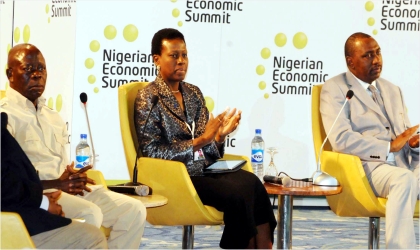
L-R: Gov. Adams Oshiomhole; Vice-Chairman, Nigerian Economic Summit Group (nesg), Mrs Sola David-Borha, and Supervisory Minister of National Planning, Amb. Bashir Yuguda, at the close of the 20th Nigerian Economic Summit in Abuja, yesterday.
The Central Bank of Nigeria (CBN) has submitted and defended its 2014 budget proposal before the House of Representatives Committee on Banking and Finance.
The Tide source reports that it is the first time the CBN would be doing so in the apex bank’s history.
The budget was presented to the House last Wednesday by Mr Suleiman Barau, Deputy Governor in charge of Corporate Services, who also defended the bank’s 2013 performance at the session.
Barau said that the CBN had projected N553bn asý expected income with a projected expenditure profile of N377bn for 2014.
Presenting its performance chart for its 2013, Barau said that the CBN overshot its 2013 expenditure by more than N326bn.
He said the bank projected N413bn as its expenditure for 2013 but ended up spending N739bn.
Barau told the committee that the bulk of the 2013 excess expenditure was spent on “liquidity management” of the country’s economy.
He said the bank earmarked N180bn forý liquidity management but ended up spending N536bn.
The Chairman of theý Committee on Banking and Currency, Rep. Jones Onyereriý, then requested for complete details of the bank’s staff nominal roll.
The CBN under its suspended governor, Malam Sanusi Lamido Sanusi, had a running battle with the Senate as he insisted on CBN’s independence based on the Banking and Other Financial Institutions Act and the CBN Act.
Sanusi insisted that the apex bank would not subject itself to the Appropriation Act of the National Assembly.

Transport
Nigeria Rates 7th For Visa Application To France —–Schengen Visa
Transport
West Zone Aviation: Adibade Olaleye Sets For NANTA President
Business
Sugar Tax ‘ll Threaten Manufacturing Sector, Says CPPE
In a statement, the Chief Executive Officer, CPPE, Muda Yusuf, said while public health concerns such as diabetes and cardiovascular diseases deserve attention, imposing an additional sugar-specific tax was economically risky and poorly suited to Nigeria’s current realities of high inflation, weak consumer purchasing power and rising production costs.
According to him, manufacturers in the non-alcoholic beverage segment are already facing heavy fiscal and cost pressures.
“The proposition of a sugar-specific tax is misplaced, economically risky, and weakly supported by empirical evidence, especially when viewed against Nigeria’s prevailing structural and macroeconomic realities.
The CPPE boss noted that retail prices of many non-alcoholic beverages have risen by about 50 per cent over the past two years, even without the introduction of new taxes, further squeezing consumers.
Yusuf further expressed reservation on the effectiveness of sugar taxes in addressing the root causes of non-communicable diseases in Nigeria.
-
News4 days agoDon Lauds RSG, NECA On Job Fair
-
Niger Delta2 days agoPDP Declares Edo Airline’s Plan As Misplaced Priority
-
Sports2 days agoSimba open Nwabali talks
-
Nation2 days agoHoS Hails Fubara Over Provision of Accommodation for Permanent Secretaries
-
Niger Delta2 days ago
Stakeholders Task INC Aspirants On Dev … As ELECO Promises Transparent, Credible Polls
-
Niger Delta2 days ago
Students Protest Non-indigene Appointment As Rector in C’River
-
Oil & Energy2 days agoNUPRC Unveils Three-pillar Transformative Vision, Pledges Efficiency, Partnership
-
Rivers2 days ago
Fubara Restates Continued Support For NYSC In Rivers