Opinion
Rivers Revolution In Education
Education in Rivers State is experiencing the best of times than what was obtained hitherto. Indeed education at the primary and post-primary levels in the state is an envy for the rest of the country to emulate. This present administration than any other if not may be that of the Alfred Diette-Spiff and late Melford Okilo in the old Rivers State government has taken education to an enviable height.
What with the unprecedented constructional rehabilitation of model schools with state-of-the-art modern facilities in both Port Harcourt and other parts of the state. These schools with modern infrastructure are equipped with computer studios and attractive sporting facilities for track and field events, football pitches, basketball courts etc. Not only the equipment but the environment and ambience is very conducive for learning, there are well laid out walk ways and lawns properly landscaped right from the entrance. Added to these is the perimeter fence that will help control and check movement of students thereby instilling discipline in them. Also, it will go a long way in helping to provide security and protection for the school pupils and the facilities. Especially in these days of kidnapping and child trafficking in persons that leaves children very vulnerable.
The Amaechi administration did not only stop at building school infrastructure but went on to provide free school uniforms and free books for pupils. Also, this writer found out that there are no school fees paid or any charges from parents/guardians of pupils. Could this be true in present day Nigeria? That is a rhetorical question with an obvious answer in the case of education revolution in the state. Although, some people have observed that some of these schools in certain areas of the state are not been utilised or occupied.
Be that as it may, solid and concrete steps are being put in place to revolutionise the fortunes of education in the entire state by this administration. It is significant to note that the teachers to apply instructions to these pupils need training and retraining to be abreast with modern, latest instructional procedure or techniques to give the students the best.
In addition, we all know that a well motivated teaching staff is synonymous with consistent and regular payment of salaries and allowances as at when due to motivate them to give their utmost best.
In this vein, I want to task the government to set a minimum standard for most of the teachers to be university graduates from reputable institutions in the state and country. Since you can’t give what you don’t have and a well qualified teacher will impart sound education – knowledge to his students. The government in conjunction with the Universal Basic Education (UBE) programme scheme should embark on a massive recruitment drive to attract good hands. This is very possible since we have qualified teachers roaming the streets or poorly engaged in mushroom private schools, who naturally would be attracted to the modern conducive work environment and commensurate remuneration package.
Interestingly, most pundits are of the view that a sound and effective management team comprising seasoned educationist, men of integrity should be constituted to manage these schools. This is to ensure that facilities/equipment installed are maintained and the teachers show commitment and diligence. Also that academic standards are set and met that can be comparable to international best practices.
Of particular mention is the scholarship award scheme for undergraduate and post-graduate studies overseas for state indigenes under the aegis of RSSDA by this same government. And this is intended to help meet the shortfall in skilled manpower particularly in the petroleum and gas sector of the economy which is an area dominated by expatriates. This effort will go a long way in building capacity for the state and beneficiaries as well as reducing unemployment and inadvertently improving the conditions of living of the people.
Then in the tertiary sector, the government could be said to be trying its best, especially with the polytechnic, the two universities (state owned) and other higher institutions who have experienced one form of development or the other under this administration which is in any case ongoing. And that is why this writer along side all good meaning people of the state welcome with great relief the planned relocation of Rivers State University of Science and Technology to its new site at the Greater Port Harcourt City.
Indeed, this government has made much giant strides in education but the issue of the continued closure of the Rivers State University of Science and Technology must be tackled headlong. Though, this writer learnt, reliably that, some of the problems bedeviling the institution were inherited from past governments.
However, the governor and his team should use a lot of wisdom, tact and brinkmanship to assuage all parties concerned and resolve the crisis affecting that enviable institution constructively.
Here is wishing the amiable governor and his team a happy and successful second tenure in office and saying they have to hit the ground running as Americans would say.
Ayooso, a Public Affairs Analyst, resides in Port Harcourt.
Samson Ayooso

Opinion
Wike VS Soldier’s Altercation: Matters Arising
The events that unfolded in Abuja on Tuesday November 11, 2025 between the Minister of the Federal Capital Territory, Chief Nyesom Wike and a detachment of soldiers guarding a disputed property, led by Adams Yerima, a commissioned Naval Officer, may go down as one of the defining images of Nigeria’s democratic contradictions. It was not merely a quarrel over land. It was a confrontation between civil authority and the military legacy that still hovers over our national life.
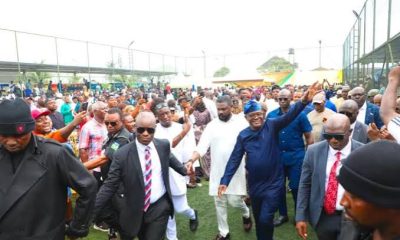
Nyesom Wike, fiery and fearless as always, was seen on video exchanging words with a uniformed officer who refused to grant him passage to inspect a parcel of land alleged to have been illegally acquired. The minister’s voice rose, his temper flared, and the soldier, too, stood his ground, insisting on his own authority. Around them, aides, security men, and bystanders watched, stunned, as two embodiments of the Nigerian state clashed in the open.
The images spread fast, igniting debates across drawing rooms, beer parlours, and social media platforms. Some hailed Wike for standing up to military arrogance; others scolded him for perceived disrespect to the armed forces. Yet beneath the noise lies a deeper question about what sort of society we are building and whether power in Nigeria truly understands the limits of its own reach.
It is tragic that, more than two decades into civil rule, the relationship between the civilian arm of government and the military remains fragile and poorly understood. The presence of soldiers in a land dispute between private individuals and the city administration is, by all civic standards, an aberration. It recalls a dark era when might was right, and uniforms conferred immunity against accountability.
Wike’s anger, even if fiery, was rooted in a legitimate concern: that no individual, however connected or retired, should deploy the military to protect personal interests. That sentiment echoes the fundamental democratic creed that the law is supreme, not personalities. If his passion overshot decorum, it was perhaps a reflection of a nation weary of impunity.
On the other hand, the soldier in question is a symbol of another truth: that discipline, respect for order, and duty to hierarchy are ingrained in our armed forces. He may have been caught between conflicting instructions one from his superiors, another from a civilian minister exercising his lawful authority. The confusion points not to personal failure but to institutional dysfunction.
It is, therefore, simplistic to turn the incident into a morality play of good versus evil.
*********”**** What happened was an institutional embarrassment. Both men represented facets of the same failing system a polity still learning how to reconcile authority with civility, law with loyalty, and service with restraint.
In fairness, Wike has shown himself as a man of uncommon courage. Whether in Rivers State or at the FCTA, he does not shy away from confrontation. Yet courage without composure often feeds misunderstanding. A public officer must always be the cooler head, even when provoked, because the power of example outweighs the satisfaction of winning an argument.
Conversely, soldiers, too, must be reminded that their uniforms do not place them above civilian oversight. The military exists to defend the nation, not to enforce property claims or intimidate lawful authorities. Their participation in purely civil matters corrodes the image of the institution and erodes public trust.
One cannot overlook the irony: in a country where kidnappers roam highways and bandits sack villages, armed men are posted to guard contested land in the capital. It reflects misplaced priorities and distorted values. The Nigerian soldier, trained to defend sovereignty, should not be drawn into private or bureaucratic tussles.
Sycophancy remains the greatest ailment of our political culture. Many of those who now cheer one side or the other do so not out of conviction but out of convenience. Tomorrow they will switch allegiance. True patriotism lies not in defending personalities but in defending principles. A people enslaved by flattery cannot nurture a culture of justice.
The Nigerian elite must learn to submit to the same laws that govern the poor. When big men fence off public land and use connections to shield their interests, they mock the very constitution they swore to uphold. The FCT, as the mirror of national order, must not become a jungle where only the powerful can build.
The lesson for Wike himself is also clear: power is best exercised with calmness. The weight of his office demands more than bravery; it demands statesmanship. To lead is not merely to command, but to persuade — even those who resist your authority.
Equally, the lesson for the armed forces is that professionalism shines brightest in restraint. Obedience to illegal orders is not loyalty; it is complicity. The soldier who stands on the side of justice protects both his honour and the dignity of his uniform.
The Presidency, too, must see this episode as a wake-up call to clarify institutional boundaries. If soldiers can be drawn into civil enforcement without authorization, then our democracy remains at risk of subtle militarization. The constitution must speak louder than confusion.
The Nigerian public deserves better than spectacles of ego. We crave leaders who rise above emotion and officers who respect civilian supremacy. Our children must not inherit a nation where authority means shouting matches and intimidation in public glare.
Every democracy matures through such tests. What matters is whether we learn the right lessons. The British once had generals who defied parliament; the Americans once fought over states’ rights; Nigeria, too, must pass through her own growing pains but with humility, not hubris.
If the confrontation has stirred discomfort, then perhaps it has done the nation some good. It forces a conversation long overdue: Who truly owns the state — the citizen or the powerful? Can we build a Nigeria where institutions, not individuals, define our destiny?
As the dust settles, both the FCTA and the military hierarchy must conduct impartial investigations. The truth must be established — not to shame anyone, but to restore order. Where laws were broken, consequences must follow. Where misunderstandings occurred, apologies must be offered.
Let the rule of law triumph over the rule of impulse. Let civility triumph over confrontation. Let governance return to the path of dialogue and procedure.
Nigeria cannot continue to oscillate between civilian bravado and military arrogance. Both impulses spring from the same insecurity — the fear of losing control. True leadership lies in the ability to trust institutions to do their work without coercion.
Those who witnessed the clash saw a drama of two gladiators. One in starched khaki, one in well-cut suit. Both proud, both unyielding. But a nation cannot be built on stubbornness; it must be built on understanding. Power, when it meets power, should produce order, not chaos.
We must resist the temptation to glorify temper. Governance is not warfare; it is stewardship. The citizen watches, the world observes, and history records. How we handle moments like this will define our collective maturity.
The confrontation may have ended without violence, but it left deep questions in the national conscience. When men of authority quarrel in the open, institutions tremble. The people, once again, become spectators in a theatre of misplaced pride.
It is time for all who hold office — civilian or military — to remember that they serve under the same flag. That flag is neither khaki nor political colour; it is green-white-green, and it demands humility.
No victor, no vanquish only a lesson for a nation still learning to govern itself with dignity.
By; King Onunwor
Opinion
Ndifon’s Verdict and University Power Reform
Opinion
As Nigeria’s Insecurity Rings Alarm
-
Politics3 days agoWhy Reno Omokri Should Be Dropped From Ambassadorial List – Arabambi
-
Sports3 days agoNigeria, Egypt friendly Hold Dec 16
-
Politics3 days agoPDP Vows Legal Action Against Rivers Lawmakers Over Defection
-
Oil & Energy3 days agoNCDMB Unveils $100m Equity Investment Scheme, Says Nigerian Content Hits 61% In 2025 ………As Board Plans Technology Challenge, Research and Development Fair In 2026
-
Sports3 days agoNSC hails S’Eagles Captain Troost-Ekong
-
Politics3 days agoRIVERS PEOPLE REACT AS 17 PDP STATE LAWMAKERS MOVE TO APC
-
Sports3 days agoMakinde becomes Nigeria’s youngest Karate black belt
-
Politics3 days agoWithdraw Ambassadorial List, It Lacks Federal Character, Ndume Tells Tinubu