Connect with us

Featured

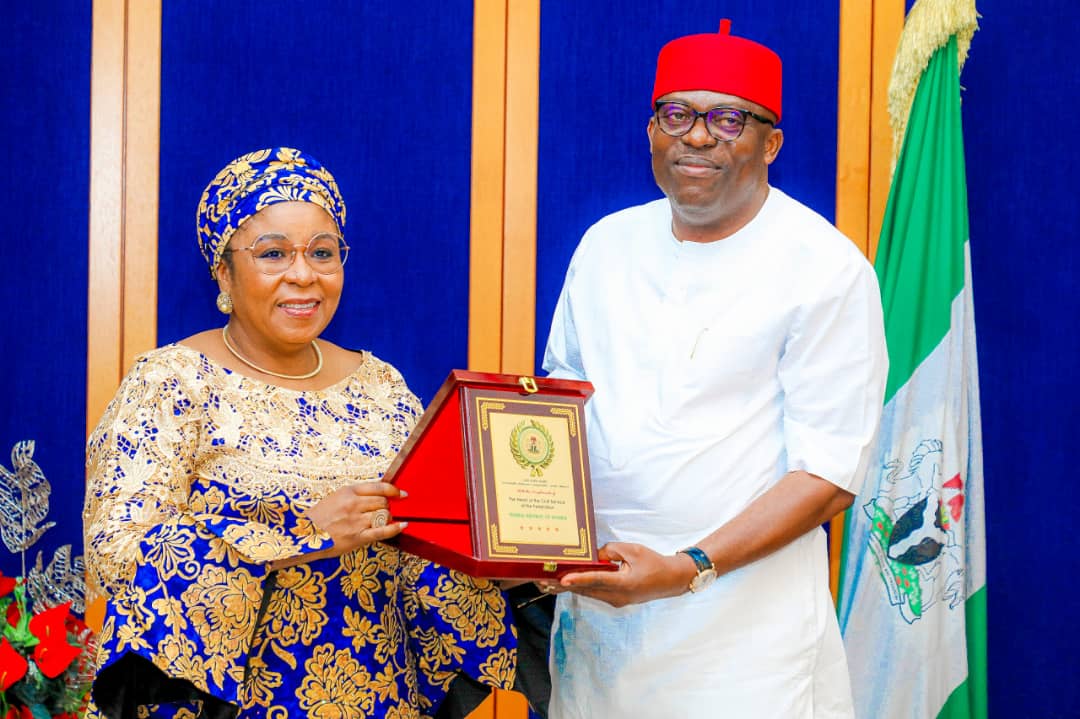
We’ll Support Efforts At Building Productive Civil Service, Fubara Assures Walson-Jack

Published

on

Rivers State Governor, Sir Siminalayi Fubara, has acknowledged the tremendous efforts of the leadership of the Federal Civil Service at building the capacity of the workforce for greater productivity, and assured that the Rivers State Government will not relent in offering tenable support that will contribute to the success of the administration of President Bola Tinubu.
The Governor maintained that in addition to joining efforts with the President Tinubu-led administration to achieve its Renewed Hope Agenda for the country, the current Head of the Civil Service of the Federation, has been a true ambassador of Rivers State with sterling performance that requires support.
Governor Fubara made the acknowledgment when he received on courtesy visit, the Head of the Civil Service of the Federation, Mrs Didi Esther Walson-Jack at Government House in Port Harcourt, last Monday.
On her entourage were; Eyo Okpo-Ene, the South-South Zonal Chairman/Local Organising Committee of Nigerian Institute of Management, Prof. Abubakar Garuba, council member and North-East Zonal Chairman of Nigerian Institute of Management, and Sir Emmanuel Okafor, council member of Nigerian Institute of Management.
Governor Fubara said: “Let me also say this to everyone, when you become an ambassador of our State, the ambassador, as I understand it very well, is that you are representing a people.
“You might be a messenger to protect their interest or maybe, do one or two things for your people. It is always good for your person to speak peace and not trouble. I can say it here without fear that you symbolize peace, and we are very proud to associate with you.
“We will, by the special grace of God, in anyway we can, support you. We will support you because we know what you stand for. We also appreciate the work you are doing, and we are going to join hands together with you to support the success of the administration of Mr. President.
“Because it is important, if we fail from the head, it will also go down to the toe. So, we need all aspects of succeed,” he added.
Governor Fubara told his quest the need to bring back the glory that was once reckoned with the Rivers State Civil Service.
He said when Mrs Walson-Jack was still with the Rivers State Civil Service, she worked with dedication and attained a certain level in the service to merit the recommendation that took her to federal level because she was an outstanding officer.
“So, those of you that are here, you can see what it means to work hard, and to be dedicated. And today, it is because of those qualities, those hard works that led her to go to the federal, and she is now the Head of the Civil Service of the Federation. It is not a walk in the pack, no. It is a big achievement. So, I am happy that you were able to achieve it for us.”
Governor Fubara said lots of initiatives and actions have been taken since he assumed office to reposition the State Civil Service that was nearly dead.
One of the decisions implemented, he stated, was to commence the promotion of civil servants who had been denied such statutory rights for upwards of 11 years, stressing that the decision has restored hope in them as a workforce of the government.
“We came in and it wasn’t easy, but we have to give the civil servants hope by ensuring that they were promoted. When we came on board, we inherited a near dead civil service. A service that there was no promotion for 11 years.
“We didn’t even end there. We immediately, when Nigerian Institute of Management visited us earlier, we assured them that they are going to be consultant to the Civil Service in terms of training, which is key.”
Governor Fubara also bemoaned how civil servants have been deprived of functional training opportunities that should expose them to contemporary procedures and work ethics, which had taken a toll on the entire service.
He said: “Training is the only thing that can build the service that will give us that level of result. Result of transparency, efficiency, even assurance that there is hope. It is only when you start building them and they feel secured that they also understand that something is at stake.
“I can’t remember the year that any of the civil servants here had gone for any training. I think the last time we did training was in 2010. That was the last time the civil service was involved in any training. So, I know what it means, because that is my primary constituency,” he said.
Governor Fubara noted with delight that the Head of the Civil Service of the Federation showed respect by undertaking the courtesy visit that most government functionaries find it difficult to do because they do not want to be in the bad book of somebody.
Specifically, he said: “I feel very honoured, I am overwhelmed with so much joy and my reason is this: We’ve had cases where people come into our State, people come in to represent the President in events, and they don’t bother paying courtesy (visit).
“The singular reason is for fear of some persons in Abuja. So, I am really happy that you are doing what is the normal standard everywhere in the federation.
“Somebody of your calibre cannot come into Rivers State without paying a courtesy call to the Governor. And by that, we also recognize you, because if anything happens to you while you are here, it is our problem. So, I want to thank you for honouring us,” he added.
In her speech, the Head of the Civil Service of the Federation, Mrs Didi Esther Walson-Jack, said as Head of the Civil Service of the Federation, she is dedicated to ensuring that Rivers State’s concerns and aspirations are amplified at the highest level of government.
She pledged her readiness to support any initiatives that align with the goals of advancing the State because of her passion to build a civil service that is robust, responsive, dynamic, and one that meets the needs of the people.
She said, “At the Federal level, our ongoing civil service reforms are focused on performance management and digital transformation to improve transparency, accountability and efficiency.
“In today’s rapidly changing world, technology has become indispensable. We have embraced digitalization in the Federal Civil Service to streamline processes, enhance communication and deliver better services.
“I look forward to discussing how the Federal and Rivers State Civil Services can collaborate on technology-driven initiatives that can serve as a model for other states and regions.”
Speaking further, she said: “Your Excellency, I have long admired your commitment to public service, and I am excited to explore how we can work together to strengthen the Rivers State Civil Service further by prioritizing initiatives such as capacity building, promotion of transparency and accountability, and fostering greater citizen engagement. We can build the service that meets and exceeds expectations.
“Your leadership vision and dedication to good governance are not just commendable, but also critical to the success of our efforts at the Federal level.
“I am confident that together, we can advocate for policies that would unlock Rivers State’s full potential, and ensure its citizens have access to the resources and opportunities needed for sustainable growth and development.”
Mrs Walson-Jack expressed delight at learning how Rivers State under the leadership of Governor Fubara is determined to host the annual Federation of Public Service Games (FEPSGA) in November, 2024, and is on the verge of securing the hosting right for the 2024 meeting of the Joint Public Service Negotiating Council.
She said the prestigious events would further advance the standing of Rivers State as a centre for national activities, and demonstrates it’s capacity for excellence.

Featured

Fubara Reaffirms Commitment To Peace, Development

Published

on

Governor of Rivers State, Sir Siminalayi Fubara, has reaffirmed the unwavering commitment of his administration to peace, unity, security, and inclusive development as Rivers State marked its 59th anniversary, last Wednesday.


In a goodwill message issued on Wednesday to commemorate the anniversary, Governor Fubara stated that despite the challenges faced over the years, the people of Rivers State have continued to demonstrate resilience, strength, and an enduring spirit of unity that has sustained the state since its creation.


The Governor noted that the strong bond of brotherhood among the various ethnic nationalities of the state, including the Ijaw, Ikwerre, Ogoni, Etche, Ekpeye, Andoni, Kalabari, and others, remains one of Rivers State’s greatest strengths and a critical foundation for peace, stability, and progress.


He further observed that Rivers State has remained a major driver of Nigeria’s economy for decades, not only because of its abundant oil and gas resources, but also because of the exceptional contributions of its people across diverse sectors including academia, jurisprudence, business, entertainment, public service, and sports.


Governor Fubara assured the people that his administration will continue to prioritize policies and programmes that promote peace, protect lives and property, and expand development across all parts of the state. He emphasized that governance must be people centered and impactful, with equal attention given to every Local Government Area of the state.


The Governor also paid tribute to the elders and founding leaders of the state for preserving the spirit of unity and coexistence over the years, while urging the youths to remain hopeful, responsible, and actively committed to building a greater Rivers State through innovation, hard work, and patriotism.


He equally acknowledged the invaluable role of women in strengthening families, communities, and society, describing them as indispensable partners in the continued growth and stability of the state.


Governor Fubara called on all Rivers people to use the occasion of the anniversary as a moment of reflection and renewed commitment to peaceful coexistence, mutual respect, dialogue, and collective progress, stressing that the unity and future of Rivers State must always rise above personal interests and political differences.


Rivers State was created on May 27, 1967, by General Yakubu Gowon.

Continue Reading

Editorial

Nigeria’s 27 Years of Civil Rule Journey

Published

on

Nigeria returned to civil rule on May 29, 1999, after several years of military intervention in politics. The transition marked a major turning point in the nation’s history and raised hopes for freedom, stability, economic growth and accountable leadership. Citizens expected that elected governments would strengthen institutions, improve living conditions and unite the country after years of authoritarian rule. Twenty-seven years later, civil rule has survived without interruption, making it the longest uninterrupted civilian administration since independence in 1960.
Since 1999, Nigeria has witnessed six administrations at the federal level. Olusegun Obasanjo governed from 1999 to 2007, followed by Umaru Musa Yar’Adua from 2007 until his death in 2010. Goodluck Jonathan served from 2010 to 2015, while Muhammadu Buhari led the country between 2015 and 2023. Since May 2023, Bola Ahmed Tinubu has been in office. Though democracy has remained stable, governance outcomes have produced mixed reactions among Nigerians.
The country has made some notable progress over the past 27 years. Democratic institutions such as the National Assembly, judiciary, political parties and the media have become stronger than they were during military rule. Elections are now regular, though still imperfect. Telecommunications, banking, entertainment and digital technology have expanded greatly. Nigerian youths have also become more politically aware and active. The country’s economy, despite its difficulties, remains one of the largest in Africa.
However, many of the expectations that came with democracy remain unmet. Corruption, unemployment, poverty, insecurity and poor infrastructure continue to trouble the nation. Public confidence in government institutions has weakened over time because many citizens believe political leaders have not done enough to improve their welfare. Ethnic and religious tensions also remain major challenges. While democracy has endured, good governance has not always matched the hopes of the people.
President Tinubu’s administration began with bold economic decisions aimed at reforming the nation’s finances. His government removed fuel subsidy and unified the foreign exchange system. Supporters argue that these measures were necessary to reduce waste and attract investment. The government also increased revenue allocation to states and sought to improve tax administration. Yet the immediate impact has been severe hardship for millions of Nigerians. Inflation, high transport costs and the falling value of the naira have placed enormous pressure on households and businesses.
In education, the Tinubu administration has promised reforms through student loan schemes, support for technical education and efforts to reduce strikes in tertiary institutions. Some progress has been recorded with the establishment of the Nigerian Education Loan Fund. However, public schools still face poor funding, inadequate facilities and shortage of teachers. Many students continue to struggle with rising school fees and declining quality of education.
The health sector under the current administration has also recorded both efforts and challenges. Government has pledged to improve health insurance coverage. Nevertheless, hospitals across the country still suffer from inadequate equipment, shortage of medical personnel and brain drain as doctors and nurses continue to leave Nigeria for better opportunities abroad. Access to affordable healthcare remains difficult for many rural communities.
The power sector remains one of Nigeria’s biggest disappointments after nearly three decades of democracy. Despite repeated promises and reforms, electricity supply is still unstable. Businesses and households spend heavily on generators and fuel. The Tinubu administration has introduced policies aimed at decentralising power generation and encouraging investment, but ordinary Nigerians are yet to feel significant improvement in electricity supply.
The rising cost of living has become the greatest concern for many Nigerians today. Food prices, transportation costs and rent have increased sharply. Though the Federal Government introduced palliative programmes and cash transfer initiatives to cushion the effects of reforms, many citizens believe the interventions have been inadequate or poorly distributed. There is growing demand for more effective social protection programmes targeted at vulnerable citizens.
On national security, the government continues to battle terrorism, banditry, kidnapping and communal violence. Security agencies have recorded some successes in parts of the country, yet insecurity remains widespread. Farmers in many rural communities still face attacks, affecting food production and increasing fear among citizens. Regional stability in West Africa has also become more uncertain due to political crises in neighbouring countries. Nigeria continues to play a leading diplomatic role in the region, but internal security challenges weaken its influence.
In infrastructure and other key sectors, the Tinubu administration has continued several road, rail and housing projects inherited from previous governments. Investments in ports, gas and digital technology have also been encouraged. In agriculture, government has promoted mechanised farming, dry season cultivation and access to credit. Yet food insecurity remains high because insecurity, inflation and poor rural infrastructure continue to affect agricultural productivity. Nigeria still imports many food items despite its vast agricultural potential.
To improve national conditions, the Federal Government must place greater attention on job creation, industrialisation and support for small businesses. More investment is needed in agriculture, healthcare, education and electricity. Anti-corruption institutions should be strengthened while government spending must become more transparent. Leaders must also prioritise national unity and reduce political divisions. Nigerians expect reforms that produce visible improvements in their daily lives, not only policy announcements.
In Rivers State, the 27 years of civilian rule have produced substantial development alongside political tensions. The state has remained economically important because of its oil and gas resources. Different administrations since 1999 have invested in roads, schools, healthcare facilities and urban renewal projects. However, political conflicts and struggles for power have often affected governance and slowed development in parts of the state.
Governor Siminalayi Fubara assumed office in May 2023 amid high expectations and intense political disagreements. In infrastructure, his administration has initiated projects such as massive road construction, bridge rehabilitation and urban development schemes in parts of the state. Ongoing works on major roads and public facilities have been presented as efforts to improve transportation and economic activities. Critics, however, argue that political instability in the state has distracted government’s attention from faster project delivery.
In education and health, the Rivers State Government has continued support for public schools and healthcare centres. Efforts have reportedly been made to improve learning environments and sustain payment of workers’ salaries. In health, there have been interventions in hospitals and primary healthcare services. On security, the administration has worked with security agencies to maintain peace, although political tensions in the state have created uncertainty. In the civil service, workers and pensioners have largely continued to receive salaries, stipends, and welfare support. The state government has also shown interest in agriculture and power development, though these sectors still require stronger investment and clearer long term strategies.
Going forward, Rivers State needs greater political stability to achieve meaningful development. The government should focus more on rural roads, youth employment, agricultural expansion and uninterrupted healthcare services. Investments in independent power projects and industrial development would help attract businesses and reduce unemployment. Above all, political leaders in the state must place the interest of the people above personal or factional battles. Democracy can only succeed when governance delivers peace, development, and hope to ordinary citizens.
Continue Reading

Featured

WASSCE: RSG Distributes Science Materials To Secondary Schools

Published

on

The Rivers State Government has distributed science equipment and materials to all senior secondary schools across the state to support students during the ongoing West African Examinations Council exams and to strengthen practical learning.

Flagging off the distribution at the Rivers State Senior Secondary Schools Board premises in Port Harcourt, on Monday, the State Commissioner for Education, Dr. Peters Nwagor, said the move demonstrates Governor Siminalayi Fubara’s commitment to improving education standards in the State.

 Nwagor said the materials were approved and provided by the state government specifically to boost the teaching and learning of science subjects, describing science education as the foundation for technological advancement, innovation, and national development.

“No society can compete globally without deliberate investment in science and technology,” the Commissioner stated.

He commended the governor for consistently prioritising the education sector by providing tools needed for effective teaching and hands-on learning.

The Commissioner directed principals to ensure that the equipment are used strictly for practical lessons in their schools, warning that any principal or administrator found diverting, hoarding, or selling the materials wil face disciplinary action under public service regulations.

 Nwagor also warned against examination malpractice,  saying any principal found aiding or encouraging malpractices will be decisively sanctioned.

“We must collectively restore the dignity and credibility of our educational system,” he said.

Also speaking, Chairman, Rivers State Senior Secondary Schools Board, Tony Egwurugwu, urged school heads to make judicious use of the materials for students’ benefit.

He thanked the State Government for providing the resources, and assured that monitoring mechanisms would be put in place to ensure the materials serve their intended purpose.

In his own remarks,  a Board Member for Technical Education, Nwisabari Bani Samuel, expressed appreciation to the governor for prioritising education and acknowledged the Commissioner’s role in advancing education development in the State.

He  said the distribution covers all senior secondary schools in the State and is intended to improve students’ performance in both internal and external science examinations.

Akujobi Amadi

Continue Reading

Trending