
Featured
Senate Not Ready For Social Media Regulation, Says Akpabio

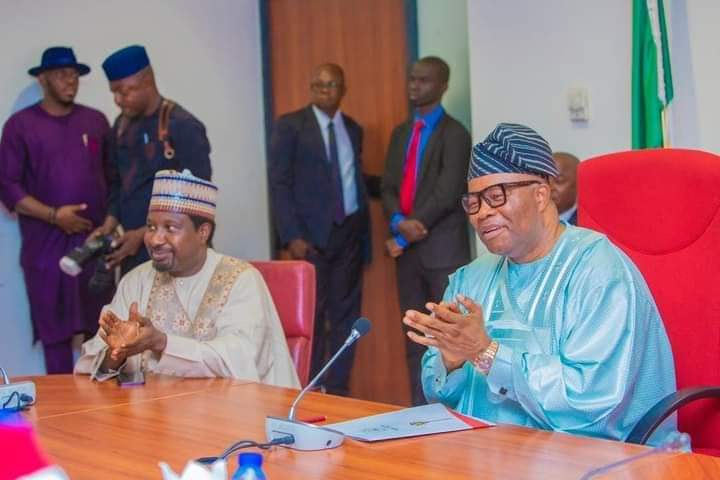
The Senate President, Godswill Akpabio said yesterday that the 10th National Assembly might not be eager to regulate social media, saying that existing laws adequately address any violations by users of social media platforms.
Akpabio enjoined social media platforms users to use the platforms for positive productive engagements for the development of the country, adding that the country needs to keep pace with the emerging technologies for the benefit of all stakeholders.
He, however, said African countries need a digital future that is inclusive, secure and innovative, stressing that this should be the focus of all.
The Senate president made the remarks at the opening ceremony of the Parliamentarian Symposium of the African Internet Governance Forum (AIGF), held at Transcorp Hotel, Abuja.
The Forum which had the theme “Transforming Africa’s Digital Landscape: Empowering Inclusion, Security, and Innovation,” was with the support of the Nigerian Communications Commission (NCC).
He expressed confidence that the commitment of African Parliamentarians would ensure and deliver progress that represents the people’s aspirations, asserting that their coming together was aimed at initiating internet governance and digital policies and legislations to boost the sector.
Akpabio said: “This theme is a reflection of the deepest yearnings of all Africans for a concerted effort to keep in step with the rest of the world in the ICT race.”
Speaking through the Senate committee chairman on Cybersecurity and ICT, Afolabi Shuiab Salisu, the Senate president said emerging technologies cannot be taken in isolation from one another and that the existing laws should be allowed to take care of them.
He explained that it would be cumbersome to have laws on the usage of social media, another one on Artificial Intelligence (AI), and internet fraud, stressing that the country already has constitutional provisions to take care of breaches in any form or shape.
He said: “I am not sure that there’s going to be any specific bill on social media regulation. However, there are many laws in various areas, social media is just one space.
“So, rather than have a specific legislation on social media. I will rather say social media is just one platform. The same way people have used regular media platforms to commit libel, defamation, or sedition. So they will be taken care of.
“Thank God there was a court judgment somewhere, where a thumbs up has been acknowledged as approval for a business deal between parties. So, I don’t need to sign documents physically now before it become valid.
He said the time has come for African countries to take advantage of its active youthful population for empowerment, innovation and job creation, noting that “almost 70 percent of Nigeria’s population are youths. What does this mean? It does mean the youths can learn new technologies and use them for the benefit of all.”
The Secretary-General (AIGF), Hon. Samuel George, a member of the Ghanaian Parliament, who spoke on internet governance in Africa said, “Governments on the African continent are doing a fantastic job when it comes to the processes of digitalisation. We’re seeing a lot more government services becoming digitalised; social services, government services, health care, and justice, are becoming digital platforms.
“On West African sub-region Nigeria, is a big leader in that so we believe that governments are doing well”.



Governor of Rivers State, Sir Siminalayi Fubara, has reaffirmed the unwavering commitment of his administration to peace, unity, security, and inclusive development as Rivers State marked its 59th anniversary, last Wednesday.
In a goodwill message issued on Wednesday to commemorate the anniversary, Governor Fubara stated that despite the challenges faced over the years, the people of Rivers State have continued to demonstrate resilience, strength, and an enduring spirit of unity that has sustained the state since its creation.
The Governor noted that the strong bond of brotherhood among the various ethnic nationalities of the state, including the Ijaw, Ikwerre, Ogoni, Etche, Ekpeye, Andoni, Kalabari, and others, remains one of Rivers State’s greatest strengths and a critical foundation for peace, stability, and progress.
He further observed that Rivers State has remained a major driver of Nigeria’s economy for decades, not only because of its abundant oil and gas resources, but also because of the exceptional contributions of its people across diverse sectors including academia, jurisprudence, business, entertainment, public service, and sports.
Governor Fubara assured the people that his administration will continue to prioritize policies and programmes that promote peace, protect lives and property, and expand development across all parts of the state. He emphasized that governance must be people centered and impactful, with equal attention given to every Local Government Area of the state.
The Governor also paid tribute to the elders and founding leaders of the state for preserving the spirit of unity and coexistence over the years, while urging the youths to remain hopeful, responsible, and actively committed to building a greater Rivers State through innovation, hard work, and patriotism.
He equally acknowledged the invaluable role of women in strengthening families, communities, and society, describing them as indispensable partners in the continued growth and stability of the state.
Governor Fubara called on all Rivers people to use the occasion of the anniversary as a moment of reflection and renewed commitment to peaceful coexistence, mutual respect, dialogue, and collective progress, stressing that the unity and future of Rivers State must always rise above personal interests and political differences.
Rivers State was created on May 27, 1967, by General Yakubu Gowon.


The Rivers State Government has distributed science equipment and materials to all senior secondary schools across the state to support students during the ongoing West African Examinations Council exams and to strengthen practical learning.
Flagging off the distribution at the Rivers State Senior Secondary Schools Board premises in Port Harcourt, on Monday, the State Commissioner for Education, Dr. Peters Nwagor, said the move demonstrates Governor Siminalayi Fubara’s commitment to improving education standards in the State.
Nwagor said the materials were approved and provided by the state government specifically to boost the teaching and learning of science subjects, describing science education as the foundation for technological advancement, innovation, and national development.
“No society can compete globally without deliberate investment in science and technology,” the Commissioner stated.
He commended the governor for consistently prioritising the education sector by providing tools needed for effective teaching and hands-on learning.
The Commissioner directed principals to ensure that the equipment are used strictly for practical lessons in their schools, warning that any principal or administrator found diverting, hoarding, or selling the materials wil face disciplinary action under public service regulations.
Nwagor also warned against examination malpractice, saying any principal found aiding or encouraging malpractices will be decisively sanctioned.
“We must collectively restore the dignity and credibility of our educational system,” he said.
Also speaking, Chairman, Rivers State Senior Secondary Schools Board, Tony Egwurugwu, urged school heads to make judicious use of the materials for students’ benefit.
He thanked the State Government for providing the resources, and assured that monitoring mechanisms would be put in place to ensure the materials serve their intended purpose.
In his own remarks, a Board Member for Technical Education, Nwisabari Bani Samuel, expressed appreciation to the governor for prioritising education and acknowledged the Commissioner’s role in advancing education development in the State.
He said the distribution covers all senior secondary schools in the State and is intended to improve students’ performance in both internal and external science examinations.
Akujobi Amadi
-

 Rivers2 days ago
Police arrest 3 suspects over killing of driver in Rivers
-
Politics2 days ago
I DIDN’T PROMISE YOU TICKETS, AKPABIO TELLS APC SENATORS WHO FAILED PRIMARIES
-

 News2 days ago
FUBARA ASSURES NUT OF SECURITY OF SCHOOLS IN RIVERS
-

 News2 days ago
NDLEA Arrests Four Notorious Female Drug Dealers In Four States
-

 Sports2 days ago
Okpekpe Road Race Gets Mobility Solutions, Fan Engagement
-
Politics2 days ago
Court Dismisses Rivers PDP Members’ Suit Over LG Election Candidates
-

 News2 days ago
WORLD FOOD SAFETY DAY: VETERINARIANS TASK GOVT ON MODERN ABATTOIR IN RIVERS
-
Politics2 days ago
POST PRIMARIES: IKWERRE MONARCHS ADVOCATE ISSUES-BASED POLITICS IN RIVERS