
Featured
Obi, LP’s Petition Mere Academic Exercise, INEC Tells Tribunal

The Independent National Electoral Commission (INEC) has asked the Presidential Election Petition Court (PEPC) to dismiss a petition filed by Labour Party (LP) and its presidential candidate, Peter Obi, saying the reliefs sought are not grantable.
INEC, the 1st respondent, stated this in its reply filed on Monday night at the PEPC’s Secretariat by its lawyer, Abubakar Mahmoud (SAN), in Abuja.
The commission prayed the court to either “dismiss or strike out the petition for being grossly incompetent, abusive, vague, nebulous, generic, general, non-specific, ambiguous, equivocal, hypothetical and academic.”
Obi, the 1st petitioner, and LP, the 2nd petitioner, had sued INEC, President-elect, Bola Tinubu; Vice President-elect, Sen. Kashim Shettima, and All Progressives Congress (APC) as 1st to 4th respondents, respectively.
The petitioners are seeking the nullification of the election victory of Tinubu and Shettima in the February 25 presidential poll.
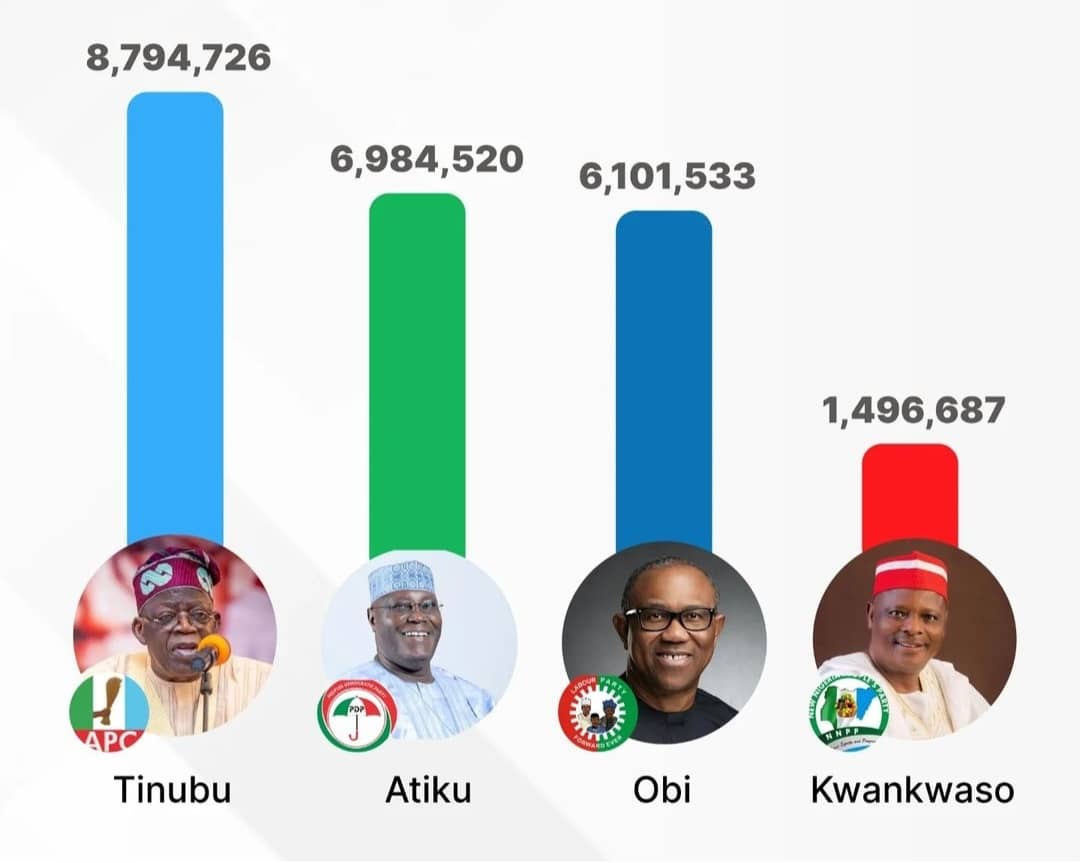
Tinubu, who defeated 17 other candidates who took part in the election, scored a total of 8,794,726 votes, the highest of all the candidates.
Former Vice-President Atiku Abubakar of the Peoples Democratic Party (PDP) came second with 6,984,520 votes in the poll; Obi came third with 6,101,533 votes.
Abubakar and PDP are also challenging the outcome of the poll in a separate petition.
However, in the petition marked: CA/PEPC/03/2023 filed by Obi and LP’s lead counsel, Livy Ozoukwu, they contended that Tinubu “was not duly elected by majority of the lawful votes cast at the time of the election.”
The petitioners claimed there was rigging in 11 states, adding that they would demonstrate this in the declaration of results based on the uploaded results.
In its notice of preliminary objection, INEC argued that the grounds on which the petition was based were defective, having regard to the vague and imprecise averments supporting the said grounds.
It said that the ground of the petitioners bordering on non-compliance with the provisions of the Electoral Act, 2022 and corrupt practices did not disclose a reasonable cause of action for failure to plead specific particulars and figures as to how the alleged non-compliance complained of substantially affected the results of the election.
The electoral body said in view of the above argument, “Prayers 3, 5(i) and 5(11) of the petition predicated on the ground of non-compliance in Paragraph 20(11) of the petition are ungrantable.”
It further said that the ground of the petition that Tinubu was not elected by majority of lawful votes cast as contained in Paragraph 20(iii) of the petition was defective for failure to plead the alleged unlawful votes to be deducted and/or lawful votes to be credited to the petitioners.
INEC argued that the petitioners’ prayer to declare that Obi scored majority of lawful votes cast at the election and be declared winner was defective for failure to join necessary parties and for lack of requisite particulars and pleading to support same.
The commission said all political parties intending to sponsor candidates in the election were required to submit lists of their agents and they were expected to observe the election process at their units, sign and collect result sheets on behalf of their political parties at the close of polls.
It argued that some of the political party agents whose names were on the list submitted to it were however absent at their polling units while some others who were present neglected to participate in the election process.
According to INEC, the petitioners (Obi and LP) did not have polling agents in all the polling units across Nigeria as they only submitted a list of 134,874 polling agents which is 41,972 short of the 176 846 polling units across Nigeria.
It disagreed with the petitioners, insisting that they were not represented in many or some of the polling units in the country.
The commission argued that while Shettima, the vice president-elect, was duly nominated and sponsored to contest the election, it also said that Tinubu and Shettima were duly declared and returned as elected and issued Certificates of Return having fulfilled the requirements of the Constitution to be declared winners and returned elected.



Governor of Rivers State, Sir Siminalayi Fubara, has reaffirmed the unwavering commitment of his administration to peace, unity, security, and inclusive development as Rivers State marked its 59th anniversary, last Wednesday.
In a goodwill message issued on Wednesday to commemorate the anniversary, Governor Fubara stated that despite the challenges faced over the years, the people of Rivers State have continued to demonstrate resilience, strength, and an enduring spirit of unity that has sustained the state since its creation.
The Governor noted that the strong bond of brotherhood among the various ethnic nationalities of the state, including the Ijaw, Ikwerre, Ogoni, Etche, Ekpeye, Andoni, Kalabari, and others, remains one of Rivers State’s greatest strengths and a critical foundation for peace, stability, and progress.
He further observed that Rivers State has remained a major driver of Nigeria’s economy for decades, not only because of its abundant oil and gas resources, but also because of the exceptional contributions of its people across diverse sectors including academia, jurisprudence, business, entertainment, public service, and sports.
Governor Fubara assured the people that his administration will continue to prioritize policies and programmes that promote peace, protect lives and property, and expand development across all parts of the state. He emphasized that governance must be people centered and impactful, with equal attention given to every Local Government Area of the state.
The Governor also paid tribute to the elders and founding leaders of the state for preserving the spirit of unity and coexistence over the years, while urging the youths to remain hopeful, responsible, and actively committed to building a greater Rivers State through innovation, hard work, and patriotism.
He equally acknowledged the invaluable role of women in strengthening families, communities, and society, describing them as indispensable partners in the continued growth and stability of the state.
Governor Fubara called on all Rivers people to use the occasion of the anniversary as a moment of reflection and renewed commitment to peaceful coexistence, mutual respect, dialogue, and collective progress, stressing that the unity and future of Rivers State must always rise above personal interests and political differences.
Rivers State was created on May 27, 1967, by General Yakubu Gowon.


The Rivers State Government has distributed science equipment and materials to all senior secondary schools across the state to support students during the ongoing West African Examinations Council exams and to strengthen practical learning.
Flagging off the distribution at the Rivers State Senior Secondary Schools Board premises in Port Harcourt, on Monday, the State Commissioner for Education, Dr. Peters Nwagor, said the move demonstrates Governor Siminalayi Fubara’s commitment to improving education standards in the State.
Nwagor said the materials were approved and provided by the state government specifically to boost the teaching and learning of science subjects, describing science education as the foundation for technological advancement, innovation, and national development.
“No society can compete globally without deliberate investment in science and technology,” the Commissioner stated.
He commended the governor for consistently prioritising the education sector by providing tools needed for effective teaching and hands-on learning.
The Commissioner directed principals to ensure that the equipment are used strictly for practical lessons in their schools, warning that any principal or administrator found diverting, hoarding, or selling the materials wil face disciplinary action under public service regulations.
Nwagor also warned against examination malpractice, saying any principal found aiding or encouraging malpractices will be decisively sanctioned.
“We must collectively restore the dignity and credibility of our educational system,” he said.
Also speaking, Chairman, Rivers State Senior Secondary Schools Board, Tony Egwurugwu, urged school heads to make judicious use of the materials for students’ benefit.
He thanked the State Government for providing the resources, and assured that monitoring mechanisms would be put in place to ensure the materials serve their intended purpose.
In his own remarks, a Board Member for Technical Education, Nwisabari Bani Samuel, expressed appreciation to the governor for prioritising education and acknowledged the Commissioner’s role in advancing education development in the State.
He said the distribution covers all senior secondary schools in the State and is intended to improve students’ performance in both internal and external science examinations.
Akujobi Amadi
-

 Rivers2 days ago
Police arrest 3 suspects over killing of driver in Rivers
-
Politics2 days ago
I DIDN’T PROMISE YOU TICKETS, AKPABIO TELLS APC SENATORS WHO FAILED PRIMARIES
-

 News2 days ago
FUBARA ASSURES NUT OF SECURITY OF SCHOOLS IN RIVERS
-

 News2 days ago
NDLEA Arrests Four Notorious Female Drug Dealers In Four States
-

 Sports2 days ago
Okpekpe Road Race Gets Mobility Solutions, Fan Engagement
-
Politics2 days ago
Court Dismisses Rivers PDP Members’ Suit Over LG Election Candidates
-
Politics2 days ago
POST PRIMARIES: IKWERRE MONARCHS ADVOCATE ISSUES-BASED POLITICS IN RIVERS
-

 News2 days ago
WORLD FOOD SAFETY DAY: VETERINARIANS TASK GOVT ON MODERN ABATTOIR IN RIVERS