
Featured
Drugs Free Port: NDLEA Boss Seeks Collaboration With Stakeholders

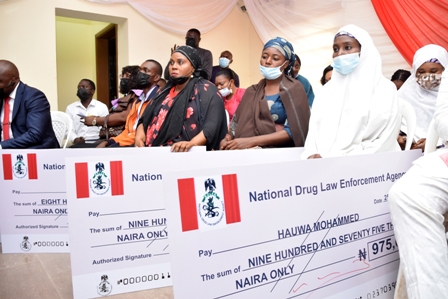
As part of efforts to prevent the inflow of illicit drugs through the seaports, the Chairman/CEO, National Drug Law a Agency (NDLEA), Brig. Gen. Mohamed Buba Marwa (rtd), has asked for more support and cooperation from stakeholders in the country’s maritime sector.
He said the anti-narcotic agency cannot fight the drug scourge alone and needs the assistance of the industry players in order to succeed in the fight to rid the country of drug traffickers and abusers.
Marwa, who made the plea at the second edition of JournalNG’s Industry Town Hall Meeting tagged ‘Towards a Drug Free Port Environment’ held in Lagos, said the NDLEA has resolved to maintain a strong presence at the Ports.
This, the NDLEA boss said the monumental drug seizures and the series of engagements of stakeholders, ranged from Bonded Terminal Owners/Operators, Shipping Lines and Agencies and other critical stakeholders within the Maritime Sector.
Marwa, who was represented as chairman of the event by the Commander, NDLEA Apapa Port Command, Inalegwu Ameh, who delivered a paper titled “Evolving a Drug Free Port Environment: A Call for Concerted Efforts”.
Speaking, the Commander, NDLEA Apapa Port Command, Inalegwu Ameh said “the task of keeping the Ports drugs-free is the primary responsibility of the operators in the maritime industry.
“For this to happen, we must realise the fact that the economy and security of the nation rest heavily on the shoulders of the maritime industry, whereas the nexus between the economy, security and drugs is well documented.
“Stakeholders at the Ports must be able to resist the lure of lucre viz-a-viz the temptations of what illicit drug traffickers offer. No amount of money is compared with the sanctity of human life.
“Maritime operators need to elevate their level of collaboration and cooperation with NDLEA.
“The intelligent hints on the clandestine activities of these unscrupulous elements who depend on the movement of ships to ply their trade will go a long way in exposing and frustrating them. We must admit that NDLEA cannot do it alone, hence, our call for concerted efforts.
“Time was when we all raised our hands on our heads in lamenting our helplessness while our entire society is being over-run by these drug marauders.
“All hands must be on deck. We now have to adopt a ‘whole-society’ and a ‘joined-hands’ approach”, he said.
“For us to treasure the imperatives of concerted efforts, we must first of all appreciate the enormity or magnitude of the drug malady stirring us in the face”.
Meanwhile, Marwa noted that several arrests and seizures have been made aboard vessels laden with huge quantities of illicit drugs at the ports.
Between January and May 2022, a total of 3, 349.25 kilograms of assorted drugs have been seized in the Lagos inland waterways alone. This is in addition to the two commercial vessels that were seized in November 2021 in connection with illicit drugs importation, and the seizure of 74.119 kilograms (451, 807 tablets) of “jihadist drug” known as Captagon at Apapa Port.
“Apart from Cannabis sativa that is known to be cultivated in commercial quantities, the seizure of pharmaceutical opiates like Tramadol being exported from Nigeria points at something: how did these large quantities of drugs get into Nigeria?
“We can say with certainty that a huge portion of these drugs come into the Country through the waterways”.
According to the NDLEA chief, the drug use prevalence in Nigeria cuts across all ages, gender and regions, adding that a great danger threatens, especially the youths because of the drug scourge, which requires an urgent collaborative intervention.
The 2018 National Drug Use Survey revealed that 14.3 million Nigerians aged 15-64 years use psychoactive substances. That means one in seven persons had used a drug (other than tobacco and alcohol) in the past year. More worrisome is the finding that one in every four drug users in Nigeria is a woman.
This shows that a significant number of females, who are supposed to play key roles in their families and the society, are dependent on chemical substances. The findings further established that more women (2.5%) than men (2.3%) abuse cough syrup containing codeine.
He stated that women involvement in substance abuse has more implications than men, especially when the critical role of women in child nurturing and upbringing is considered.
By: Nkpemenyie Mcdominic, Lagos



Governor of Rivers State, Sir Siminalayi Fubara, has reaffirmed the unwavering commitment of his administration to peace, unity, security, and inclusive development as Rivers State marked its 59th anniversary, last Wednesday.
In a goodwill message issued on Wednesday to commemorate the anniversary, Governor Fubara stated that despite the challenges faced over the years, the people of Rivers State have continued to demonstrate resilience, strength, and an enduring spirit of unity that has sustained the state since its creation.
The Governor noted that the strong bond of brotherhood among the various ethnic nationalities of the state, including the Ijaw, Ikwerre, Ogoni, Etche, Ekpeye, Andoni, Kalabari, and others, remains one of Rivers State’s greatest strengths and a critical foundation for peace, stability, and progress.
He further observed that Rivers State has remained a major driver of Nigeria’s economy for decades, not only because of its abundant oil and gas resources, but also because of the exceptional contributions of its people across diverse sectors including academia, jurisprudence, business, entertainment, public service, and sports.
Governor Fubara assured the people that his administration will continue to prioritize policies and programmes that promote peace, protect lives and property, and expand development across all parts of the state. He emphasized that governance must be people centered and impactful, with equal attention given to every Local Government Area of the state.
The Governor also paid tribute to the elders and founding leaders of the state for preserving the spirit of unity and coexistence over the years, while urging the youths to remain hopeful, responsible, and actively committed to building a greater Rivers State through innovation, hard work, and patriotism.
He equally acknowledged the invaluable role of women in strengthening families, communities, and society, describing them as indispensable partners in the continued growth and stability of the state.
Governor Fubara called on all Rivers people to use the occasion of the anniversary as a moment of reflection and renewed commitment to peaceful coexistence, mutual respect, dialogue, and collective progress, stressing that the unity and future of Rivers State must always rise above personal interests and political differences.
Rivers State was created on May 27, 1967, by General Yakubu Gowon.


The Rivers State Government has distributed science equipment and materials to all senior secondary schools across the state to support students during the ongoing West African Examinations Council exams and to strengthen practical learning.
Flagging off the distribution at the Rivers State Senior Secondary Schools Board premises in Port Harcourt, on Monday, the State Commissioner for Education, Dr. Peters Nwagor, said the move demonstrates Governor Siminalayi Fubara’s commitment to improving education standards in the State.
Nwagor said the materials were approved and provided by the state government specifically to boost the teaching and learning of science subjects, describing science education as the foundation for technological advancement, innovation, and national development.
“No society can compete globally without deliberate investment in science and technology,” the Commissioner stated.
He commended the governor for consistently prioritising the education sector by providing tools needed for effective teaching and hands-on learning.
The Commissioner directed principals to ensure that the equipment are used strictly for practical lessons in their schools, warning that any principal or administrator found diverting, hoarding, or selling the materials wil face disciplinary action under public service regulations.
Nwagor also warned against examination malpractice, saying any principal found aiding or encouraging malpractices will be decisively sanctioned.
“We must collectively restore the dignity and credibility of our educational system,” he said.
Also speaking, Chairman, Rivers State Senior Secondary Schools Board, Tony Egwurugwu, urged school heads to make judicious use of the materials for students’ benefit.
He thanked the State Government for providing the resources, and assured that monitoring mechanisms would be put in place to ensure the materials serve their intended purpose.
In his own remarks, a Board Member for Technical Education, Nwisabari Bani Samuel, expressed appreciation to the governor for prioritising education and acknowledged the Commissioner’s role in advancing education development in the State.
He said the distribution covers all senior secondary schools in the State and is intended to improve students’ performance in both internal and external science examinations.
Akujobi Amadi
-

 Rivers2 days ago
Police arrest 3 suspects over killing of driver in Rivers
-
Politics2 days ago
I DIDN’T PROMISE YOU TICKETS, AKPABIO TELLS APC SENATORS WHO FAILED PRIMARIES
-

 News2 days ago
FUBARA ASSURES NUT OF SECURITY OF SCHOOLS IN RIVERS
-

 News2 days ago
NDLEA Arrests Four Notorious Female Drug Dealers In Four States
-

 Sports2 days ago
Okpekpe Road Race Gets Mobility Solutions, Fan Engagement
-
Politics2 days ago
Court Dismisses Rivers PDP Members’ Suit Over LG Election Candidates
-
Politics2 days ago
POST PRIMARIES: IKWERRE MONARCHS ADVOCATE ISSUES-BASED POLITICS IN RIVERS
-

 News2 days ago
WORLD FOOD SAFETY DAY: VETERINARIANS TASK GOVT ON MODERN ABATTOIR IN RIVERS