
Featured
EFCC, INEC’s Synergy Targetted At Opposition -Wike …Says He’s Not Vying For VP In 2019

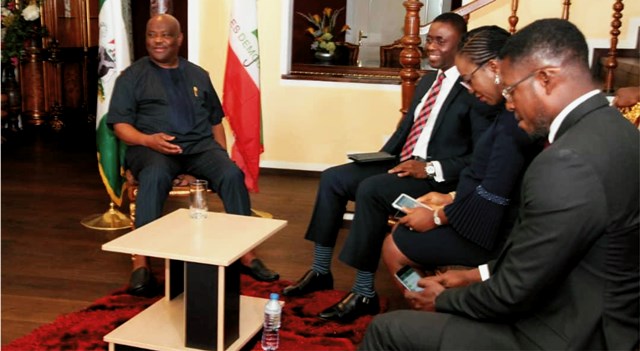
The Rivers State Governor, Chief Nyesom Wike has declared that the so-called partnership between the Economic and Financial Crimes Commission (EFCC) and Independent National Electoral Commission (INEC) to monitor campaign finances ahead of 2019 elections is a witch-hunt targeted at the opposition.
Speaking during a special appearance on Channels Television Sunrise Daily broadcast from the Government House, Port Harcourt, yesterday, Wike described the partnership as a political deception.
He said: “EFCC working with INEC to investigate campaign finances is merely a smokescreen. It is targeted at the opposition party.
“When have you heard that EFCC would come up to say, as regards the ruling party, funds came from the government; I will not be carried away by the so-called EFCC investigation”.
Wike noted that the EFCC is working towards creating an atmosphere of advantage for the ruling party in the long run.
He said: “The fund they want to investigate is only when it has to do with the opposition states. Take for example: EFCC said PDP spent money in the last 2015 elections.
“Has EFCC investigated those states that were APC, like Rivers State at that time that funded part of their election? Who is deceiving who? EFCC is only working to witch-hunt the opposition.”
The governor regretted that since 2015, the APC-led Federal Government has been unable to complete the Port Harcourt International Airport.
He said despite criticising Jonathan, the APC-led Federal Government has refused to upgrade the airport.
“When you look at the whole thing, you see the hatred. How this government does not like the people of Rivers State”, the governor said.
Commenting on the 2019 elections, Wike said that the desperate rigging moves on August 18, 2018 at the Port Harcourt State Constituency Three Elections indicate that the APC is not ready for elections.
“Through the Port Harcourt State Constituency Three Election, they revealed to us what they planned for 2019. They don’t want election. They want to use security to rig”, he said.
Wike denied claims that he drafted a Presidential Aspirant from another political party to fly the party’s flag. He stated that no single governor can achieve that.
“We have 36 States and Abuja. We have about 14 governors. How can a governor of one state lure a particular aspirant to run for the Presidential Election.
“I am not a member of the convention planning committee. I am only providing the venue. I am not going to be a member of any sub-committees, so, where does the influence. In any case, if you like you do the election in Lagos, people will still have influence”, Wike said.
He reiterated his position that certain Presidential Aspirants are funded by the APC and planted in the PDP ahead of the primary.
He said: “As I speak with you, just yesterday, certain Presidential Aspirants and some people in the ruling party met to take some steps to make sure that our convention fails”.
Speaking on the environmental challenge posed by flooding, Wike said that the state government has established an emergency response team to tackle issue.
He added that the state government is working with other stakeholders to end the prevalence of soot in the state.
Meanwhile, the Rivers State Governor, Chief Nyesom Wike has declared that he would not be vying for the position of Vice President of the country as being speculated in certain quarters ahead of the 2019 elections.
Wike said though some of the presidential aspirants seeking his support have offered him the position of Vice President in the course of political consultations, he insisted that the interest of Rivers State was paramount.
Speaking in an interview with The Osasu Show at the Government House, Port Harcourt, yesterday, Wike said: “There are aspirants who have promised me the position of the Vice President, but I said I will not seek the position.
“Not even in the dream will I seek that position at this point. I am a first term governor and the National Chairman of PDP is from my State and the South-South.
“These are mere allegations. People can carry rumours, but everything I will do, will be in the interest of Rivers State. Nobody can use Rivers State as a tool. They did that in the past, but not anymore “.
Wike said that the decision to host the October 5/6 2018 National Convention in Port Harcourt was initiated without his knowledge, adding that he eventually attended a meeting where Governors and Presidential Aspirants ratified the resolution.
He expressed surprise that a few presidential aspirants who never opposed the decision to host the National Convention in Port Harcourt, have turned around to sponsor reports against the venue of the convention.
He said: “I am shocked that a few presidential aspirants who never opposed Port Harcourt as a venue would begin the sponsorship of media attacks on the venue of the convention, which was not initiated by us.
“When we say that there are moles amongst the Presidential Aspirants, this is one of the manifestations. A decision that is collectively taken is being contested through clandestine sponsorship.
“But if they want, the National Convention can be held at Maiduguri, Yola, Sokoto, Jigawa, Kano or any other city. A presidential aspirant that would lose would lose.
“All the national delegates that will vote at the National Convention will emerge from the different local government areas of the country and from the statutory delegates list. None will be elected in Port Harcourt. Therefore, it is uncharitable to attempt to create the impression that hosting it in Port Harcourt will influence the outcome”.
Asked to comment on the Lagos State political rift between Governor Akinwunmi Ambode and his godfather, Wike advised him to resist the godfather.
He said: “If it is correct that the godfather is against Ambode, I will tell him (Ambode) to resist it. I will tell him to promote the interest of his state. Godatherism is not good. It negates development.”
He said that in Rivers State, the immediate past governor sold state assets to his business partner, only to turn around to anoint the business partner to contest for the governorship position of the state.
“No more godfather politics in Rivers State. We are not in Lagos State. Rivers State will not accept godfatherism. My concern is to do well for Rivers State.
“For the over three years that we have managed Rivers State, nobody of good conscience will say that we have not done well. We are not threatened because in Rivers State, PDP is a dominant party”, he said.
In another development, the Rivers State Governor, Chief Nyesom Wike, yesterday, admonished his Lagos State counterpart, Akinwunmi Ambode to resist the practice of “godfatherism” in his state.
Wike, a governor on the platform of the Peoples Democratic Party (PDP), said this while reacting to the alleged rift between Ambode and a National Leader of the All Progressives Congress (APC), Ahmed Bola Tinubu.
Following a reported relationship breakdown with Ambode, Tinubu was said to have anointed one Babajide Sanwon-olu as the next governor of Lagos State.
It would be recalled that the Vice Chairman of the APC in Lagos East Senatorial District, Asipa Kaoli Olusanya, has stated that National Leader of the party, Bola Tinubu instructed them to work towards the emergence of Sanwon-olu as the next governor of the state.
However, Wike while speaking during an interview with The Osasu Show at the Government House, Port Harcourt, yesterday, said Ambode should negate godfatherism and promote the interest of his state.
Wike said, “If it is correct that the godfather is against Ambode, I will tell him (Ambode) to resist it.
“I will tell him to promote the interest of his state. Godfatherism is not good. It negates development.”
Wike also declared that godfatherism has no place in Rivers State.
“No more godfather politics in Rivers State. We are not in Lagos State. Rivers State will not accept godfatherism. My concern is to do well for Rivers State.
“For the over three years that we have managed Rivers State, nobody of good conscience will say that we have not done well. We are not threatened because in Rivers State, PDP is a dominant party”, he said.



Governor of Rivers State, Sir Siminalayi Fubara, has reaffirmed the unwavering commitment of his administration to peace, unity, security, and inclusive development as Rivers State marked its 59th anniversary, last Wednesday.
In a goodwill message issued on Wednesday to commemorate the anniversary, Governor Fubara stated that despite the challenges faced over the years, the people of Rivers State have continued to demonstrate resilience, strength, and an enduring spirit of unity that has sustained the state since its creation.
The Governor noted that the strong bond of brotherhood among the various ethnic nationalities of the state, including the Ijaw, Ikwerre, Ogoni, Etche, Ekpeye, Andoni, Kalabari, and others, remains one of Rivers State’s greatest strengths and a critical foundation for peace, stability, and progress.
He further observed that Rivers State has remained a major driver of Nigeria’s economy for decades, not only because of its abundant oil and gas resources, but also because of the exceptional contributions of its people across diverse sectors including academia, jurisprudence, business, entertainment, public service, and sports.
Governor Fubara assured the people that his administration will continue to prioritize policies and programmes that promote peace, protect lives and property, and expand development across all parts of the state. He emphasized that governance must be people centered and impactful, with equal attention given to every Local Government Area of the state.
The Governor also paid tribute to the elders and founding leaders of the state for preserving the spirit of unity and coexistence over the years, while urging the youths to remain hopeful, responsible, and actively committed to building a greater Rivers State through innovation, hard work, and patriotism.
He equally acknowledged the invaluable role of women in strengthening families, communities, and society, describing them as indispensable partners in the continued growth and stability of the state.
Governor Fubara called on all Rivers people to use the occasion of the anniversary as a moment of reflection and renewed commitment to peaceful coexistence, mutual respect, dialogue, and collective progress, stressing that the unity and future of Rivers State must always rise above personal interests and political differences.
Rivers State was created on May 27, 1967, by General Yakubu Gowon.


The Rivers State Government has distributed science equipment and materials to all senior secondary schools across the state to support students during the ongoing West African Examinations Council exams and to strengthen practical learning.
Flagging off the distribution at the Rivers State Senior Secondary Schools Board premises in Port Harcourt, on Monday, the State Commissioner for Education, Dr. Peters Nwagor, said the move demonstrates Governor Siminalayi Fubara’s commitment to improving education standards in the State.
Nwagor said the materials were approved and provided by the state government specifically to boost the teaching and learning of science subjects, describing science education as the foundation for technological advancement, innovation, and national development.
“No society can compete globally without deliberate investment in science and technology,” the Commissioner stated.
He commended the governor for consistently prioritising the education sector by providing tools needed for effective teaching and hands-on learning.
The Commissioner directed principals to ensure that the equipment are used strictly for practical lessons in their schools, warning that any principal or administrator found diverting, hoarding, or selling the materials wil face disciplinary action under public service regulations.
Nwagor also warned against examination malpractice, saying any principal found aiding or encouraging malpractices will be decisively sanctioned.
“We must collectively restore the dignity and credibility of our educational system,” he said.
Also speaking, Chairman, Rivers State Senior Secondary Schools Board, Tony Egwurugwu, urged school heads to make judicious use of the materials for students’ benefit.
He thanked the State Government for providing the resources, and assured that monitoring mechanisms would be put in place to ensure the materials serve their intended purpose.
In his own remarks, a Board Member for Technical Education, Nwisabari Bani Samuel, expressed appreciation to the governor for prioritising education and acknowledged the Commissioner’s role in advancing education development in the State.
He said the distribution covers all senior secondary schools in the State and is intended to improve students’ performance in both internal and external science examinations.
Akujobi Amadi
-

 Rivers2 days ago
Police arrest 3 suspects over killing of driver in Rivers
-
Politics2 days ago
I DIDN’T PROMISE YOU TICKETS, AKPABIO TELLS APC SENATORS WHO FAILED PRIMARIES
-

 News2 days ago
FUBARA ASSURES NUT OF SECURITY OF SCHOOLS IN RIVERS
-

 News2 days ago
NDLEA Arrests Four Notorious Female Drug Dealers In Four States
-

 Sports2 days ago
Okpekpe Road Race Gets Mobility Solutions, Fan Engagement
-
Politics2 days ago
Court Dismisses Rivers PDP Members’ Suit Over LG Election Candidates
-
Politics2 days ago
POST PRIMARIES: IKWERRE MONARCHS ADVOCATE ISSUES-BASED POLITICS IN RIVERS
-

 News2 days ago
WORLD FOOD SAFETY DAY: VETERINARIANS TASK GOVT ON MODERN ABATTOIR IN RIVERS