
Featured
Wike Decries Retrogressive Politics In Rivers

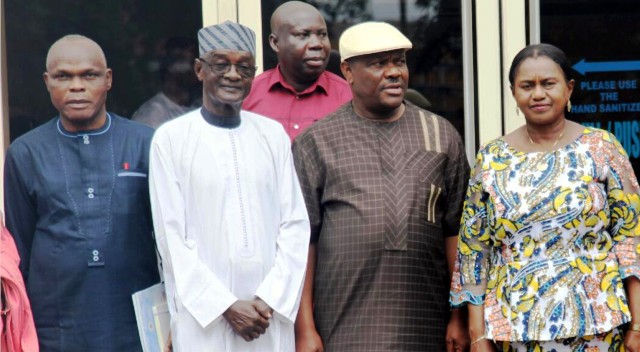
The Rivers State Governor, Chief Nyesom Wike, has decried the politics of under-development being promoted by some politicians from the state, saying that he will remain committed to develop the state despite plots to distract him.
Speaking while commissioning the Rukpokwu-Aluu Road and Rumuokoro Market and Park in Obio/Akpor Local Government Area, last Thursday, Wike said Rivers people must take note of those who are bent on frustrating development in the state.
The two projects were billed to be commissioned by Acting President, Prof Yemi Osinbajo but the acting president departed for Abuja shortly after commissioning the world-class Indorama Eleme Fertiliser Plant in Eleme and two major roads in Etche.
Wike said: “They are annoyed that our projects are being commissioned. Their anger will not stop us from delivering projects for our people.
“We wrote to the acting president to visit Rivers State to commission a number of projects on the 19th July, 2017. We got a response that due to his crowded schedule, that day was not feasible. They gave us 27th July. The advance team came on Wednesday, and said there is also the commissioning of Indorama fertiliser plant.
“I heard on the radio that the other party wrote the acting president saying that the commissioning of projects make us shine. They have forgotten that we shine because God is with us and the numerous projects that we execute for our people”, Wike explained.
At the Rukpokwu-Aluu road, the governor told the people that during the campaign, he made two promises to the people, which he has fulfilled.
While commissioning the Rumuokoro Market and motor park, the governor urged the market women trading along the Rumuokoro roundabout were commercial motorists using the intersections as bus-stops, to stop as they are expected to begin using the market and park forthwith.
Wike particularly directed members of the National Union of Road Transport Workers to desist from picking passengers on the road, and begin using the motor park in the market, instead.
He said: “Now that we have opened the market, nobody should trade on the roadside. Nobody should pick passengers on the road. Henceforth, we will take action against those who flout this order.”
But the acting president appears to have spoken Wike’s mind when he addressed Rivers political leaders, chief and elders earlier.
Osinbajo had advised the two political ‘gladiators’, in the state to pursue issues that would bring development to the people rather than fighting on partisan lines.
He spoke while commissioning the Chokocho-Umuechem-Ozuzu road and Chokocho-Igbo-Etche-Rumuokurushi inter-change in Etche Local Government Area.
Osinbajo, who was full of praises for Wike’s wisdom in embarking on many pro-people projects, charged Rivers political leaders to de-emphasise partisan concerns and work in the interest of their people.
He said: “We must always look for ways to advance the interest of our people. We are greater together than apart. Today is a very happy day. We will always have happy days.
“Here with us to commission the project of the Rivers State Government is Senator Magnus Abe, who is from another party. The Federal Government supports every effort that benefits the people,” the acting president noted.
Earlier, a drama had played out at the Port Harcourt International Airport on whether the acting president should ride in a gleaming BMW car provided by Wike to take him to the site of commissioning of the Indorama’s fertilizer plant or a chopper where Amaechi and other APC chieftains were already seated.
But after a brief exchange of pleasantries and rousing reception for Osinbajo, the acting president, tactically held the governor’s hand, and took him along to the waiting chopper, en route to Indorama Eleme Fertiliser Plant, Eleme, for the commissioning ceremonies.
The Tide gathered that neither Amaechi nor his APC supporters joined Rivers chiefs, elders and other stakeholders to give the acting president the deserved Rivers hospitality during the reception, an action seen by millions as an insult on Rivers people.



Governor of Rivers State, Sir Siminalayi Fubara, has reaffirmed the unwavering commitment of his administration to peace, unity, security, and inclusive development as Rivers State marked its 59th anniversary, last Wednesday.
In a goodwill message issued on Wednesday to commemorate the anniversary, Governor Fubara stated that despite the challenges faced over the years, the people of Rivers State have continued to demonstrate resilience, strength, and an enduring spirit of unity that has sustained the state since its creation.
The Governor noted that the strong bond of brotherhood among the various ethnic nationalities of the state, including the Ijaw, Ikwerre, Ogoni, Etche, Ekpeye, Andoni, Kalabari, and others, remains one of Rivers State’s greatest strengths and a critical foundation for peace, stability, and progress.
He further observed that Rivers State has remained a major driver of Nigeria’s economy for decades, not only because of its abundant oil and gas resources, but also because of the exceptional contributions of its people across diverse sectors including academia, jurisprudence, business, entertainment, public service, and sports.
Governor Fubara assured the people that his administration will continue to prioritize policies and programmes that promote peace, protect lives and property, and expand development across all parts of the state. He emphasized that governance must be people centered and impactful, with equal attention given to every Local Government Area of the state.
The Governor also paid tribute to the elders and founding leaders of the state for preserving the spirit of unity and coexistence over the years, while urging the youths to remain hopeful, responsible, and actively committed to building a greater Rivers State through innovation, hard work, and patriotism.
He equally acknowledged the invaluable role of women in strengthening families, communities, and society, describing them as indispensable partners in the continued growth and stability of the state.
Governor Fubara called on all Rivers people to use the occasion of the anniversary as a moment of reflection and renewed commitment to peaceful coexistence, mutual respect, dialogue, and collective progress, stressing that the unity and future of Rivers State must always rise above personal interests and political differences.
Rivers State was created on May 27, 1967, by General Yakubu Gowon.


The Rivers State Government has distributed science equipment and materials to all senior secondary schools across the state to support students during the ongoing West African Examinations Council exams and to strengthen practical learning.
Flagging off the distribution at the Rivers State Senior Secondary Schools Board premises in Port Harcourt, on Monday, the State Commissioner for Education, Dr. Peters Nwagor, said the move demonstrates Governor Siminalayi Fubara’s commitment to improving education standards in the State.
Nwagor said the materials were approved and provided by the state government specifically to boost the teaching and learning of science subjects, describing science education as the foundation for technological advancement, innovation, and national development.
“No society can compete globally without deliberate investment in science and technology,” the Commissioner stated.
He commended the governor for consistently prioritising the education sector by providing tools needed for effective teaching and hands-on learning.
The Commissioner directed principals to ensure that the equipment are used strictly for practical lessons in their schools, warning that any principal or administrator found diverting, hoarding, or selling the materials wil face disciplinary action under public service regulations.
Nwagor also warned against examination malpractice, saying any principal found aiding or encouraging malpractices will be decisively sanctioned.
“We must collectively restore the dignity and credibility of our educational system,” he said.
Also speaking, Chairman, Rivers State Senior Secondary Schools Board, Tony Egwurugwu, urged school heads to make judicious use of the materials for students’ benefit.
He thanked the State Government for providing the resources, and assured that monitoring mechanisms would be put in place to ensure the materials serve their intended purpose.
In his own remarks, a Board Member for Technical Education, Nwisabari Bani Samuel, expressed appreciation to the governor for prioritising education and acknowledged the Commissioner’s role in advancing education development in the State.
He said the distribution covers all senior secondary schools in the State and is intended to improve students’ performance in both internal and external science examinations.
Akujobi Amadi
-

 Rivers2 days ago
Police arrest 3 suspects over killing of driver in Rivers
-
Politics2 days ago
I DIDN’T PROMISE YOU TICKETS, AKPABIO TELLS APC SENATORS WHO FAILED PRIMARIES
-

 News2 days ago
FUBARA ASSURES NUT OF SECURITY OF SCHOOLS IN RIVERS
-

 News2 days ago
NDLEA Arrests Four Notorious Female Drug Dealers In Four States
-

 Sports2 days ago
Okpekpe Road Race Gets Mobility Solutions, Fan Engagement
-
Politics2 days ago
Court Dismisses Rivers PDP Members’ Suit Over LG Election Candidates
-
Politics2 days ago
POST PRIMARIES: IKWERRE MONARCHS ADVOCATE ISSUES-BASED POLITICS IN RIVERS
-

 News2 days ago
WORLD FOOD SAFETY DAY: VETERINARIANS TASK GOVT ON MODERN ABATTOIR IN RIVERS