
Nation
THE STATES

Borno
The 7th Division of the Nigerian Army in Maiduguri
on Saturday cautioned residents of Borno State against embarking on street protests, saying such was not allowed under emergency rule, the News Agency of Nigeria reports.
The division’s spokesman, Col. Sani Usman, in a statement, said, “Some unscrupulous elements, under the guise of (being) concerned indigenes of some parts of Borno, intend to stage a protest in Maiduguri.
“We are calling on these miscreants to stop their plans. We are also reminding all residents that Borno is under a state of emergency declared by the Federal Government.
“Consequently, such protest is unlawful and anyone involved in such acts will have himself to blame.”
Usman said the military was working hard to root out suspected terrorists from the state.
“We wish to assure the good people of Borno and indeed all law-abiding citizens that the military is doing all it could to root out terrorists causing mayhem in the society.
“Therefore, we solicit your continued support and understanding in the fight against insurgency and terrorism in the country,” he said.
Jigawa
The Jigawa State Government has expressed worry
over the rate of rape incidence which stands at seven to 10 cases in recent months.
Attorney General and Commissioner for Justice Yakubu Abdullahi Ruba, who spoke to reporters in Dutse, the state capital, said the judiciary has mapped out a plan to effect quick dispensation of cases at the courts.
Abdullahi said his ministry in collaboration with the justice sector and law reform commission have embarked on mass enlightenment campaign to reduce their occurrence adding that the state chief judge, in line with the quick dispensation of cases, had ordered the hearings on criminal cases on daily bases.
He said the state government recently organised a stakeholders’ meeting, where security agencies were educated on the state’s laws and how some cases are to be handled.
“We in Jigawa State are making efforts to ensure that justice is done to all parties on any criminal offence,” he added.
Kano
The Kano State Hisbah authorities said on Wednes
day in Kano that they arrested 200 persons for street begging in Kano municipal area.Hisbah is the law enforcement arm of the sharia law. The Deputy Commander, Operations, Hisbah Board, Malam Yusuf Nabahani, told newsmen that preliminary investigations indicated that the beggars were new to the city. Nabahani also said that most of those arrested claimed ignorance of the ban on street begging by the Kano State Government.”We plan to return all of them to their various communities after making inquiries. We will warn them never to return,” he said. One of those arrested said that his community was facing famine, adding that there was not much farm activities for him to undertake. Another batch of 15 beggars, which was arrested by the board, was given assistance by the state government to start their own businesses.
Kwara
Kwara State Governor Abdulfatah Ahmed said yes
terday his administration has redeemed the N17 billion bond obtained in 2009 for infrastructural development projects.
Ahmed, who announced the redemption at a meeting with stakeholders in Ilorin, the state capital, expressed satisfaction that Kwara had met its obligations under the bond.
He said the N17 billion was utilised for the Kwara State University Malete, the International Aviation College, Harmony Advanced Diagnostic Centre, the Ilorin Township Stadium, Ilorin Water Reticulation Project (Phase One) as well as road and electrification projects.
The governor said information from the capital market indicates that the market is excited and reinvigorated to subscribe to the state’s proposed N23 billion bond for infrastructural development.
Katsina
The Katsina State Government has approved an addi
tional N97 million for securing befitting accommodation for its pilgrims participating in the 2014 Hajj. The state’s Deputy Governor, Alhaji Andullahi Faskari, said this recently at the opening of an enlightenment workshop year’s intending pilgrims at Matazu, in Matazu Local Government Area of the state. Faskari said the state government had earmarked N15 million for the workshop which would be conducted in the 34 local government areas of the state. Represented by the Special Adviser to the Governor on Community Development, Alhaji Abubakar Yusuf, Faskari also said the government was making arrangements for the feeding of the pilgrims.
Kaduna
A former Minister of Finance and Agriculture, Mallam
Adamu Ciroma, said in Kaduna on Saturday he lost interest in Nigerian politics because of the insincerity of the leadership of the Peoples Democratic Party on rotational Presidency. He said rather than abiding by the agreement on rotational presidency, the party leadership scuttled it soon as former President Umaru Yar-Adua died in 2010.
Ciroma, who spoke on the Liberty FM, Kaduna, insisted that somebody from the North should have completed Yar’Adua’s tenure and not President Goodluck Jonathan.
Ciroma said, “I was there when the party was moving the Presidency between the North and the south. And this President was there when General (Olusegun) Obasanjo presided over the agreement in the PDP, which agreed that the movement of the Presidency from North to South should be based on two terms. While assessing the party since 2011 to date, the former minister expressed concern over the current security challenge in the land.
Lagos
Former Speaker, Lagos State House of Assembly, Hon.
Jokotola Pelumi, at the weekend, decried the treatment being meted to delegates from the state at the National Conference, who he said were not allowed to present Lagosians’ views, declaring that the delagates might refuse to sign the final report of the Confab. Hon. Pelumi said he had the mandates of elders and leaders in the state to speak on the issue noted that similar national conferences occurred under late Sani Abacha and Chief Obasanjo’s administrations, but the opportunities were squandered, Pelumi pointed out that Lagos State had its own delegates at the Confab with a mandate to present the people’s demands that should form part of the new constitution in the making, but that none of them (delegates) were recognised by the Confab secretariat to speak on the floor whenever they moved to do so.
Nasarawa
The Nasarawa State House of Assembly has criticised
the acquittal of governor, Tanko Al-Makura, saying that the seven-man panel did not exist in the first instance to warrant any verdict.
The House also served notice it was going ahead with the removal of the governor despite the dismissal of the 16 offences levelled against him by the panel.
The Chairman of the House Committee on Information and Security, Baba Ibaku, who announced the rejection of the panel’s verdict in Lafia, said that there was no going back on the impeachment move against the governor.
He said the panel set up by the Chief Judge, Justice Umaru Dikko, to investigate 16-count charge against the governor violated Section 188 Subsection (5) of the 1999 Constitution of Federal Republic of Nigeria as amended, describing its sitting as illegal.
Ogun
The Ogun State Government has urged those hunting
for Wild Life and Games Animals to suspend their activities forthwith in the state as part of measures to curtail the outbreak of Ebola Hemorrhagic Fever Virus in Nigeria. Commissioner for Agriculture, Mrs. Ronke Sokefun in a statement said such huntings facilitate the outbreak of the disease as they pose some risks.
The Commissioner however assured that the risk of slaughtered animal at the state’s slabs having Ebola Virus is False saying that the rumoured outbreak in slaughtered cattle should be discountenanced.
While noting that transmission is relatively easy through direct contact with bodily fluids such as blood, saliva, sweat and vomit of infected animals commonly monkeys or fruit bats, she advised that domestic pets be screened especially at night in environments that are known to have significant bat populations or areas that serve as migratory routes for bats.
Osun
The Transition Monitoring Group has commended the Independent National Electoral Commission for the smooth conduct of Saturday’s Osun State governorship election.
TMG, which is a coalition of civil society groups, said the Osun election was an improvement on the Ekiti State governorship election, which held in June.
The Deputy Chairperson of TMG, who led the team to observe the Osun election, Hajiya Goroso Giwa, told our correspondent that the conduct of the Osun election was very commendable, except for some hitches in the some parts of the state.
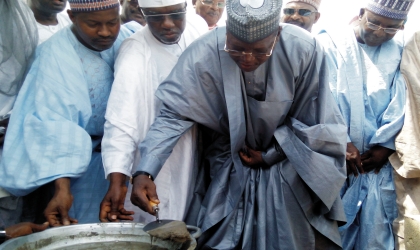
Gov. Sule Lamido of Jigawa State (2nd right), laying foundation stone for the senate building of the State University at Kafin-hausa recently. Photo: NAN



The Rivers State Commissioner for Education, Dr. Peters Nwagor, has commended the orderly conduct of the ongoing 2026 West African Senior School Certificate Examination in the state and urged schools to sustain the standard.
Dr. Nwagor gave the commendation on Tuesday during a monitoring tour of selected secondary schools in Port Harcourt and environs where the WAEC exam is ongoing.
The commissioner, who was accompanied by directors and monitors from the Ministry of Education, said he was impressed with the peaceful atmosphere at the centres visited.
“The students conducted themselves properly and wrote their papers under conducive conditions. Invigilators and supervisors also performed their duties professionally,” he stated.

Nwagor noted that the Rivers State Government had invested heavily to ensure the smooth and credible conduct of the examination across the state
He urged candidates to reciprocate government’s effort by shunning all forms of examination malpractice and focusing on their studies.
“Government has done so much to ensure successful examinations in our schools. Students should take advantage of it by remaining focused,” the commissioner said.
While no case of malpractice was recorded in the centres inspected, Dr. Nwagor warned that any principal, teacher, invigilator, or official caught aiding malpractice would face strict sanctions in line with regulations.
He also commended school administrators, teachers, WAEC officials, and security personnel for upholding the integrity of the process.
Centres visited included County Grammar School, Ikwerre/Etche; Government Comprehensive Secondary School, Borokiri; Government Secondary School, Borokiri; and Pabod Model Secondary School.

Rivers State University and the Otonti Nduka Foundation for Values Education jointly hosted a two-day National Conference on 8 and 9 May 2026 to examine the state of values in Nigeria.
The two days conference held at Rivers State University convocation arena brought together academics, policymakers, legal experts and education leaders under the theme _“Trends and Challenges in Upholding Values in Nigeria.”_
The gathering focused on policy gaps, curriculum reform, and the role of ethics in public service and education.
The event opened on Friday with remarks from Vice Chancellor Prof. Chief Isaac Zeb-Obipi, who stressed the need to address declining moral and civic values across Nigeria’s education and public sectors. A book of abstracts for the plenary sessions was also presented to participants.
Key speakers included former Attorney General Chief Dr Kanu Agabi, SAN; NERDC Executive Secretary Prof. Shehu Salisu; Prof. Hauwa Imam, FNAE, of the University of Abuja; former Rivers SUBEB Chairman Ven Dr Fyneface Akah, ; former NIMASA DG Dr Hon. Dakuku Adol-Peterside; and RSU Director of ICT Prof. Sunny Orike.
Discussions centered on integrating values education into schools, tertiary institutions and public institutions, alongside the impact of technology on moral development among young Nigerians. Panel and plenary sessions produced practical recommendations for curriculum and policy reform.
On Saturday, the foundation marked its centenary with the unveiling of the book _Otonti Nduka in History_, launched by Chief Engr. Grant Offor, FNSE. The Nigerian Academy of Education held a ceremonial procession led by its President Prof. Olu Jegede and the Ikwerre Professors Forum.
In a communiqué, participants called for stronger collaboration between government, civil society and academia to mainstream values education nationwide. They recommended reviewing teacher training curricula and expanding digital platforms to promote ethical civic engagement, with the foundation pledging to share the outcomes with education authorities for implementation.
Dignitaries present included Ogbakor Ikwerre Worldwide as Chief Host, Prof. Emeritus Chief T. Uzodimma Nwala, the Ikenga 1 of Mbaise and first philosophy student of Prof. Otonti Nduka, alongside scholars and community leaders.
Amadi Akujobi
-

 Rivers2 days ago
Police arrest 3 suspects over killing of driver in Rivers
-
Politics2 days ago
I DIDN’T PROMISE YOU TICKETS, AKPABIO TELLS APC SENATORS WHO FAILED PRIMARIES
-

 News2 days ago
FUBARA ASSURES NUT OF SECURITY OF SCHOOLS IN RIVERS
-

 News2 days ago
NDLEA Arrests Four Notorious Female Drug Dealers In Four States
-

 Sports2 days ago
Okpekpe Road Race Gets Mobility Solutions, Fan Engagement
-

 News2 days ago
WORLD FOOD SAFETY DAY: VETERINARIANS TASK GOVT ON MODERN ABATTOIR IN RIVERS
-
Politics2 days ago
Court Dismisses Rivers PDP Members’ Suit Over LG Election Candidates
-
Politics2 days ago
POST PRIMARIES: IKWERRE MONARCHS ADVOCATE ISSUES-BASED POLITICS IN RIVERS