
Nation
THE STATES

Adamawa
The Adamawa State Commissioner for Environment, Mrs
Arziki Sawa, has raised alarm over what she described as the rapid desert encroachment threatening the northern part of the state.
Sawa said in Yola at an event organised to celebrate the 2014 World Environment Day that the northern part of the state had been identified as a desertification-prone area due to the loss of its vegetation.
She attributed the development to the over exploitation of the vegetation and drought and listed the most affected areas as Madagali, Mubi North, Mubi South, Maiha, Gombi, Shelleng and Guyuk.
Others are Demsa, Fufore, Girei, Numan, Lamurde, Yola North and Yola South Local Government Areas.
According to the commissioner, the state has benefitted from the Federal Government’s ongoing Great Green Wall programme.
Bauchi
The Bauchi State Agency for the Control of HIV/
AIDs,Tuberculosis, Leprosy and Malaria (BACATMA), says it has concluded arrangements for the distribution of 3.2 million Long Lasting Mosquito Nets (LLMN) in the state.
The Chairman of the agency, Dr Abdulaziz Manga, who made the disclosure last Tuesday in an interview in Bauchi, said that a committee had been set up to map out modalities on the distribution.
According to him, 60 supervisors have been trained for the exercise.
“The nets are already in Bauchi and very soon, we will start the distribution. “We have our trained personnel ready, we are just working out modalities and the strategy to employ for the exercise,” he said.
FCT
The International Centre for Investigative Reporting
(ICIR), an NGO, in Abuja last Tuesday commenced three-day training for 40 journalists on investigative reporting.
The journalists were drawn from the 36 states of the federation and the Federal Capital Territory (FCT).
The Executive Director of the NGO, Mr Dayo Aiyetan, said that the training would expose the journalists to the intricacies involved in investigative journalism.
He said the aspect of journalism globally had moved beyond the traditional journalism being the norm in Nigeria and attributed the development to lack of skills required for journalists to perform their duties effectively.
Jigawa
The Jigawa State chapter of the All Farmers Association
of Nigeria (AFAN), has lauded the Federal Government for introducing the Growth Enhancement Support (GES) scheme.
The scheme is the flagship programme of the Agricultural Transformation Agenda under which registered farmers are allocated two bags of fertiliser each and seeds on their mobile phones through an electronic platform known as the e-wallet.
The Chairman of the association, Alhaji Habibu Isa, who made the commendation while speaking with newsmen in Dutse, on Tuesday, said that the scheme had facilitated timely input distribution to farmers.
He said that the initiative had also resulted in improved crop yields among the farmers, adding that it would go a long way in ensuring food security in the country.
Kogi
The Kabba-Bunu Local Government Council of Kogi
State, has disbursed N107.7 million Subsidy Re-investment Programme (SURE-P) intervention funds for the execution of 20 rural development projects in the area.
The Chairman of the council, Mr Emmanuel Funsho, made the disclosure recently, while addressing members of the state council of Nigeria Union of Journalists (NUJ), who were on assessment tour of SURE-P projects in the area.
Represented by Mr Sam Obanibi, the Vice Chairman of the council, Funsho said the 20 projects include education, water, transport and health sectors, adding that the council had been transparent in the use of SURE-P funds intervention.
He commended the NUJ team for the concern over utilisation of public funds and delivery of democracy dividends to the people.
Kwara
K Kwara
The Federal Road Safety Commission last Tuesday
warned officers and men of the commission to refrain from racketeering.
The FRSC Deputy Corps Marshal, Boboye Oyeyemi,who gave the warning during an inspection visit to the Kwara State Command of the commission in Ilorin, last Tuesday, said any official found wanting “ would be sacked with immediate effect.’’
He charged the commission’s personnel to remain committed in the discharge of their duties and commended officials of the commission, especially the special marshals, for their efficiency.
Oyeyemi, whose visit coincided with the opening of the State General Hospital in Ilorin, commended the state government for putting in place a trauma centre at the health facility.
Lagos
The oldest Catholic priest in Nigeria, the late Monsignor
Pedro Martins, was last Tuesday laid to rest in Lagos, amidst tributes by clerics, friends relatives.
Martins, aged 103, was laid to rest at the Vaults and Gardens Cemetery, Ikoyi , Lagos, after a funeral mass at the Holy Cross Cathedral, Lagos.
He was born on November 16 , 1910, and spent 70 years as a Catholic priest, having been ordained on August 8, 1943, by the late Rt. Rev. P.F. Kelly, the then Vicar Apostolic of Asaba and Benin.
Late Pedro Martins, an old student of King’s College, Lagos, was one of the first eleven indigenous priests.
Archbishop Emeritus of the Catholic Archdiocese of Lagos, Anthony Cardinal Okogie, said that the late Martins dedicated his long life to selfless service to mankind.
Nasarawa
The police last Tuesday arraigned Mustapha Labaran,
21, a resident of Nyanya, Abuja, in a Senior Magistrates’ Court in Marararba, Nasarawa State, for criminal breach of trust and cheating.
The police prosecutor, Donald Hemen, told the court that one Badamasi Umar, reported the matter at the Sani Abacha Road Police Station, Mararaba, on June 6.
Hemen alleged that the accused person collected the complainant’s Honda motorcycle valued at N130,000 for commercial purposes, promising to remit N700 every day adding that after collecting the motorcycle, the accused person absconded to an unknown destination.
The prosecutor said that when the accused was arrested, he claimed that he gave the motorcycle to one Sanusi (surname unknown) who was now at large, as a collateral.
He said the accused person also threatened to kill the complainant noting that the offences contravened the Penal Code.
The accused pleaded not guilty to the charges.
Osun
The Peoples Democratic Party (PDP) in Osun State said
a seven-man committee had been set up to coordinate its campaign ahead of the August 9 governorship election in the state.
The Chairman of the party, Alhaji Gani Olaoluwa, said this in a statement made available to newsmen in Osogbo on Tuesday.
According to the statement, Mr Lere Oyewumi is the Director-General of the team while Mr Jimoh Bello will serve as secretary and Prince Diran Odeyemi will be in charge of publicity.
The other members of the committee are Mr Aderoju Ibitoye, Mr Yekinni Omisore, Ms Funmilayo Olasehinde, and Mr Paul Olukunle.
Oyo
The Oyo State Commissioner for Transport, Prof.
Nurudeen Tanimowo, in Oyo last Tuesday urged youths to imbibe reading culture for all-round development.
Tanimowo, who was represented by a Chief Lecturer at the Federal College of Education (Special), Oyo, Mr Samson Atolagbe, made the call at a Readership Promotion Campaign, with the theme, “Reading on the Move, “ organised by the Oyo State Library Board.
The commissioner, who advocated reading for self fulfillment and social change, said: “Reading is a basic tool of education, information and relaxation. “This allows individual to cope with new knowledge in the changing world of technological age.’’
Also speaking, the Chairman of the occasion, Chief Bamiji Ojo, urged students to be more committed to their education noting that there could be no education without reading.
In his remarks, the Acting Librarian in Oyo State, Mr Olakanmi Adigun, said that the programme was organised to inculcate reading culture in youths.
Adigun said a reading culture would enhance better academic performance and commended Governor Abiola Ajimobi for ensuring free qualitative education and his support to the board.
Zamfara
The Zamfara State Government has released over N40.7
million to assist victims of wind and rainstorm in the state.
The state Acting Governor, Malam Ibrahim Wakkala ,who made the announcement last Tuesday, while presenting cash to victims in Barakallahu and Tsunami communities in Gusau Local Government area said the money would be distributed to victims in four communities affected by the disaster.
He named the communities as Barakallahu and Tsunami in Gusau local government area and Morai and Kagara villages in Talata-Mafara local government area and urged the victims to consider the incident as an act of God.
The acting governor urged the people of the state to remain calm, saying that the government would always assist them in times of need.
The Executive Secretary, State Emergency Management Agency (SEMA), Malam Atiku Maradun, urged the people of the area to obey town planning rules and regulations when laying foundation of their houses.
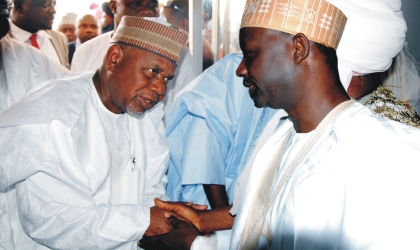
Governor Ibrahim Dankwambo of Gombe State (right) being consoled by the Acting Governor of Taraba State, Alhaji Garba Umar who paid him condolence visit Gombe, recently.



The Rivers State Commissioner for Education, Dr. Peters Nwagor, has commended the orderly conduct of the ongoing 2026 West African Senior School Certificate Examination in the state and urged schools to sustain the standard.
Dr. Nwagor gave the commendation on Tuesday during a monitoring tour of selected secondary schools in Port Harcourt and environs where the WAEC exam is ongoing.
The commissioner, who was accompanied by directors and monitors from the Ministry of Education, said he was impressed with the peaceful atmosphere at the centres visited.
“The students conducted themselves properly and wrote their papers under conducive conditions. Invigilators and supervisors also performed their duties professionally,” he stated.

Nwagor noted that the Rivers State Government had invested heavily to ensure the smooth and credible conduct of the examination across the state
He urged candidates to reciprocate government’s effort by shunning all forms of examination malpractice and focusing on their studies.
“Government has done so much to ensure successful examinations in our schools. Students should take advantage of it by remaining focused,” the commissioner said.
While no case of malpractice was recorded in the centres inspected, Dr. Nwagor warned that any principal, teacher, invigilator, or official caught aiding malpractice would face strict sanctions in line with regulations.
He also commended school administrators, teachers, WAEC officials, and security personnel for upholding the integrity of the process.
Centres visited included County Grammar School, Ikwerre/Etche; Government Comprehensive Secondary School, Borokiri; Government Secondary School, Borokiri; and Pabod Model Secondary School.

Rivers State University and the Otonti Nduka Foundation for Values Education jointly hosted a two-day National Conference on 8 and 9 May 2026 to examine the state of values in Nigeria.
The two days conference held at Rivers State University convocation arena brought together academics, policymakers, legal experts and education leaders under the theme _“Trends and Challenges in Upholding Values in Nigeria.”_
The gathering focused on policy gaps, curriculum reform, and the role of ethics in public service and education.
The event opened on Friday with remarks from Vice Chancellor Prof. Chief Isaac Zeb-Obipi, who stressed the need to address declining moral and civic values across Nigeria’s education and public sectors. A book of abstracts for the plenary sessions was also presented to participants.
Key speakers included former Attorney General Chief Dr Kanu Agabi, SAN; NERDC Executive Secretary Prof. Shehu Salisu; Prof. Hauwa Imam, FNAE, of the University of Abuja; former Rivers SUBEB Chairman Ven Dr Fyneface Akah, ; former NIMASA DG Dr Hon. Dakuku Adol-Peterside; and RSU Director of ICT Prof. Sunny Orike.
Discussions centered on integrating values education into schools, tertiary institutions and public institutions, alongside the impact of technology on moral development among young Nigerians. Panel and plenary sessions produced practical recommendations for curriculum and policy reform.
On Saturday, the foundation marked its centenary with the unveiling of the book _Otonti Nduka in History_, launched by Chief Engr. Grant Offor, FNSE. The Nigerian Academy of Education held a ceremonial procession led by its President Prof. Olu Jegede and the Ikwerre Professors Forum.
In a communiqué, participants called for stronger collaboration between government, civil society and academia to mainstream values education nationwide. They recommended reviewing teacher training curricula and expanding digital platforms to promote ethical civic engagement, with the foundation pledging to share the outcomes with education authorities for implementation.
Dignitaries present included Ogbakor Ikwerre Worldwide as Chief Host, Prof. Emeritus Chief T. Uzodimma Nwala, the Ikenga 1 of Mbaise and first philosophy student of Prof. Otonti Nduka, alongside scholars and community leaders.
Amadi Akujobi
-

 Rivers2 days ago
Police arrest 3 suspects over killing of driver in Rivers
-
Politics2 days ago
I DIDN’T PROMISE YOU TICKETS, AKPABIO TELLS APC SENATORS WHO FAILED PRIMARIES
-

 News2 days ago
FUBARA ASSURES NUT OF SECURITY OF SCHOOLS IN RIVERS
-

 News2 days ago
NDLEA Arrests Four Notorious Female Drug Dealers In Four States
-

 Sports2 days ago
Okpekpe Road Race Gets Mobility Solutions, Fan Engagement
-
Politics2 days ago
Court Dismisses Rivers PDP Members’ Suit Over LG Election Candidates
-

 News2 days ago
WORLD FOOD SAFETY DAY: VETERINARIANS TASK GOVT ON MODERN ABATTOIR IN RIVERS
-
Politics2 days ago
POST PRIMARIES: IKWERRE MONARCHS ADVOCATE ISSUES-BASED POLITICS IN RIVERS