
Nation
THE STATES

Bauchi
The proposed Kafin Zaki dam in Bauchi State, is to be
re-designed to accommodate the interests of communities in Yobe and Jigawa states.
Vice President Namadi Sambo stated this in Bauchi during the North East Zonal Rally of the Peoples Democratic Party (PDP).
He said that President Goodluck Jonathan, who authorized the re-designing of the dam, had also directed that work should commence on the project.
Sambo also said that the completion of another dam in Taraba, the Mambilla Hydropower project, would transform the North East sub-region.
Benue
Suspected Fulani Herdsmen, have attacked some vil
lages in Agatu local government area of Benue State, killing over 19 people and abducting others in the process.
It was gathered that more than 15 people, including women and children were whisked away by the gunmen to unknown destination.
Sources say the gunmen also razed houses and destroyed farmlands during the late night invasion.
The council chairman, Stephen Dutse, said the attackers invaded the villages of Olegaje, Ogumogbo, Ejuma and Ogbagaji, the headquarters of the local government.
FCT
The Association of Nigerian Authors (ANA), said it
would join the rest of the world to celebrate the 50th anniversary of Chinua Achebe’s novel, Arrow of God.
The National Vice President of the association, Danja Abdullahi, told newsmen in Abuja that the event would come up on April 3 in Abuja.
He said that ANA resolved to celebrate the 50th anniversary of Achebe’s novel “because Chinua Achebe was a hero in the literary world, besides being a worthy son of Nigeria.
“This year marks the golden anniversary of the publication of the novel, Arrow of God, by Chinua Achebe, his third novel after Things Fall Apart and No Longer at Ease.
Jigawa
The Birniwa Local Government Area of Jigawa State
is targeting immunisation of 121, 000 animals against various diseases within four weeks, the Chairman, Malam Muhammad Bundai, said recently.
Bundai gave the assurance while inspecting animal vaccination in Birniwa.
He urged Fulani herdsmen to present their animals for vaccination to check outbreak of diseases and improve animal health.
The chairman said that the council had provided logistics support to facilitate smooth conduct of the exercise.
Kaduna
The Governing Council of the Nigerian Institute of
Transport Technology (NITT), Zaria, Kaduna State, has approved the appointment of three acting directors to substantive positions.
The approval is contained in a statement issued by the institute’s Chief Principal Public Relations Officer, Mr Paul Mshelizah in Zaria.
The statement quoted Mshelizah as saying the decision was taken at the 19th meeting of the council held in Zaria, Kaduna State on March 28, chaired by its Chairman, Mr Olusola Akanmode.
The new appointees are Alhaji Sule Bello, who is now the institute’s substantive Registrar, Mr Uzoma Ugoke, who becomes the Director, Library and Information and Mr Femi Jemirin, now the institute’s Director, Consultancy Services.
Kano
Kano State Governor, Rabiu Musa Kwankwaso,
has declared that the ongoing National Conference would end up as another talk show, as it was meant to waste government’s fund.
In an interview with the BBC Hausa service in Kaduna recently, he wondered why a whopping N7 billion was budgeted for the conference, while only a paltry N2 billion was given to three North-Eastern states grappling with terrorism and insurgency.
Kwankwaso stated that the President, Goodluck Jonathan, hurriedly organised the conference because he was short of ideas on how to run the country.
He alleged that the motive behind the confab was to open old wounds with a clear intent to cause confusion in the polity.
Kwara
A lawmaker, Dr Rafiu Ibrahim, says the pres
ence of “too many old people’’ at the National Conference may be a negation of President Goodluck Jonathan’s good intention of convening it.
Ibrahim, who said this in Ilorin, recently, told newsmen that the ongoing National Conference was a laudable event which had too many old people as delegates.
The lawmaker, who was inaugurated as Honorary President of Mess Committee of the Nigeria Navy School of Health Sciences in Offa, Kwara said the timeliness of the conference was apt.
Lagos
Some residents of Ejigbo in Alimosho Local Gov
ernment Area of Lagos State have urged the state government to provide an efficient network of drains in the area.
In separate interviews with newsmen in Lagos, they said that functional drainage channels would give room for easy flow of waste water into the canals.
“In Ejigbo, most homes don’t know where to discharge waste water because there is no functional drainage system.
“So, what happens is that the water is discharged in the compounds and you know this can cause health problems.
Ogun
A member of the Ogun State House of As
sembly, Mr Oludaisi Elemide, has urged delegates to the National Conference to put the interest of the nation first in all their deliberations.
Elemide, (APC-Odeda), made the call in Abeokuta in an interview with newsmen
The lawmaker said that the outcome of the on-going national conference would only be meaningful if the interest and future of the nation were put into consideration in all issues to be discussed.
He stated that lack of love for one another had been a major factor affecting development and growth of the country.
He added that Nigerians should love one another irrespective of religious or ethnic differences.
The legislator noted that Nigeria would be a better place if the fear of God, love and honesty were allowed to reign supreme at the conference.
He, however, urged the leadership of the country to ensure that the views of Nigerians were not subverted at the end of the conference.
Ondo
The Chairman of Ondo State Cocoa Revolution
Implementation Committee, Dr Jibayo Oyebade, says cocoa produced in the state for chocolate production, has received world certification and recognition.
Oyebade told newsmen in Akure, that the product had already been presented to the partnering firm overseas, Cargill Cocoa and Chocolate firm, Netherland.
“We taught our cocoa farmers how to improve the quality of their cocoa, through proper fermentation.
“Our partners have taken our sample and are satisfied with it. I am proud that our effort has yielded good results. We want to reproduce chocolate from our own cocoa” he said.
Zamfara
The National Chairman of Miyetti Allah Cattle
Breeders Association, Alhaji Abdullahi Bodejo, has called on Governor Ibrahim Shema of Katsina State, to convene a nationwide meeting of Fulanis.
Bodejo made the call in Gusau while conferring the title of Sardaunan Fulani on Shema.
He explained that such a meeting would help to find lasting solutions to problems involving Fulani and others in the country.
“If a meeting is convened by a personality like the Katsina state governor, I am very certain that the truth about us will come to light’’, Bodejo said.
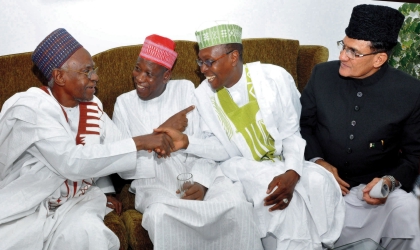
L-R: Former President Shehu Shagari, Deputy Governor of Kano Stae, Alhaji Abdullahi Ganduji, an Activist, Dr Junaid Mohammed and High Commissioner of Pakistan to Nigeria, Muhammad Saleem, at the 75th National Day of the Islamic Republic of Pakistan in Abuja last Sunday. Photo: NAN



The Rivers State Commissioner for Education, Dr. Peters Nwagor, has commended the orderly conduct of the ongoing 2026 West African Senior School Certificate Examination in the state and urged schools to sustain the standard.
Dr. Nwagor gave the commendation on Tuesday during a monitoring tour of selected secondary schools in Port Harcourt and environs where the WAEC exam is ongoing.
The commissioner, who was accompanied by directors and monitors from the Ministry of Education, said he was impressed with the peaceful atmosphere at the centres visited.
“The students conducted themselves properly and wrote their papers under conducive conditions. Invigilators and supervisors also performed their duties professionally,” he stated.

Nwagor noted that the Rivers State Government had invested heavily to ensure the smooth and credible conduct of the examination across the state
He urged candidates to reciprocate government’s effort by shunning all forms of examination malpractice and focusing on their studies.
“Government has done so much to ensure successful examinations in our schools. Students should take advantage of it by remaining focused,” the commissioner said.
While no case of malpractice was recorded in the centres inspected, Dr. Nwagor warned that any principal, teacher, invigilator, or official caught aiding malpractice would face strict sanctions in line with regulations.
He also commended school administrators, teachers, WAEC officials, and security personnel for upholding the integrity of the process.
Centres visited included County Grammar School, Ikwerre/Etche; Government Comprehensive Secondary School, Borokiri; Government Secondary School, Borokiri; and Pabod Model Secondary School.

Rivers State University and the Otonti Nduka Foundation for Values Education jointly hosted a two-day National Conference on 8 and 9 May 2026 to examine the state of values in Nigeria.
The two days conference held at Rivers State University convocation arena brought together academics, policymakers, legal experts and education leaders under the theme _“Trends and Challenges in Upholding Values in Nigeria.”_
The gathering focused on policy gaps, curriculum reform, and the role of ethics in public service and education.
The event opened on Friday with remarks from Vice Chancellor Prof. Chief Isaac Zeb-Obipi, who stressed the need to address declining moral and civic values across Nigeria’s education and public sectors. A book of abstracts for the plenary sessions was also presented to participants.
Key speakers included former Attorney General Chief Dr Kanu Agabi, SAN; NERDC Executive Secretary Prof. Shehu Salisu; Prof. Hauwa Imam, FNAE, of the University of Abuja; former Rivers SUBEB Chairman Ven Dr Fyneface Akah, ; former NIMASA DG Dr Hon. Dakuku Adol-Peterside; and RSU Director of ICT Prof. Sunny Orike.
Discussions centered on integrating values education into schools, tertiary institutions and public institutions, alongside the impact of technology on moral development among young Nigerians. Panel and plenary sessions produced practical recommendations for curriculum and policy reform.
On Saturday, the foundation marked its centenary with the unveiling of the book _Otonti Nduka in History_, launched by Chief Engr. Grant Offor, FNSE. The Nigerian Academy of Education held a ceremonial procession led by its President Prof. Olu Jegede and the Ikwerre Professors Forum.
In a communiqué, participants called for stronger collaboration between government, civil society and academia to mainstream values education nationwide. They recommended reviewing teacher training curricula and expanding digital platforms to promote ethical civic engagement, with the foundation pledging to share the outcomes with education authorities for implementation.
Dignitaries present included Ogbakor Ikwerre Worldwide as Chief Host, Prof. Emeritus Chief T. Uzodimma Nwala, the Ikenga 1 of Mbaise and first philosophy student of Prof. Otonti Nduka, alongside scholars and community leaders.
Amadi Akujobi
-

 Rivers2 days ago
Police arrest 3 suspects over killing of driver in Rivers
-
Politics2 days ago
I DIDN’T PROMISE YOU TICKETS, AKPABIO TELLS APC SENATORS WHO FAILED PRIMARIES
-

 News2 days ago
FUBARA ASSURES NUT OF SECURITY OF SCHOOLS IN RIVERS
-

 News2 days ago
NDLEA Arrests Four Notorious Female Drug Dealers In Four States
-

 Sports2 days ago
Okpekpe Road Race Gets Mobility Solutions, Fan Engagement
-
Politics2 days ago
Court Dismisses Rivers PDP Members’ Suit Over LG Election Candidates
-
Politics2 days ago
POST PRIMARIES: IKWERRE MONARCHS ADVOCATE ISSUES-BASED POLITICS IN RIVERS
-

 News2 days ago
WORLD FOOD SAFETY DAY: VETERINARIANS TASK GOVT ON MODERN ABATTOIR IN RIVERS