
Featured
2023 Election Failure’ll Polarise The Polity, Set Democracy Backwards -Wike

Rivers State governor, Nyesom Wike, has urged Nigerians not to allow the 2023 general elections to fail.
He said the failure of the 2023 elections would increase political polarisation, exacerbate social fault lines and set Nigeria’s democracy backwards.
Governor Wike gave the charge at the 2023 Port Harcourt International Conference, sponsored by Rivers State Government, with the theme: Deepening Democratic Culture and Institutions for Sustainable Development and Security in Nigeria”, held at Obi Wali International Conference in Port Harcourt, last Thursday.
The governor, in a statement issued by his Special Assistant on Media, Kelvin Ebiri, noted that barely one month away, Nigerians are hoping and praying for the 2023 general elections to herald the deepening of democratic culture, the rule of law and good governance in the country.
Governor Wike, however, insisted that the opportunity to elect a new President of the federation and 30 State Governors should be a success because it will consolidate and strengthen the roots of democracy in the national life of Nigeria.
“In a democracy, periodic elections are the only legitimate means for the peaceful transfer of power from one party to another. Since 1999, Nigeria has had six general election circles, but none was considered substantially clean and fair.
“The outcome of the 2003 general elections was rejected at different levels by the opposition and the losers, and litigated up to the Supreme Court. The outcome of the 2007 elections led to protests, riots, the loss of several lives, and the destruction of property in particular sections of the country”, he noted.
Governor Wike also recalled that even President Musa Ya’ardua had promised necessary electoral reforms when he publicly denounced the process that brought him to power because it was severely flawed.
According to him, the 2011 general election also suffered a similar experience and was litigated by the opposition to the Supreme Court.
“None of the defeated contestants believed they lost fairly and blamed the umpire, the security agencies and politicians for undermining our democracy with brazen electoral fraud”.
Governor Wike noted further that the 2015 general election, though considered rigged, recorded some improvements with the use of the smart card reader and the emergence of opposition candidates as the winners of the presidential.
The governor said the 2019 general election was equally problematic and rejected as highly compromised by the opposition and litigated up to the Supreme Court.
“In Rivers State, we battled the military in the 2015 and 2019 re-run and general elections with pure courage and determination to secure our victory and retain our mandate with the sweat and blood of innocent citizens”, he said.
Governor Wike pointed out that when the government compromises the integrity of elections through election management agencies, it denies citizens their constitutional right to elect the leaders they want and can hold accountable.
Conversely, he emphasised, when elections lack integrity, the leaders who emerged from outside the people’s will are illegitimate.
According to him, “Such leaders without trust are likely to be authoritarian, divisive and incapable of effective governance. Serial election rigging threatens our democracy and constitutes an existential challenge to the nation’s future stability.
“Therefore, deepening democratic culture and institutions for sustainable development and security is important to us as a nation, and free and fair elections with integrity remain the only path to achieving this objective”.
Speaking further, Governor Wike said the new electoral law, especially with the provisions of the use of technology, holds the prospect for a brighter democratic experience for Nigeria if implemented effectively.
However, he stressed, that beyond the legal regime, political parties’ internal practices and external electioneering behaviour must conform to democratic norms and standards.
“The efficiency of the judiciary in interpreting and enforcing the existing regulatory regime, including the laws, regulations and guidelines beyond reproach and the capacity and consistency of INEC and the security agencies to be firm, impartial and independent in the discharge of their functions are most crucial.
“Safeguarding and deepening our democracy lies with every citizen. We must have the courage to stand up for justice, the rule of law, an independent and courageous judiciary, and our rights and freedoms to vote and be voted in a transparent election”, he stated.
Presenting his keynote address, former president of Nigeria, Chief Olusegun Obasanjo, who titled his paper: “Respecting the Principles of Democracy”, noted that Nigeria’s democracy has gone through twists, dives and turns since political independence.
He said the best of the country’s history has been the sustenance of democracy since the military transfer of power to an elected government in 1999.
He however, observed that there may be reasons to doubt how much lessons the leaders and followers have drawn from the country’s past and how far they are willing to go to deepen, widen and strengthen democracy and democratic practice.
The former president declared that the ways in which the political class have practised democracy have deepened contradictions, negative coalitions, distrust, disloyalty and unpatriotic tendencies within and between communities and constituencies all over the country.
He stated that this means that there is a deep structural and philosophical problems that must be deal with.
Chief Obasanjo informed that if the practice of democracy is superficial and opportunistic and it is designed to pursue a struggle of limited objectives, it would precipitate variants of fractured engagements that cannot address structural and philosophical contradictions and challenges.
“In fact, the order of the day would be community against community, religion against religion, leader against leader. Ordinary citizens are then dragged into the directionless, meaningless and opportunistic personal or narrow ambitions of leaders. The end result will be confusion, diffusion, distraction and possibly leading to separation and disintegration”, he said.
The former president stressed that democracy is possible in Nigeria and the people have the capacity to build a culture of democratization. However, he insisted that Nigerians must recognise and accept the fact that it is an evolutionary process with principles.
“Without retracing our political steps to the right direction, the current process will either not produce the right leaders or it will leave so many broken blocks on the path to governance and attract resources and energy away from the task of rebuilding Nigeria and consolidating our democratic practice.
“The result will be democratic quagmire, increased corruption, insecurity and survival of the fittest, richest and better connected with little or no recognition of merits. The implications and cost of such a scenario to our present and future can best be imagined. I pray that God will grant us the wisdom to do what is right for our country and people at all times and more so now”, he said.
In his opening remarks, former Governor of Ekiti State, Dr. Kayode Fayemi, who was the chairman of the occasion, said the theme of the conference addresses itself to the imperative of enhancing democratic governance to the benefit of Nigerians and the country.
Fayemi pointed to the scholarly assertions of late Claude Ake, on feasibility and possibility of democracy wherein there has to be enduring democratic culture and democracy being structured to be developmental in nature.
He observed that Nigeria’s democracy is bedevilled by lack of party based politics, issued based politicking, untamed political violence, winner take all mentality, growing influence of money in politics, exploitation of loophole to subvert the will of the people and social media and spread of fake news.
“Though, there are some political milestones achieved since 1999, there is no doubt that we still have a longway to go in building a robust culture of power and politics that is both democratic and sustaining”, he said.
As part of the event, there was the unveiling of the book, “Bridging Rivers”, under the chairmanship of former governor of Rivers State, Dr. Peter Odili.















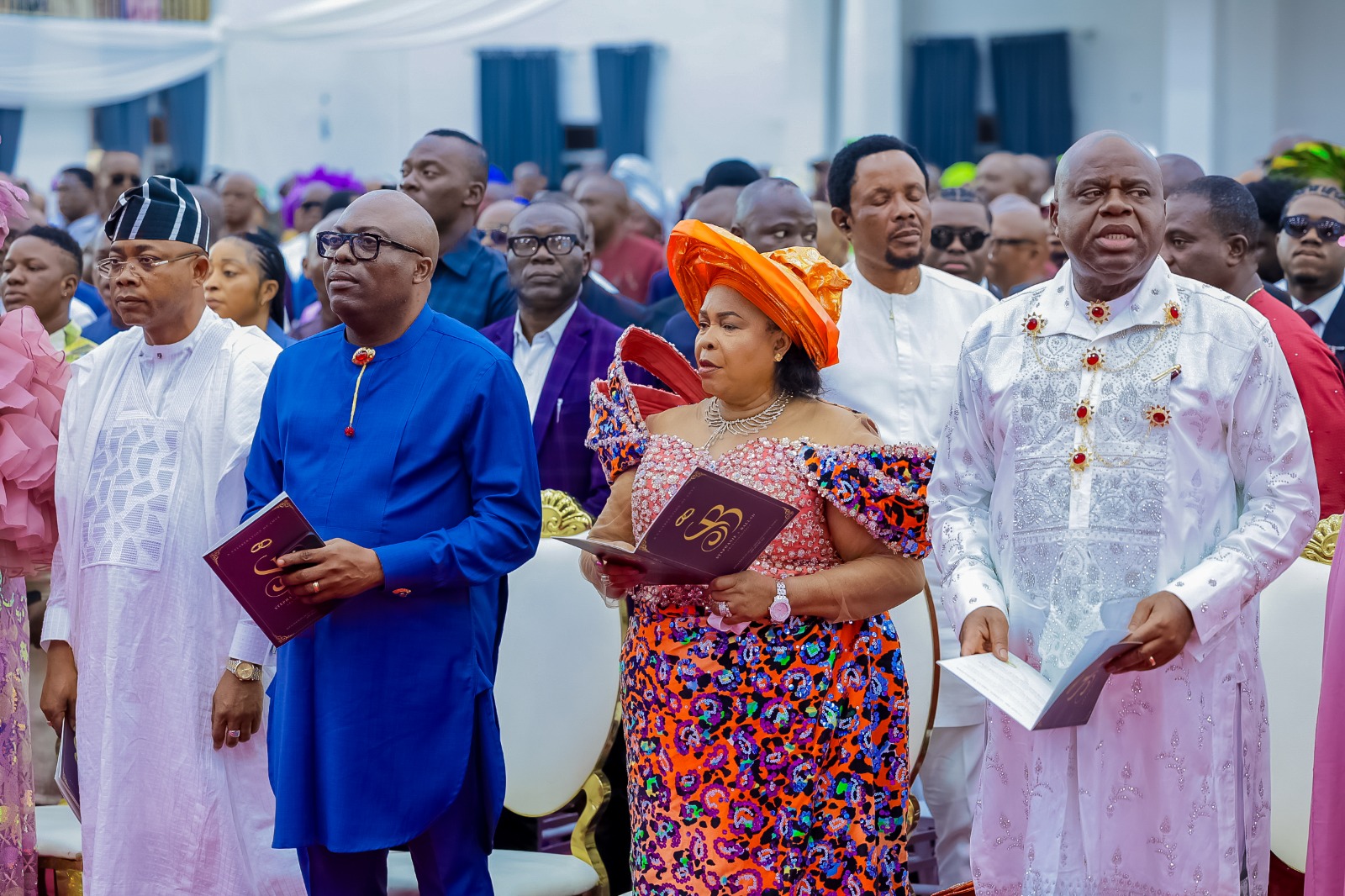
Rivers State, Sir Siminalayi Fubara, has assured members of the National Youth Service Corps (NYSC) of his administration’s commitment to supporting and strengthening the scheme in the State.
Fubara gave the assurance last Friday at the NYSC permanent orientation camp, Nonwa-Gbam, Tai Local Government Area in the State, during the swearing-in ceremony of 2026 Batch B Stream II orientation course.
Represented by the Permanent Secretary, Cabinet Bureau, Office of the Secretary to the State Government, Dr. Promise Oguzie, the governor said the State Government would remain intentional in providing the necessary support to improve the NYSC scheme and enhance the experiences of corps members deployed to the state.
He charged the corps members to be role models and quality nation-builders in their service to the good people of Rivers State in particular, and Nigeria at large.
“I charge you to be exemplary, dedicated and committed in all you do. Take full advantage of all the camp programmes and activities to enrich yourselves”, he said.
In his welcome address, the State Coordinator of NYSC in Rivers State, Mr. Moses Oleghe, urged corps members to see their deployment to Rivers State as a “veritable opportunity to make meaningful contribution to the growth of the State in particular and Nigeria at large.”
He further charged them to serve with all sense of “integrity, discipline, and the fear of God, especially when they will be engaged as INEC ad-hoc staff that will conduct the 2027 general elections.”
A total of 3,584 corps members composed of 1,421 males and 2,163 females were sworn in by the Chief Judge of Rivers State, who was represented by Justice Godspower Aguma.

Governor of Rivers State, Sir Siminalayi Fubara, says Nigeria needs God-fearing leaders for the nation to move in the right direction and make meaningful progress.
The Governor stated this yesterday when he received in audience, the World President of the Seventh Day Adventist Church, Pastor Erton Kohler; his wife, Andriene Marques Kohler; daughter Mariana Marques Kohler and a retinue of ministers of the church at Government House, Port Harcourt.
Fubara who hailed the Seventh Day Adventist Church for its contributions to education and the grooming of future leaders in Nigeria, expressed delight that the Church had over the years, been investing in education at various levels and currently runs two universities in the country.
He commended the church for not only using its institutions to spread the gospel of Christianity but to groom future leaders for the country.
According to him, religion should not be just about defending one’s faith, but also making meaningful impact on the lives of the people.
He said that by floating these educational institutions, the church has demonstrated capacity to support Nigeria in the task of producing not only educated people but a breed of God-fearing leaders.
“Our country is where it is today because we lack the fear of God. If you have the fear of God, there should be a limit to what you can do because you understand the supremacy of God. But when God is not in your equation, you’ll go beyond the line and that is what has brought us to where we are today.
“So, I feel very happy that you are contributing to the development of our future leaders in this country. We need the right people being in the right place; prepared properly with good minds; that is what we need, not just in Nigeria but round the whole world.,” he said.
Governor Fubara further observed that the absence of God-fearing people in high places to take the right decisions that could impact positively on the society, has also given rise to other problems such as social inequality, poverty, corruption and criminality. According to him, Nigeria needs a system where the average parent could afford quality education for their children and a guarantee that upon graduation, the average child will have the capacity to compete favourably with anybody, anywhere in the world.
“If we have a situation where the little money that you’re being paid as wage can also afford you quality healthcare and after working at least for 15-20 years, you have a roof over your head, tell me why you should be involved in any kind of crime? At that point, you’ll feel secured and this attitude of insecurity about the future that leads to all the social vices we have today won’t be there,” he said.
Governor Fubara expressed appreciation to the delegation for the visit and for their prayers for Rivers State, assuring them of his continued support for their programmes in the state.
Leader of the delegation and World President of the Seventh Day Adventist Church, Pastor Erton Kohler said he was in Nigeria for a special conference of the church during which thousands of the church’s ministers will be undergoing an empowerment programme to further equip them for the task of herding their flocks and serving the society.
He expressed gratitude to the Governor for the warm reception accorded his entourage, saying the memory of the visit will linger in his mind for a lifetime.
Kohler disclosed that the Church has over twenty -four million (24,000,000) members and more than 182,000 places of worship, spread across 212 countries of the world.

The Rivers State House of Assembly has approved the 2026–2028 Medium Term Expenditure Framework (MTEF) submitted by Governor Siminalayi Fubara.
This reaffirms the lawmakers’ commitment to enacting laws and taking legislative actions geared towards the overall development of the State.
The Assembly gave the approval during its Second Legislative Sitting of the Fourth Session held last Friday.
Speaking on the MTEF document during plenary, the House Speaker, Rt. Hon. Martin Amaewhule, noted that by the provision of Section 10(1)(b) of the Rivers State Fiscal Responsibility Law No. 8 of 2010, the MTEF ought to have been laid before the House in September 2025.
Amaewhule explained that traditionally, the document is expected to be presented four months before the commencement of the next financial year and immediately after the expiration of every three-year fiscal cycle.
He, however, stated that in the interest of the State and its people, the House considered it necessary to deliberate on the document, describing it as a precursor to the 2026 Budget Estimates.
The Speaker expressed concern that the year had already progressed significantly before the presentation of the framework.
During deliberations on the document, members examined the assumptions and projections contained in the MTEF and observed that strict adherence to the outlined fiscal parameters would ultimately serve the interest of Rivers people.
The lawmakers maintained that effective implementation of the framework would promote prudent financial management and enhance developmental planning across the State.
Following the debate and positive consideration by members, the Speaker put the question to the House and members voted overwhelmingly in support of the approval of the MTEF.
Meanwhile, during the same sitting last Friday, the House also received a petition from the Chairman of Obio/Akpor Local Government Council, Dr. Gift Worlu.
The petition was presented by the member representing Obio/Akpor Constituency II, Hon. Emilia Amadi.
According to the petition, concerns were raised over an imminent security breach, threats to lives, destruction of property and alleged forceful takeover of property by some lawless persons within parts of the Local Government Area.
Presenting the petition before the House, Hon. Amadi appealed to the lawmakers to revisit the matter and take necessary steps aimed at safeguarding lives and property in the affected communities.
The House is expected to further deliberate on the petition and consider measures to address the concerns raised in order to sustain peace and security in the area.
King Onunwor
-

 News2 days ago
RSG Targets Nine Million Residents in Mosquito Net Distribution Campaign
-

 Oil & Energy2 days ago
Aiyedatiwa Signs New Electricity Bill
-

 Oil & Energy2 days ago
NLNG Commissions Research And Innovation Centre In RSU
-

 Maritime2 days ago
Marine Minister Commends President Tinubu On NPERA Bill Assent
-

 News2 days ago
KenPoly Holds Eight Convocations, August 29
-

 News2 days ago
RSG Begins Another Phase of Projects Commissioning Today
-

 News2 days ago
RMAFC Completes Revenue Sharing Review, Proposes New Pay
-

 Maritime2 days ago
NAGAFF Petitions IGP Over Alleged Maritime Police Harassment