
Oil & Energy
Unveiling Of Crane: Energy Infrastructure Set To Get Boost

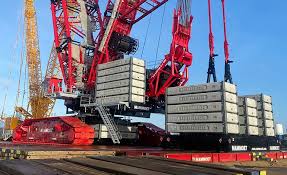
Energy infrastructure, a crucial part of global oil and gas supply and the energy transition, are set to get a boost after a heavy lifting equipment provider unveiled the world’s strongest crane-equipment capable of lifting 6,000 tons, or 15 fully loaded Boeing 747 aircraft.
Dutch heavy lifting and transport services company Mammoet has launched a new type of crane, the SK6,000, which, the firm said, could be used for modules to be built faster and also “bigger than ever before”.
As oil and gas continue to be a key part of the world’s energy system—and likely will continue for decades to come—and as renewable energy developers aim for bigger wind turbines, the support equipment for installing oil and gas platforms, offshore wind equipment, and even nuclear power stations is becoming bigger.
Bigger cranes such Mammoet’s SK6,000 could remove some of the limitations of engineering and construction firms. These firms are generally limited by how much weight can be lifted when installed on a platform or turbine.
Cranes that can carry 5,000 tons and more can shorten the time of a project being erected on a site, onshore or offshore, Mammoet says.
“Limitations on lifting capacity force engineers to fabricate smaller modules than would be optimal; tying up site space and increasing the complexity and duration of projects,” the company notes.
“This limitation can also narrow the execution choices available during each project’s planning stage and the percentage of each project that can be executed locally.”
These days, energy companies and their contractors seek faster deployment of energy infrastructure, be it wind turbines or floating production storage and offloading (FPSO) vessels and platforms for oil and gas production.
“There are so many supply chain constraints at the moment that need to be de-bottlenecked,” Gavin Kerr, Mammoet’s director of global services, told Bloomberg, commenting on the new crane.
“The bigger everything gets, you need bigger cranes.”
Moreover, the SK6,000 is containerised and can be assembled quickly on-site. This feature allows it to deliver heavy lift capability wherever it is needed, giving contractors greater flexibility in where and how energy projects are completed” Mammoet said.
“With the innovation of the SK6,000 crane, our customers can think bigger than ever before; pushing modules beyond the 4,000t and even 5,000t barriers. Its low ground bearing capacity also means the crane can be used all over the world”, said Mammoet’s Sales Director Giovanni Alders.
“With its long outreach, small minimum footprint and relatively small site impact, the SK6,000 greatly reduces the topside integration time.
“Needless to say, with larger building blocks you spend less time connecting and testing, and more time producing” Alders added
Energy companies do need faster permit-to-production times in both oil and gas and renewable energy to provide the conventional and green energy sources the world will need.
Wind turbine technology is evolving and making the hub height increasingly taller. According to the Office of Energy Efficiency & Renewable Energy at the U.S. Department of Energy, the hub height for utility-scale land-based wind turbines has surged by 83per cent since 1998–1999, to about 103.4 meters (339 feet) in 2023. That’s taller than the statue of Liberty.
The average hub height for offshore wind turbines in the United States is projected to grow even taller from 100 meters (330 feet) in 2016 to about 150 meters (500 feet), or about the height of the Washington Monument, in 2035, DOE said.
In the oil and gas industry, new resource development is needed as demand for LNG grows and legacy oilfields mature and output declines.
If contractors can bring energy projects on stream faster, both oil and gas supply and the energy transition will benefit.
By: Charles Kennedy





-

 News4 days ago
RSG Targets Nine Million Residents in Mosquito Net Distribution Campaign
-

 Oil & Energy4 days ago
Aiyedatiwa Signs New Electricity Bill
-

 Oil & Energy4 days ago
NLNG Commissions Research And Innovation Centre In RSU
-

 Maritime4 days ago
Marine Minister Commends President Tinubu On NPERA Bill Assent
-

 News4 days ago
KenPoly Holds Eight Convocations, August 29
-

 News4 days ago
RSG Begins Another Phase of Projects Commissioning Today
-

 News4 days ago
RMAFC Completes Revenue Sharing Review, Proposes New Pay
-

 Maritime4 days ago
NAGAFF Petitions IGP Over Alleged Maritime Police Harassment