
Politics
How Buhari’s Indecision Caused Confusion In APC

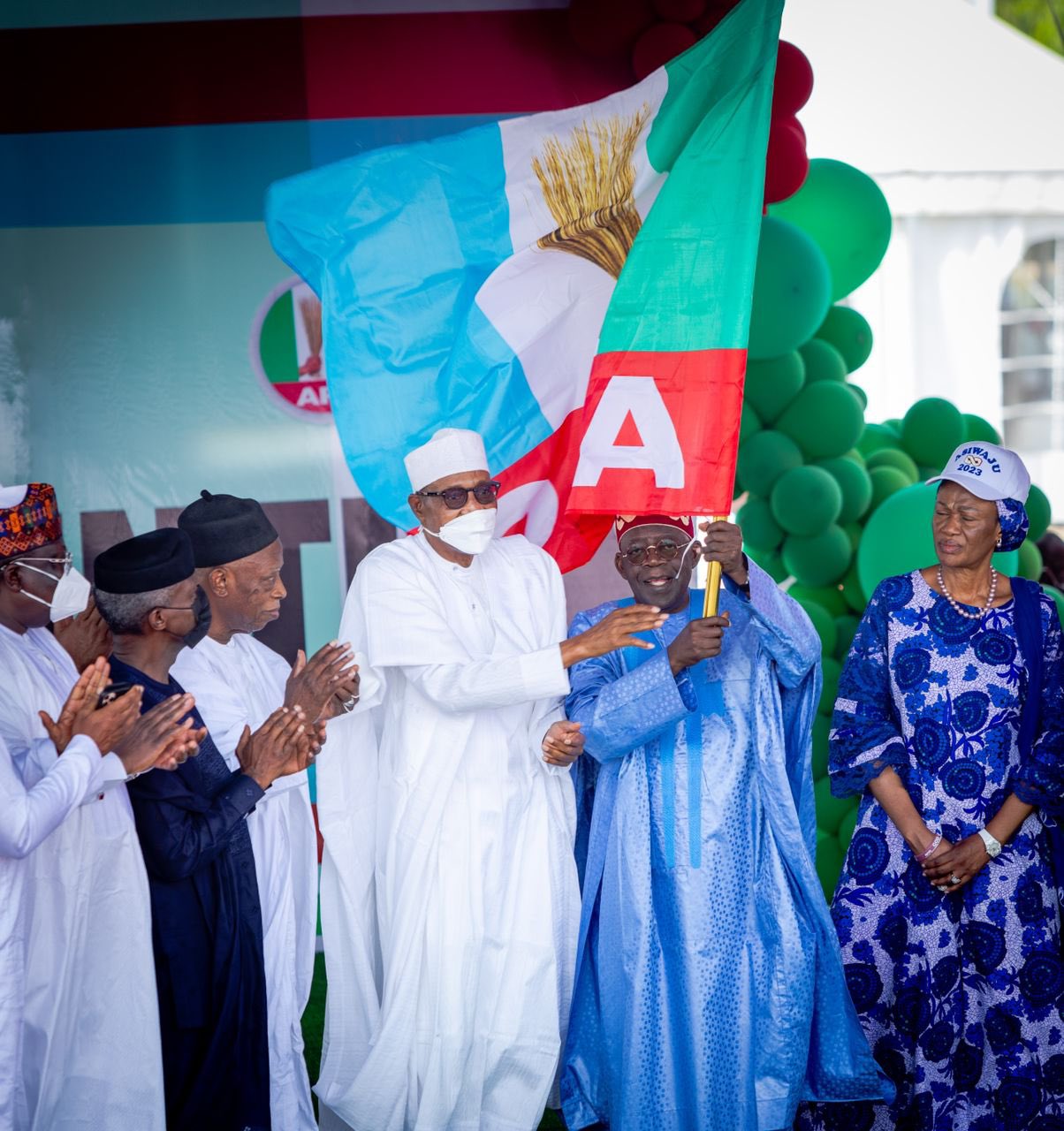
The road to the special convention of the All Progressives Congress (APC) to elect its presidential candidate was tinged with hazy permutations, melodrama and political machinations.
Pundits and party chieftains pointed to one direction for the heightened drama: President Muhammadu Buhari.
The development aggravated the tension ahead of the convention as various interest groups used the president’s silence to intensify horse-trading and peddle the name of the president to sell the candidature of their preferred aspirants.
The Tide source reports that the battle to succeed President Buhari had been fierce and tension-soaked in the ruling party. From the 23 aspirants who were screened by the John Oyegun-led screening committee, the electioneering had been breath-taking as members of the party studied the body language of Buhari who once said he had a preferred successor but failed to name him.
Up to the last minute of the electioneering, the President kept members of the party guessing on his preferred successor, with different contradictory statements, saying at one time that he had a preferred candidate and at another recanting the claim on his successor.
So many chieftains of the party were apprehensive over the president’s indecision amidst speculations that he might want to have his way.
He did that during the race for the chairmanship of the party. He settled for Senator Abdullahi Adamu at the eleventh hour amidst grumbling from party stakeholders, including the Governors of the party. But he had his way. Adamu emerged as the consensus candidate and was eventually affirmed at the convention held on March 26.
But while many aspirants were banking on the president’s endorsement to win, pundits said that pasture was a miscalculation as the President was not known to put a spirited fight for anyone.
As far back as January this year, Buhari granted an interview to Channels Television where he hinted that he had a favourite to succeed him but he would not reveal the name.
He said he was “open to the emergence of anyone,” but later, when pressed, added that he had one person in mind but he would not name him so that he would not be eliminated.
Pressed on whether he had any favourite in the APC, he added: “No. I wouldn’t because the person could be eliminated if I mention it. I better keep it secret.”
Earlier in the interview, Buhari said: “I am not interested in who becomes the presidential candidate of the ruling All Progressives Congress (APC) as I am open to the emergence of anyone.
“No. Let him come, whoever it is. The only important thing (is) I made sure that on record, nobody should ask me to come and give any evidence in any court.
“Otherwise, whoever it is, he will be in trouble. Because all the important things are on record. I made sure about that. Important issues are all on record.”
Days after the conduct of party primaries for other elective positions in 2023, the President met the party’s Governors under the aegis of the Progressive Governors’ Forum (PGF), urging them to allow him to pick his successor.
Buhari at the meeting on Tuesday May 31, stated that state Governors were given the opportunity to pick their successor, so they should also allow him to do the same at the federal level.
Buhari said, “In keeping with the established internal policies of the party and as we approach the convention in a few days, therefore, I wish to solicit the reciprocity and support of the governors and other stakeholders in picking my successor, who would fly the flag of our party for election into the office of the President of the Federal Republic of Nigeria in 2023.
“We gave governors re-election tickets or opportunity to pick their successors; allow me pick my successor.”
The APC national chairman on Monday flew a kite when he announced Senate President Lawan as the consensus candidate endorsed by President Buhari. The announcement was greeted with a flurry of angry reactions, especially from the camp of 13 other aspirants in the race.
His announcement came after Governors of the party from the North backed power shift to the South.
However, the kite failed to fly anywhere as the President, through a statement from Presidential spokesman Garba Shehu countered the national chairman, saying Buhari had not anointed anyone as his preferred candidate.
Shehu expressed the president’s determination to ensure that “there shall be no imposition of any candidate on the party.”
He quoted Buhari as speaking during a meeting with the Governors at the State House, Abuja, saying the party is important and its members must be respected and made to feel they are important.
The President said he had a clear mind about what he was doing and asked the APC governors to feel the same. “You were elected as I was. Have a clear mind as I have. God gave us the chance; we have no reason to complain. We must be ready to take pain as we take the joy. Allow the delegates to decide. The party must participate, nobody will appoint anybody,” he said.
A public affairs analyst and political scientist, Gbade Ojo said, “All eyes being on Mr President is making him a dictator. In a democracy, Mr President doesn’t have to dictate who should be his successor.”
According to him, if the president’s favourite is not the preference of majority of the party’s members, the person might suffer legitimacy crisis.
Eze writes for Daily Trust.



The Independent National Electoral Commission (INEC) has extended the deadline for political parties to submit the list of candidates for the 2027 governorship and state Houses of Assembly elections from Saturday, August 8, to Tuesday, August 11, 2026.
The commission announced the extension in a statement issued on Saturday and signed by the National Commissioner and Chairman of its Information and Voter Education Committee, Mohammed Haruna.
According to INEC, the decision followed appeals by political parties for additional time to complete the submission process through the dedicated online portal.
“The submission window, which according to the revised Timetable and Schedule of Activities for the General Election was originally scheduled to close on Saturday, 8th August, 2026, has been extended to Tuesday, 11th August, 2026,” the commission said.
In a a related development, INEC announced the suspension of PVC collection in Osun State ahead of the August 15 governorship election.
The commission said voters who applied for replacement of lost, damaged or defaced Permanent Voter Cards would have until midnight on Sunday, August 9, to print downloadable copies of their cards.
The electoral body explained that the deadline was necessary to enable it compile data on downloaded PVCs and produce final statistics on the total number of cards collected ahead of the election.
INEC said PVC collection in Osun commenced at the Registration Area level from July 22 to 28, 2026, but was extended to July 31 following complaints about large crowds and difficulties experienced by voters at collection centres.
The exercise subsequently moved to the local government level and ran from August 1 to 7.
The commission also disclosed that replacement downloadable PVCs had been made available to voters in Odo-Otin and Ife Central Local Government Areas following the theft of cards during attacks on the two collection centres.
It stressed that the stolen cards could not be used to vote.
INEC reassured Osun residents of its preparedness for the August 15 governorship election.
“The commission reiterates that the stolen cards cannot be used to vote.
“INEC reassures the people of Osun State of its readiness to conduct a free, fair, credible and inclusive governorship election on 15th August, 2026,” the statement said.
The commission said the deadline, initially set for Saturday, 8 August, has been extended to Tuesday, 11 August 2026, following appeals from political parties for more time.
INEC also announced that the window for voters who applied to replace lost, damaged or defaced PVCs to download their replacement cards will close at midnight on Sunday, 9 August.
The move is to enable the commission compile final PVC collection figures ahead of the 15 August Osun governorship election.
INEC said replacement downloadable PVCs have also been provided to affected voters in Odo-Otin and Ife Central Local Government Areas after hoodlums carted away cards from two collection centres, stressing that the stolen cards cannot be used to vote.
The commission reaffirmed its readiness to conduct a free, fair, credible and inclusive election in Osun State.
Gov. Kefas made the remarks over the weekend at the Federal Medical Centre (FMC), Jalingo, during the flag-off of the second phase of the Renewed Hope Medical Outreach in Taraba State, organised as part of activities marking Prof. Yilwatda’s 58th birthday.
The governor commended Prof. Yilwatda for choosing to mark his birthday by providing medical care to people in need.
“What Professor Nentawe did is a powerful demonstration of what leadership should be,” Gov. Kefas said.
He assured that his administration would continue to support initiatives that complement government efforts to improve healthcare delivery and the wellbeing of residents.
Speaking at the event, Prof. Yilwatda called on Nigerian leaders to embrace the culture of giving and use their positions to touch the lives of the less privileged.
He said his decision to celebrate his 58th birthday in Taraba State was deliberate and informed by the needs of underserved communities, particularly people who face difficulties accessing healthcare because of distance and financial constraints.
According to him, the intervention followed a needs assessment and was extended across the three senatorial districts of the state.
He said the exercise commenced on August 3 at Takum General Hospital and covered the Federal University Teaching Hospital, Wukari; First Referral Hospital, Sunkani, Ardo-Kola Local Government Area; General Hospital, Bali; General Hospital, Gembu; and FMC Jalingo.
Prof. Yilwatda said the intervention provided medical services to thousands of beneficiaries, including people who required surgical procedures.
He said sustainable national development could only be achieved when strong institutions placed Nigerians at the centre of development.
“Leadership is about service,” he said, urging political and public leaders to make giving back to society an important part of their responsibilities.
He reaffirmed his commitment to serving Nigeria and its people, saying his personal vision was to make every day of his life useful to humanity.
“Every day that I live, the vision is: let it be useful to humanity,” he said.
The Taraba State Commissioner for Health, Dr. Bordiya Buma, commended the initiative, saying it was consistent with the Renewed Hope agenda and efforts to strengthen healthcare delivery in the state.
Dr Buma said the second phase followed the successful completion of the first phase, which was conducted simultaneously in six local government areas, with two LGAs selected from each of the three senatorial districts.
According to him, more than 10,000 patients were attended to during the first phase, including people with medical and surgical conditions.
He disclosed that 327 general surgeries, 71 eye surgeries and 575 dental procedures were carried out during the exercise.
The commissioner expressed appreciation to President Bola Tinubu for the Renewed Hope Medical Outreach and thanked Prof. Yilwatda for supporting the initiative and choosing Taraba State as a beneficiary.
The Minister of Health and Social Welfare, Prof. Muhammad Ali Pate, also commended Prof. Yilwatda for choosing Taraba State to mark his 58th birthday through a medical outreach.
Prof. Pate said making healthcare the centrepiece of the birthday celebration was significant because health affects everyone.
-

 News3 days ago
RSG Targets Nine Million Residents in Mosquito Net Distribution Campaign
-

 Oil & Energy3 days ago
Aiyedatiwa Signs New Electricity Bill
-

 Oil & Energy3 days ago
NLNG Commissions Research And Innovation Centre In RSU
-

 Maritime3 days ago
Marine Minister Commends President Tinubu On NPERA Bill Assent
-

 News3 days ago
KenPoly Holds Eight Convocations, August 29
-

 News3 days ago
RSG Begins Another Phase of Projects Commissioning Today
-

 News3 days ago
RMAFC Completes Revenue Sharing Review, Proposes New Pay
-

 Maritime3 days ago
NAGAFF Petitions IGP Over Alleged Maritime Police Harassment