
Politics
RSG Takes Proactive Steps To Tackle Illegal Refineries

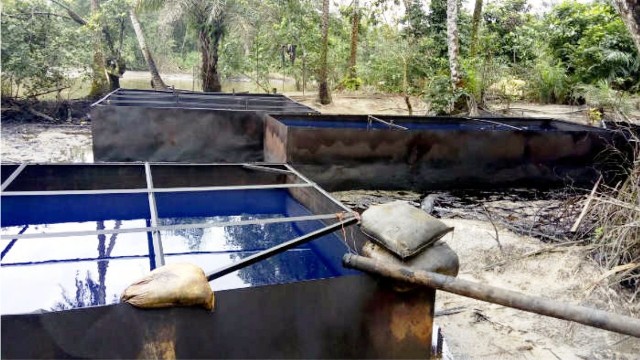
Determined to tackle the incessant activities of illegal crude oil refining in Rivers State and its menace on the natural environment, Rivers State Governor, Nyesom Ezenwo Wike has issued a 48-hour ultimatum to the 23 Local Government Chairmen to provide a comprehensive list of illegal refineries and their operators within their jurisdiction.
Governor Wike gave the ultimatum at a meeting with the council chairmen and heads of the Nigerian Army, Nigerian Air force, Nigerian Navy, Nigerian Police, the Directorate of State Service and the Nigeria Security and Civil Defence Corps at Government House on Friday.
The governor challenged the council chairmen to prove that they were not complicit in the noxious business that has continued to threaten the health of Rivers people and the national economy.
Governor Wike stated that his administration was poised to safeguard residents of the state from the hazards and death that are forced upon them by criminal minded operators of artisanal refineries.
“Now, every council chairman must go and identify where illegal refineries are taking place. If you identify one, you get N2million (Two million Naira). So, go and identify as many as you can. I will pay N2million for each one. And I am going to fight against this. Our people are dying and we owe our people the responsibility to protect them, to save them from death they never caused.
“So, you must, and you’re given 48 hours to go and identify all illegal refineries sites, and those who are in charge of them.
Governor Wike emphasised that any of the council chairmen who is afraid to join in the fight against these criminals operating the illegal refineries should be ready to resign, noting that the activities of illegal crude oil refiners did not only constitute health nuisance but depletes the revenue profile of the state.
According to the governor, part of their social contract with their people is also to protect them and stop any illegal economic practices in their domains.
“I’ve called you here to tell you that it is a total war. It is either we do it or we do not do it. We cannot allow what is going on to continue. Two things; our people are dying, two, it is shortening our own revenue.
The Rivers State governor also frowned at security agencies for the role some of their personnel have played in aiding and providing cover to the operators of the illegal refineries in the State.
The governor urged the State Police Commissioner, Eboka Friday, to redeploy out of the state a particular DPO in Emohua Local Government Area who operates an illegal refinery in the area.
Governor Wike directed the CP to immediately arrest Chief W. J. Wocha, Fubara Ohaka, and chief Promise Ezekwe, who have been fingered for operating illegal refineries deep inside the forest of Ibaa community in Emohua Local Government Area.
The governor further urged Commandant of the Nigeria Security and Civil Defence Corps, Rivers State command, to immediately transfer its personnel in charge of vandalisation of pipelines in the State.
Governor urged the Department of State Service (DSS) to profile persons involved in the heinous illegal refining business and make the list available to him. He assured of acting on the list.
Meanwhile Gov Wike has called on the federal government to give priority attention to issues of national security and save Nigerians from incessant killings by bandits.
Gov Wike stated this during the 2022 edition of the Armed Forces Remembrance Day Ceremony in Port Harcourt.
The Rivers State Governor, who urged the Presidency to effectively mobilise the armed forces to confront the challenges of insurgency, commended the men of the armed forces for their galantary in putting their lives on the line to defend the unity of Nigeria.
Gov Wike, who donated the sum N50million as support fund to families of the fallen heroes pledged the support of the Rivers State Government to their welfare at all times.
By: Beemene Tanee


The Commission disclosed the figure in its weekly update for week 14 of the second phase of the exercise, which ended on Friday, April 17, 2026.
According to the breakdown, 2,259,288 Nigerians completed their registration through the online pre-registration portal, while 1,489,416 finalized their registration physically at designated centres nationwide.
INEC noted that the figures remain preliminary and are subject to further verification and data cleaning processes to ensure accuracy ahead of the consolidation of the national voter register.
With the conclusion of the registration phase, the Commission has now shifted focus to the display of the Register of Voters for Claims and Objections, a statutory stage aimed at strengthening the credibility and integrity of the voters register.
The display exercise is scheduled to hold from April 29 to May 5, 2026, across designated centres nationwide, providing citizens the opportunity to verify their details and raise objections where necessary.
The Commission urged all registered voters from the concluded phase to take advantage of the exercise to confirm the accuracy of their information and assist in identifying ineligible entries, including duplicate registrations, deceased persons, and non-citizens.
INEC explained that the Continuous Voter Registration exercise is being conducted in phases, with the first phase running from August 18 to December 10, 2025, while the second phase commenced on January 5, 2026 and ended on April 17, 2026.
The Commission further stated that the date for the commencement of the third phase will be announced in due course.
Reaffirming its commitment to credible elections, INEC stressed that maintaining a clean and accurate voter register remains central to ensuring free, fair, and transparent electoral processes in Nigeria.
The Executive Director of IPC, Mr Lanre Arogundade, informed the journalists that the dialogue was sponsored by the European Union, under the auspices of the EU-Support to Democratic Governance in Nigeria (EU-SDGN II), Component 4: Support to Media.
According to the veteran media practitioner, the programme is aimed at strengthening the capacity of the media to promote credible elections through factual, accurate and fair reporting.
He explained that the programme is part of a broader five-year intervention designed to support democratic governance and improve the role of the media in Nigeria’s electoral process, stressing that fact-checking and inclusive reporting are critical responsibilities for journalists, especially during electioneering.
He described the media as a central role agent with regard to upholding transparency and accountability in the democratic process.
A resource person and Director of Journalism Clinic, Lagos, Mr Taiwo Obe, enjoined journalists to embrace the evolving technology so that they would not be in the backwaters in the practice of the profession.
He advised journalists not to downplay Artificial Intelligence (AI) in their bid to remain relevant in the media environment by being abreast of the changing patterns of news consumption.
The journalism teacher explained that with digital transformation of the media industry, it had become imperative for journalists to constantly upgrade and update their skills, stressing the fundamental place of attitude and self-development and underscored the dynamic nature of media consumption in the digital age, thereby compelling journalists to embrace tools and platforms, but without much reliance on AI.
In his lecture, a Professor of Mass Communication at the Federal University Oye-Ekiti (FUOYE), Adebola Aderibigbe, advised journalists in Ekiti State to ensure that coverage of the upcoming governorship poll is issue-based rather than dwelling on personalities.
He added that sensationalism should not occupy the front-burner of any discussions concerning the 2026 election, admonishing that sustenance of democracy is anchored on responsible journalism.
”Journalists must prioritise accuracy, fairness and balance in their reports by verifying facts and giving all parties involved in political matters the opportunity to present their views”, he said.
According to the university don, the election will not be defined by personalities, but by issues. ”Let issues be the pivotal ring upon which every discussion should be made. Sensationalisation of issues should not be the bedrock of discussions in the 2026 election”, he added.
“Do not hear from Party A without hearing from Party B, otherwise the report will be skewed to one side and once issues of elections are skewed, problems will naturally arise”, he stressed.