
Sports
Osimhen’s Absence: Five Quality Alternatives To Transform Rohr’s S’Eagles

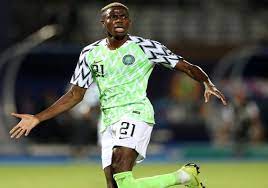
It is no longer news that the Super Eagles’ biggest star at the moment, Victor Osimhen, is out of the Africa Cup of Nations tournament in January.
The Napoli striker suffered a terrible injury last weekend that damaged his face and required surgery.
Even though the complicated surgical operation was a success, the surgeon who worked on the 22-year-old has confirmed that the youngster is not expected to take to a football pitch for another two months.
That dashes any hope any Super Eagles fan has of the Napoli lad miraculously making a quick recovery and being a part of the party to Cameroon less than six weeks from today.
Needless to say, Osimhen is a massive loss for the Nigerian national team. The former Lille star has shouldered the Super Eagles’ goalscoring burden almost effortlessly since Odion Ighalo first announced his retirement from the team.
Osimhen scored five goals in six games to help the Gernot Rohr-led side qualify for the AFCON with a game to spare. And he delivered four more goals during the World Cup qualifying campaign to power the Eagles to the playoff round.
His ten goals and six assists in his last 16 appearances across two years paint the picture of a striker who thrives, not only at club level but also in the green-and-white colours.
Rohr will struggle to replace Osimhen’s energy, industry, and quality in attack, especially with little time available for the Super Eagles to adapt to playing with a new number nine.
Nigerian attackers have hit a purple patch in Europe at the moment, and it appears every major club already has one or is targeting to sign one.
At a point in the summer, Genk had four Nigerian forwards on their payroll, while Watford had two. From Union Berlin in the German Bundesliga to Slovan Bratislava in the Slovakian Fortuna Liga, there is at least one Nigerian forward delivering the goods regularly.
There is, therefore, a long list of strikers, head coach Gernot Rohr can choose from to improve the Super Eagles’ forward line.
Bar any major surprises, Genk’s Paul Onuachu, Leicester City’s Kelechi Iheanacho, and Al Shabab’s Odion Ighalo already make up the bulk of the attackers Rohr will take to Cameroon in January.
But Onuachu is not fast enough for the kind of football Rohr wants his team to play. The German gaffer does not trust Iheanacho to lead the attack all on his own, and it is evident that age and the Saudi Arabian Pro League have slowed down Ighalo more than a bit.
Rohr and his assistants, therefore, need to look further than their noses and give a chance to one or two of the strikers who are painting Europe red with goals.
One of which is Union Berlin’s Taiwo Awoniyi. It is so difficult to look past a striker who has been tested in the Belgian and Dutch leagues and is presently flourishing in the German top-flight.
The 24-year-old is not Osimhen, but he is also strong, fast, and troubles defenders with his tireless pressing and endless running. The former Liverpool signing recently became Union Berlin’s record goalscorer in the Bundesliga, and it still beggars belief that he has only one Super Eagles cap to his name.
Watford’s Emmanuel Dennis is another name that should catch Rohr’s attention. The 24-year-old has not played more than 11 minutes in each of the three times he has featured for the Super Eagles, but his talent is undeniable.
And he is currently displaying it on the most glamorous stage of all, the English Premier League. The former Club Brugge star has four goals and five assists in nine league games for the Hornets and was the architect of Manchester United’s 4-1 thrashing at the Vicarage Road last weekend.
He can play anywhere in the front three, but through the centre is where he could be most devastating for the Eagles.
There is also Umar Sadiq. The former U-23 star has been Nigeria’s brightest shining star in the Spanish second division, and there is a reason why he is linked to Barcelona, Newcastle, Sevilla, and some other notable clubs on the continent.
Sadiq has pace, holds the ball well, and scores goals for fun. His commitment to Almeria has made him snub a couple of Rohr’s invitations before, but who can say no to a chance to be at Africa’s biggest football festival?
And there is Cyriel Dessers. The Feyenoord man is an old-fashioned fox-in-the-box type of striker who is blessed with two good feet.
The Genk-owned forward is building a reputation in the Netherlands as a supersub, but he can certainly get the job done from kick-off, as he showed many times at Heracles.
And it is almost unforgivable that he has made just one appearance for the Super Eagles after committing to Nigeria ahead of Belgium.
Another forward whose form could pave the way for a maiden call-up is Slovan Bratislava’s Ezekiel Henty.
A powerful presence in the box and adept at sticking the ball in the back of the net, Henty is Nigeria’s most prolific striker in Europe at this point, with 14 goals across all competitions.
The 28-year-old attacker looks like a fine blend of a right-footed Iheanacho and a faster Ighalo. He may, however, not have the international experience required to keep Onuachu and Ighalo on the Eagles bench at a major tournament.
Other notable mentions include Venezia’s David Okereke, Randers’ Stephen Odey, Lorient’s Terem Moffi, Trabzonspor’s Anthony Nwakaeme, Slavia Prague’s Peter Olayinka, and, Sivasspor’s Olanrewaju Kayode. They have all shown their quality in recent times and should at least get a look-in from Rohr.
The Super Eagles and their fans should not give up the hopes of a fourth continental title charge because of Osimhen’s injury and expected absence. It is not over yet.
The introduction of a reliable striking replacement and adequate technical input from the coaching crew can make the 2013 Afcon champions the team to beat in Cameroon.


The Los Angeles Lakers shrugged off their injury worries to make a winning start to the NBA play-offs.
The 18-time champions were without key players Luka Doncic, Austin Reaves and Maxi Kleber but 41-year-old LeBron James produced another fine display in a 107-98 win over the Houston Rockets.
The Cleveland Cavaliers, Denver Nuggets and New York Knicks were the other winners on day one of the play-offs, while the Phoenix Suns and Orlando Magic won the play-in tournament to book their places.
James controlled the floor while racking up 19 points, 13 assists and eight rebounds against a Houston side who lost key man Kevin Durant to injury just before play started.
“It’s just our play-off mentality,” Lakers coach JJ Redick said.
“You can’t worry about who’s in or out of the line-up. It’s our gameplan. It’s our standards. It’s how we play, and we’ve built towards that.
“I thought our guys just responded well and met the moment. That’s the biggest thing. You’ve got to meet the moment in every game, and we were able to do that.”
Luke Kennard continued to step up as a starter with a career play-off high 27 points as the Lakers took the opening game in the best-of-seven series.
Durant, 37, has a bruised knee and could return for game two on Tuesday night.
Defending champions Oklahoma City Thunder began their campaign last night against the Suns.
Brentford missed the chance to go sixth in the Premier League with a goalless draw against visitors Fulham, their fifth consecutive stalemate in the top flight.
A win would have helped the Bees overtake Chelsea and boost their chances of qualifying for a debut European campaign but they failed to capitalise in a game of few real chances at Gtech Community Stadium.
Fulham had the majority of possession but it was Brentford who had the best of chances in a lacklustre early kick-off.
Igor Thiago, only one behind 22-goal Erling Haaland in the Golden Boot race, headed wide from close range early on while Keane Lewis-Potter fired just over Bernd Leno’s goal from eight yards in the dying seconds of the first half.
Dango Ouattara, who attempted the only shot on target before the interval, failed to trouble Leno again with an effort from distance in the 58th minute.
An unmarked Mikkel Damsgaard then failed to hit the target with a first-time effort from the edge of the box after Kevin Schade played him through as frustration continued to build for Keith Andrews’ side.
Harry Wilson produced a well-timed run to get on the end of a cross in the 78th minute but dragged his shot wide in a rare opening for Fulham.
The teenager delivered a standout performance in what is regarded as one of Africa’s more competitive road cycling events, further strengthening her growing reputation as one of the sport’s most promising young riders.
The Tour du Faso, organised by the Amaury Sport Organisation, which also runs the Tour de France, has been part of the UCI Africa Tour since 2005 and is classified as a 2.2 event.
First held in 1987, it was reserved for amateurs until 1998. It is widely regarded as Africa’s biggest cycling race, a demanding ten-stage challenge that brings together European amateur riders and African local competitors in a contest often described as a blend of sporting ambition and opportunity.
Osaretin’s latest success in stage five adds to a remarkable journey that has seen her rise from humble beginnings as a wheelbarrow pusher to becoming both a Nigerian and African junior champion.
Her breakthrough on the national stage came at the 2024 National Sports Festival in May 2025, where she shocked everyone by defeating Nigeria’s first cycling Olympian Ese Ukpeseraye to win gold in the women’s 200m sprint final.
She went on to win another gold medal in the women’s road race at the inaugural African School Games in Algeria.
Her stage five victory in Burkina Faso now signals continued upward momentum as she establishes herself on the international cycling circuit and looks to build on her early success.
Kola Daniel, special assistant on media to the director general of the National Sports Commission, confirmed the development in a statement released on April 18, 2026.
4th
Falconets intensify preparations for Malawi clash
Nigeria’s U-20 women’s national team, the Falconets, have stepped up their build-up ahead of their FIFA U-20 Women’s World Cup final qualifying first-leg encounter against Malawi, scheduled for May 2, Tidesports source reports.
The team have been in intensive training in Abuja as they fine-tune tactics and sharpen their preparations for the decisive fixture, with coaches focusing on team organisation and match strategy ahead of the encounter.
Head coach Moses Aduku expressed confidence in his squad’s readiness, stressing that preparations had reached an advanced stage and that focus had shifted fully to tactical execution.
Aduku said the team are fully concentrated on the task ahead and believes they are well positioned to secure a positive result in the first leg.
“We have a full squad on ground and everyone is focused on the task at hand. From now, we will concentrate on team planning and tactical work. We are taking this very seriously, and I believe by the end of the match we will come out victorious,” he told NFF media.
The Falconets have maintained a positive atmosphere in camp, with high morale among the players and no reported injury concerns.
The coaching staff have also been working on integrating players from different clubs, with emphasis on building cohesion and balance within a short preparation window.
Aduku also appealed for continued support from fans, drawing parallels with previous qualifying rounds against Rwanda and Senegal, while expressing confidence that the team would secure qualification over the two legs.
“To our supporters, we plead that you pray for us as you did when we played Rwanda and Senegal in the earlier rounds. I believe Nigeria will smile with a ticket to the World Cup after the two legs against Malawi,” he added.
Nigeria reached this stage after overcoming Senegal 3-1 on aggregate in the previous round, following a 1-0 home win and a 2-1 away victory.
They had earlier defeated Rwanda 5-0 on aggregate to advance.
Their opponents, Malawi, arrive in strong form after a commanding 6-2 aggregate win over Guinea Bissau, including a 5-1 victory in Lilongwe following a 1-1 draw in the first leg away from home.
The return leg of the qualifier will be held in Lilongwe on May 9, with both sides competing for a place at the FIFA U-20 Women’s World Cup in Poland in 2026.
-
Politics3 days ago
ADC ELECTS NEW EXECUTIVES IN RIVERS LGA
-
Politics3 days ago
INEC To Display Voters Register April 29 As CVR Phase II Closes Nationwide
-
Politics3 days ago
Ekiti 2026: IPC Trains Journalists On Election Coverage
-
Sports3 days ago
WAN Mourns Ex-NFF President Galadima
-
Sports3 days ago
Brentford Miss Chance To Move Up
-
Sports3 days ago
NBA PlayOff: Lakers Make Winning Start
-
Politics3 days ago
GROUP BLASTS ATIKU CRITICAL COMMENTS AGAINST JONATHAN … SAYS EX-VP CAREER ASPIRANT
-
Sports3 days ago
NSF champion Osaretin wins at Tour du Faso