
Featured
Be Fearless, Dispense Justice, Wike Tells Judges

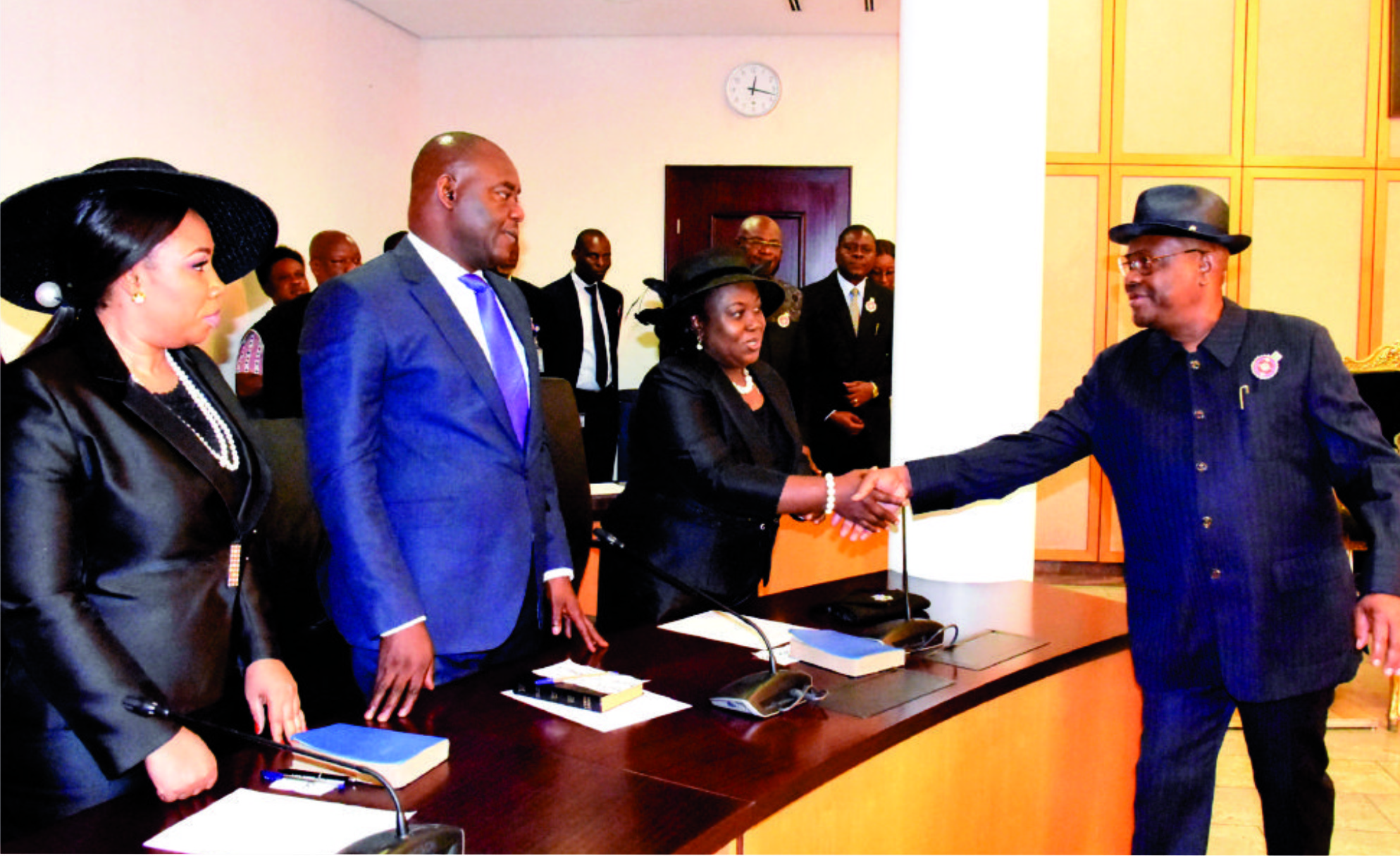
The Rivers State Governor, Chief Nyesom Wike, has charged judges of the High Court and Customary Court of Appeal to be fearless, firm and steadfast in dispensing justice for the development of society.
Wike has also threatened to take the issue of practising judges, who are traditional rulers, to the National Judicial Commission (NJC), for action.
He stated this when he swore in judges of the State High Court and Customary Court of Appeal at the Government House, Port Harcourt, yesterday.
The governor tasked the judges to be more committed to carrying out their jobs and be guided by the oath of office they had taken.
He said: “It is easy to take the oath of office and difficult to abide by the oath of office. As judges, show commitment in the administration of justice.
“Wherever you serve, it is important for you to show commitment.”
The governor said that the Judiciary has the responsibility to correct the executive whenever it goes wrong.
He expressed optimism that Nigeria would progress if the Judiciary could play its constitutional roles.
Wike stated: “This country can be better if the Judiciary plays its role. The Judiciary is the most powerful. When the executive is wrong, the Judiciary is there to correct it. Anything done by the Executive, can be upturned by the Judiciary if they are firm.
“I vied to be governor of Rivers State and there were challenges. You opted to be a judge, and there were challenges. You should be mentally and psychologically prepared to face the challenges.
“After today, you are required to do tasking jobs – jobs that will affect you and your family. You have taken oath and you must abide by the tenets of the oath,” he said
Wike charged judges of the state Judiciary to be focused and not be distracted by other responsibilities.
He regretted that a few judges, aside serving in the state Judiciary, were also traditional rulers.
He urged such judges to choose between the traditional institution and the Judiciary.
He asked: “How can you go to court to seek justice and the judge that is supposed to preside over the matter is not there? You cannot continue to collect salaries and you are not working.
“We are taking the matter of judges who are traditional rulers up with the National Judicial Council for necessary action”, Wike said.
He announced that the state government would legalise the owner-occupier policy of residential quarters for judges of the state Judiciary.
He said that his administration was implementing the owner-occupier policy to encourage the Judiciary to serve the state better.
Those sworn-in by the governor as judges of the state High Court included Justice Florence Atili Fiberesima (immediate past solicitor general/permanent secretary, Ministry of Justice), Justice Mark Onyema Chuku, (former chief magistrate 1/deputy chief registrar), and Justice Lemea Ngbor-Abina (former private legal practitioner).
For the state Customary Court of Appeal, Wike inaugurated Justice Ericonda Amadi, as a judge.



Governor of Rivers State, Sir Siminalayi Fubara, has reaffirmed the unwavering commitment of his administration to peace, unity, security, and inclusive development as Rivers State marked its 59th anniversary, last Wednesday.
In a goodwill message issued on Wednesday to commemorate the anniversary, Governor Fubara stated that despite the challenges faced over the years, the people of Rivers State have continued to demonstrate resilience, strength, and an enduring spirit of unity that has sustained the state since its creation.
The Governor noted that the strong bond of brotherhood among the various ethnic nationalities of the state, including the Ijaw, Ikwerre, Ogoni, Etche, Ekpeye, Andoni, Kalabari, and others, remains one of Rivers State’s greatest strengths and a critical foundation for peace, stability, and progress.
He further observed that Rivers State has remained a major driver of Nigeria’s economy for decades, not only because of its abundant oil and gas resources, but also because of the exceptional contributions of its people across diverse sectors including academia, jurisprudence, business, entertainment, public service, and sports.
Governor Fubara assured the people that his administration will continue to prioritize policies and programmes that promote peace, protect lives and property, and expand development across all parts of the state. He emphasized that governance must be people centered and impactful, with equal attention given to every Local Government Area of the state.
The Governor also paid tribute to the elders and founding leaders of the state for preserving the spirit of unity and coexistence over the years, while urging the youths to remain hopeful, responsible, and actively committed to building a greater Rivers State through innovation, hard work, and patriotism.
He equally acknowledged the invaluable role of women in strengthening families, communities, and society, describing them as indispensable partners in the continued growth and stability of the state.
Governor Fubara called on all Rivers people to use the occasion of the anniversary as a moment of reflection and renewed commitment to peaceful coexistence, mutual respect, dialogue, and collective progress, stressing that the unity and future of Rivers State must always rise above personal interests and political differences.
Rivers State was created on May 27, 1967, by General Yakubu Gowon.


The Rivers State Government has distributed science equipment and materials to all senior secondary schools across the state to support students during the ongoing West African Examinations Council exams and to strengthen practical learning.
Flagging off the distribution at the Rivers State Senior Secondary Schools Board premises in Port Harcourt, on Monday, the State Commissioner for Education, Dr. Peters Nwagor, said the move demonstrates Governor Siminalayi Fubara’s commitment to improving education standards in the State.
Nwagor said the materials were approved and provided by the state government specifically to boost the teaching and learning of science subjects, describing science education as the foundation for technological advancement, innovation, and national development.
“No society can compete globally without deliberate investment in science and technology,” the Commissioner stated.
He commended the governor for consistently prioritising the education sector by providing tools needed for effective teaching and hands-on learning.
The Commissioner directed principals to ensure that the equipment are used strictly for practical lessons in their schools, warning that any principal or administrator found diverting, hoarding, or selling the materials wil face disciplinary action under public service regulations.
Nwagor also warned against examination malpractice, saying any principal found aiding or encouraging malpractices will be decisively sanctioned.
“We must collectively restore the dignity and credibility of our educational system,” he said.
Also speaking, Chairman, Rivers State Senior Secondary Schools Board, Tony Egwurugwu, urged school heads to make judicious use of the materials for students’ benefit.
He thanked the State Government for providing the resources, and assured that monitoring mechanisms would be put in place to ensure the materials serve their intended purpose.
In his own remarks, a Board Member for Technical Education, Nwisabari Bani Samuel, expressed appreciation to the governor for prioritising education and acknowledged the Commissioner’s role in advancing education development in the State.
He said the distribution covers all senior secondary schools in the State and is intended to improve students’ performance in both internal and external science examinations.
Akujobi Amadi
-

 Rivers2 days ago
Police arrest 3 suspects over killing of driver in Rivers
-
Politics2 days ago
I DIDN’T PROMISE YOU TICKETS, AKPABIO TELLS APC SENATORS WHO FAILED PRIMARIES
-

 News2 days ago
FUBARA ASSURES NUT OF SECURITY OF SCHOOLS IN RIVERS
-

 News2 days ago
NDLEA Arrests Four Notorious Female Drug Dealers In Four States
-

 Sports2 days ago
Okpekpe Road Race Gets Mobility Solutions, Fan Engagement
-
Politics2 days ago
POST PRIMARIES: IKWERRE MONARCHS ADVOCATE ISSUES-BASED POLITICS IN RIVERS
-
Politics2 days ago
Court Dismisses Rivers PDP Members’ Suit Over LG Election Candidates
-

 News2 days ago
WORLD FOOD SAFETY DAY: VETERINARIANS TASK GOVT ON MODERN ABATTOIR IN RIVERS